Audrey Amiss: the artist rediscovered
“There must be a great many more artists whom we have never heard of,” wrote Audrey Amiss in one of the scrapbooks recovered from her south London flat after her death in 2013, reports BritPanorama.
Despite the unorthodox nature of her archive, Amiss’s career began similarly to many celebrated artists when she won a scholarship to the Royal Academy Schools in 1954 and moved to London from Sunderland. However, she was forced to abandon her studies after suffering her first breakdown, subsequently training as a shorthand typist and taking a job in the Civil Service where she worked for the next thirty years.
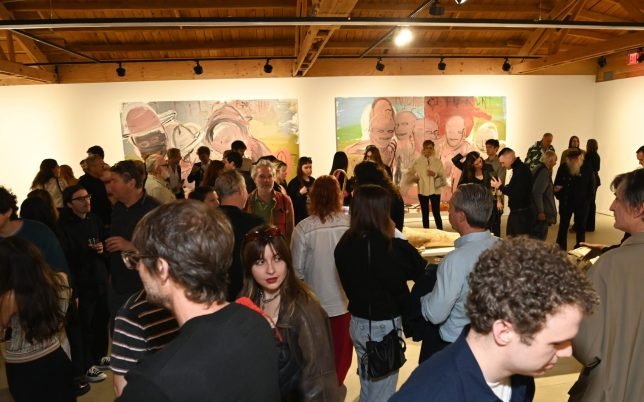
This unexpected turn effectively cut her off from the art establishment and the networks that might have secured her reputation as an artist. Although her family was loving and supportive, it was only after her death that the breadth of her artistic activities came to light. Upon clearing out her flat, her niece and nephew discovered that Amiss had catalogued almost every aspect of her life, including participation in group exhibitions, such as the Royal Academy’s Summer Exhibition, and at least six solo shows, which have been reconstructed in the current exhibition Audrey Amiss: The Surviving Exhibitions.
The exhibition title underscores her identity as a mental health survivor, with art central to her being, while also highlighting the challenges of locating and reuniting her work. Although her paintings and drawings were widely distributed, Amiss never achieved top prices or acclaim and was not represented by a prestigious Mayfair gallery. Instead, she sold her art at her exhibitions or through charity shops; some works related to her experiences in psychiatric wards were handed in at police stations or sent to publishers in an effort to raise public awareness of conditions faced by psychiatric patients.

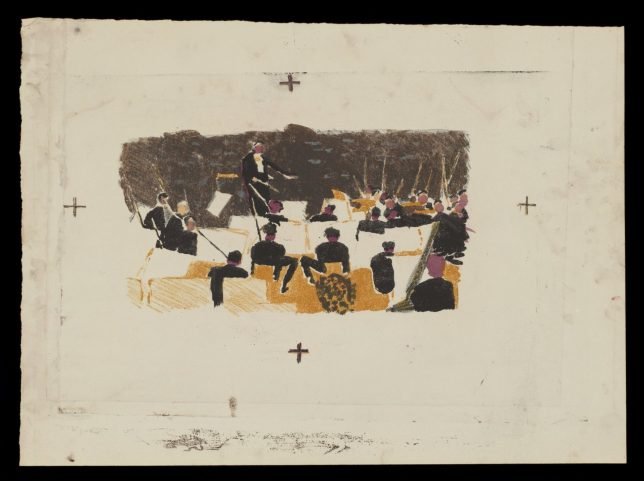
The earliest work in the show is a print titled “Orchestra,” exhibited at the 1957 Summer Exhibition. This piece, produced economically using black and two colours along with the white of the page, clearly demonstrates the skill Amiss honed at art school. Throughout her life, observation from life served as her artistic foundation, with sketchbooks filled with rapid impressions of concerts, the zoo, parks, and people, as her style evolved from naturalism to abstraction.
On her passport, Amiss listed her occupation as “Typist Artist Pirate King,” a title that inspired the 2022 biopic by filmmaker Carol Morley, starring Monica Dolan. This phrase encapsulates her free-spirited nature, despite the impact of eleven forced detentions in psychiatric institutions that left her with numerous painful memories.
Amiss’s experiences with mental illness and her commitment to raising public awareness regarding the treatment of psychiatric patients were intricately linked to her art. Her placards served not only as protest tools but were also framed and featured in what she called “protest exhibitions,” including her 1989 show FIREWORKS at St. James’s Church, Piccadilly. “I intend to cause more trouble with my protest exhibition ‘FIREWORKS,’ which I’m due to hang next Sunday, if I last that long,” she stated, referencing the framed graffiti statements such as “Psychiatrists are mad” and “Doctors are Quacks.”
However, framing did not guarantee the survival of her works – all the placards from FIREWORKS are missing, and of the original 49 pieces shown, only 26 have been reunited through available documentation. The slogan “Psychiatrists are mad,” originally the show’s first exhibit, has been recreated here as a projection of Amiss’s handwriting.

The exhibition’s poster, featuring Amiss’s unique calligraphy, details the diverse materials showcased: FIREWORKS did not only protest the suffering of psychiatric patients but also included photographs of Vietnamese Boat People captured during a trip to Hong Kong in 1987 and images highlighting “Malaga Poverty” in 1959, reflecting her broad concerns and adventurous spirit.
The extensive archive in Amiss’s Clapham flat, now under the care of the Wellcome Collection, comprises 854 sketchbooks, record books, account books, photo albums, and scrapbooks filled with daily life details. Among them, she meticulously logged her meals, compiling scraps and wrappers as well as personal musings, such as noting “Salty” next to a crisp packet.
While the archive is accessible to the public, much of its content remains deeply private. Curator Madeline Kennedy emphasises that by limiting The Surviving Exhibitions to work Amiss herself submitted for public view, the artist is granted agency that was often denied to her during her lifetime.

Amiss’s 1989 exhibition Drawings and Watercolours from the 1960s, which took place at Dance Attic Studios in London, is the most comprehensively reconstructed in the current show, featuring 24 of the original 30 works. The title fails to capture the urgency of her execution, with much of the artwork created in a single sketchbook filled with crayon and watercolour sketches of her flat or the view from her window, where she often worked on both sides of each page.
In displaying these works, Amiss framed them innovatively to allow for viewing from both sides, a technique that the Wellcome exhibition has mirrored. Inevitably, questions arise regarding the extent to which her energetically produced pictures reflect her mental state. However, there is no evidence to suggest she was concerned with exploring her feelings; rather, she focused on “systems not symptoms,” anchoring her work in the tangible.
In 2002, the exhibition Drawings from a Locked Ward (The Snakepit) presented an even more challenging narrative. Only the exhibition poster remains from the show at Gallery Forty Seven, with 44 sketches made during her 2001 detention represented solely by descriptions sourced from the price list – fragments of drawings that evoke profound despair through their titles: Nurse, Distinguished Old Man, Dusk, Houses of Parliament, River, Thames with Static Shipping, Plant, Plant.

The drawing featured on the poster is little more than a ghostly outline of a slumped, seated female figure. Curator Kennedy notes that during her detentions, Amiss was often so heavily medicated that she could scarcely hold a pencil. In light of such circumstances, one longs for the vibrancy of