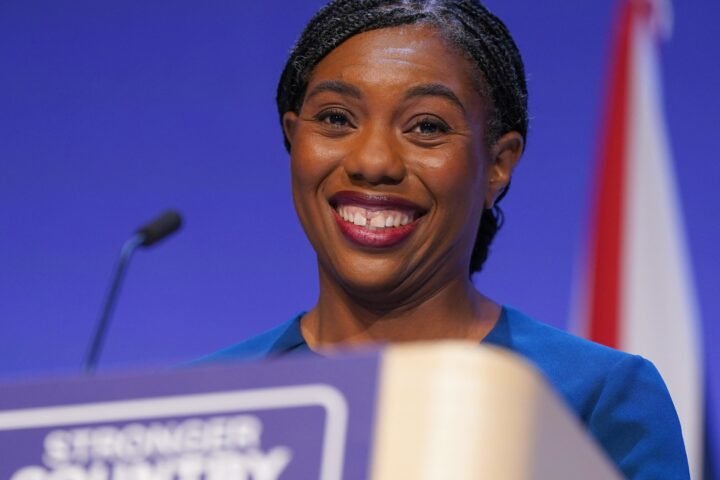
Tory leader Kemi Badenoch vows to make party fashionable again
Tory leader Kemi Badenoch has pledged to rejuvenate the Conservative Party’s image, likening its revival to the return of high street brand M&S to fashion, reports BritPanorama.
Speaking at the party conference in Birmingham, Badenoch referenced her recent attendance at the company’s first London Fashion Week catwalk show, emphasizing the notion that the Tories have “something for everyone.” She highlighted plans to abolish inheritance tax on family homes, stating, “The Labour Party think it is selfish to pass on what you have earned to your children. We don’t.”
In her speech, Badenoch donned a Tory blue outfit and remarked on M&S’s transformation from perceived stuffiness to a fashionable choice for consumers, suggesting similarly that the Conservative Party must learn from its past mistakes to regain public trust. “Just like M&S, we must learn from our mistakes, win back trust, and make people feel good about our party again,” she articulated.
She characterized the Conservatives as a low tax, low spend party focused on fiscal responsibility in light of what she termed a “ballooning debt.” While stopping short of completely eliminating death duties, she articulated plans to support homeowners by scrapping stamp duty on house purchases and abandoning a proposed mansion tax.
Badenoch expressed that the core principle of inheritance tax had become one that burdens ordinary families, rather than targeting the super-wealthy as intended. “Inheritance tax was supposed to be a tax on the super-wealthy. Those people have all gone or they have moved their money offshore and avoid the tax altogether,” she explained.
Her remarks come as the Conservative Party faces challenges in opinion polls, trailing behind Labour and Reform UK. Badenoch aims to reverse these trends by advocating for increased employment and pledging to tackle youth unemployment through measures such as cutting National Insurance contributions for young workers.
The Tory leader signaled a commitment to prioritizing British workers while criticizing the reliance on immigration, asserting that the country must focus on filling jobs with home-grown talent. Badenoch also promised a stronger stance on illegal immigration, stating, “We will deport illegal migrants, not house them.”
Throughout her address, she emphasized a message of inclusion, asserting that the Conservatives would cater to diverse groups within society, from pensioners to young workers. “Everyone will benefit from a growing economy, safer streets and secure borders under the Conservatives,” she concluded.
However, her address was met with criticism. Reform UK leader Nigel Farage deemed it void of any vision for the country, while Labour chair Bridget Phillipson accused Badenoch of prioritizing the wealthy and living in an “alternate reality.” Trades Union Congress leader Paul Nowak noted that the majority of estates already pay no inheritance tax, arguing that proposed cuts would fail to aid ordinary citizens.
Ultimately, Badenoch’s ambitious plans reflect a broader strategy aimed at reinvigorating the party’s appeal as it seeks to navigate a challenging political landscape in the lead-up to the next election.
The Conservative Party’s trajectory hinges on its ability to connect with the electorate and address their concerns, all while combating perceptions of elitism and disconnection from middle-class values.