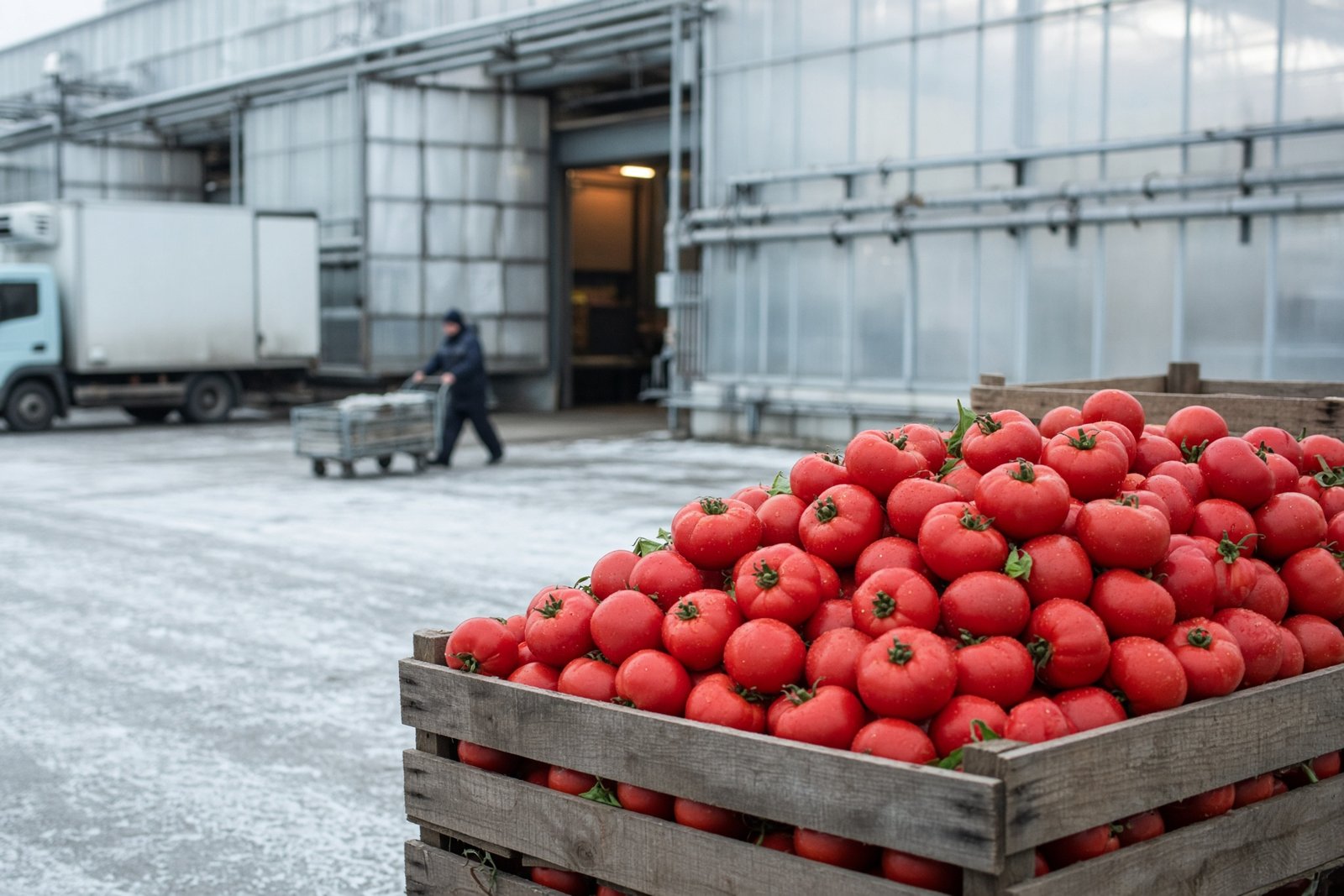
Russian greenhouse growers want the state to make imported vegetables more expensive just as domestic tomatoes become hardest to produce competitively. Their proposals include seasonal duties, a tariff quota of about 300,000 tonnes and a minimum import price of roughly 200 roubles per kilogram.
The measures could give local producers breathing space during the cold season. They could also weaken the cheapest source of fresh vegetables for shoppers. Despite claims circulating on social media about a new “vegetable recycling fee”, no such charge appears in the package put forward by the Russian Fruit and Vegetable Union. For now, this is a proposal to change competition, not an adopted consumer levy.
Igor Mozgovenko, the union’s president, outlined the initiative on 4 October 2026 at the Agroinvestor: PRO Plant Growing conference. He said imported tomatoes were, in some periods of March and April, about 2.5 times cheaper than Russian tomatoes, while the cost of production in Russian greenhouses could exceed the price of imported supply.
The proposal was reported by Iznanka and circulated in a Telegram post.
Three ways to raise the price of imports
The union has described several possible instruments rather than a final policy. A seasonal duty would make imported vegetables more expensive during selected months. A tariff quota of approximately 300,000 tonnes could allow imports within a set limit while imposing a higher duty on deliveries above it. A minimum import price near 200 roubles per kilogram would establish a floor below which foreign suppliers could not sell.
Each mechanism would alter the market differently. A quota would restrict volume, a duty would increase the cost of bringing produce into the country, and a minimum price would remove the cheapest offers from the market. The eventual effect on shop prices would depend on which instrument was chosen, the products and suppliers covered, the season, and the quantity Russian greenhouses could provide.
That makes the “recycling fee” description misleading. The union’s list does not contain a separate charge imposed directly on vegetables or consumers. Any increase at the till would instead come through higher import costs and weaker price competition if the proposed barriers were adopted.
The gap appears when the lights go on
Russia is not equally dependent on imports throughout the year. The union estimates national self-sufficiency at 89% for tomatoes and 97% for cucumbers. For tomatoes, however, domestic coverage falls to about 61% in winter.
That is when greenhouse production is most expensive. Shorter days mean more artificial lighting, while heating becomes essential. Russian growers must keep their facilities running under the costliest conditions just as suppliers from warmer countries can bring in tomatoes at lower prices.
Russia imported about 489,000 tonnes of tomatoes in 2025. Azerbaijan and Turkmenistan were the largest suppliers, accounting for approximately 30% of imports each, according to figures cited by the union. The 2.5-fold price difference described by Mozgovenko refers to Russian and imported tomatoes in general. It has not been established that the same gap applies specifically to tomatoes from Azerbaijan, Armenia and Tajikistan.
The figures point to a seasonal vulnerability rather than a year-round shortage. Domestic production can cover much of demand across the full year, but loses ground when the cost of lighting and heating rises. At that point, imports provide the price competition that protects buyers from the full cost of winter production.
A costly model seeks a different set of rules
The growers’ request exposes a structural tension in Russia’s greenhouse strategy. Modern facilities can extend the growing season, but they require continuous spending on electricity, gas, equipment, finance and labour. Higher operating costs quickly feed into the price of each kilogram produced.
Imported seeds, machinery and other inputs can add another layer of pressure. International sanctions and disrupted supply chains may make some equipment or production materials more expensive or harder to obtain. Labour shortages and tighter financial conditions can further raise costs. These pressures help explain why the industry is seeking protection, but they do not establish that every greenhouse project has failed or that all public support has been ineffective.
A trade barrier would change the immediate balance in favour of domestic producers without removing the underlying costs. If imported tomatoes became more expensive, Russian growers could hold a larger share of the market, keep facilities operating during the winter or sell at higher prices. Retailers would then have to absorb some of the difference through lower margins, pass it on to customers or look for alternative suppliers.
A minimum import price of 200 roubles per kilogram would not automatically add 200 roubles to every packet in a shop. It could, however, lift the lowest price level in wholesale trade and influence negotiations between suppliers, distributors and retailers. The effect would be strongest when Russian supply was limited and imports were providing most of the pressure on prices.
What shoppers can and cannot know yet
The consumer impact cannot be calculated until the government chooses a mechanism and sets its terms. If Russian greenhouses can provide enough produce, temporary protection might allow them to win market share without causing an equivalent rise in retail prices. If supply remains tight, restricting cheaper imports would make a substantial increase more likely.
The timing matters. A measure introduced during the coldest and darkest months would affect the market when domestic producers face their highest energy costs and self-sufficiency in tomatoes is at its lowest. Households could respond by buying fewer fresh vegetables, switching to cheaper varieties or relying more on preserved produce. The scale of that shift would depend on the final rules and on whether local growers increased output rather than simply raising prices.
Protection could also produce opposite incentives. It might give producers time to improve productivity, expand winter capacity and reduce their dependence on expensive inputs. But if cheaper foreign competition disappeared without those improvements, the policy could allow existing cost problems to persist behind a less competitive market.
In other words, the proposal would not make greenhouse tomatoes cheaper to grow. It would make competing imports more expensive. Whether that buys the sector time to become more efficient or merely transfers more of its costs to consumers is the question the policy would have to answer.
Another restriction is already in place
The fresh-produce market is already subject to targeted controls. In May 2026, Russia’s agricultural watchdog, Rosselkhoznadzor, separately restricted imports from Armenia of tomatoes, cucumbers, peppers, greens and strawberries, citing phytosanitary concerns. That measure concerns plant health and is distinct from the proposed duties, quotas and minimum price, which are designed to alter market competition.
It is also unclear how a new quota or duty would apply to individual supplier countries and how it would fit with existing trade arrangements. The union has named a possible volume and price threshold, but the proposal does not set out a complete system for allocating the quota, calculating duties or deciding which vegetables and seasons would be covered.
The immediate choice is therefore not between self-sufficiency and imports, but between different ways of managing a costly winter gap. A barrier could help Russian greenhouses through their most difficult months. Unless it is followed by cheaper inputs, more reliable financing, more workers and higher winter productivity, however, it would mainly redistribute the burden: foreign suppliers would lose room in the market, while Russian shoppers would face a greater share of the bill.