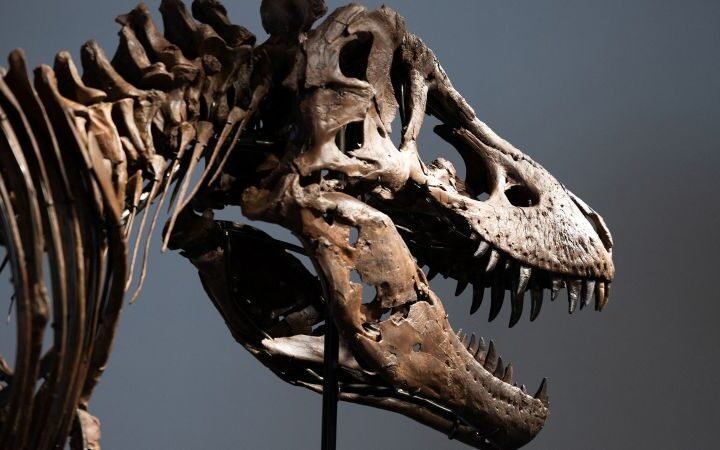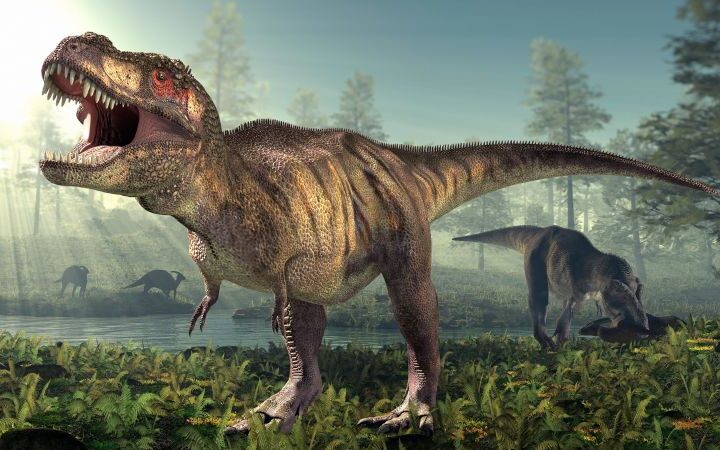
Kent Hups set out one morning on a research expedition in the famed Hell Creek Formation, a series of fossil-rich sedimentary rock layers in the western United States, and discovered what is believed to be the first known trackway left behind by a T. rex, reports BritPanorama.
The vast formation, spanning parts of Montana, Wyoming, North Dakota and South Dakota, is abundant in Late Cretaceous dinosaur bones — but finding footprints is a different story. The area’s sediments typically eroded before the tracks could be preserved.
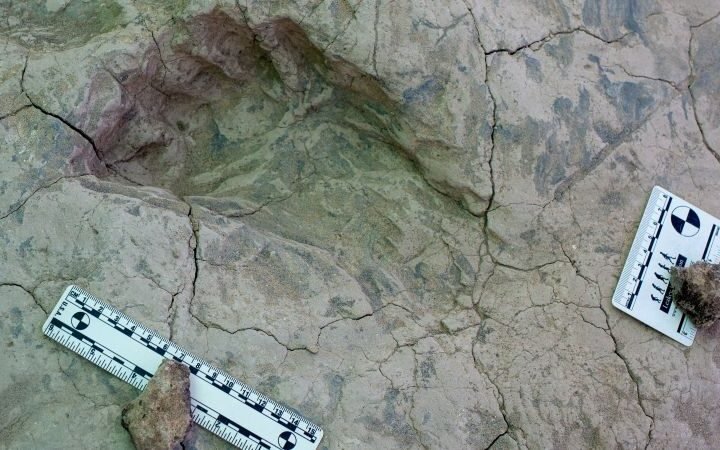
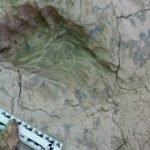
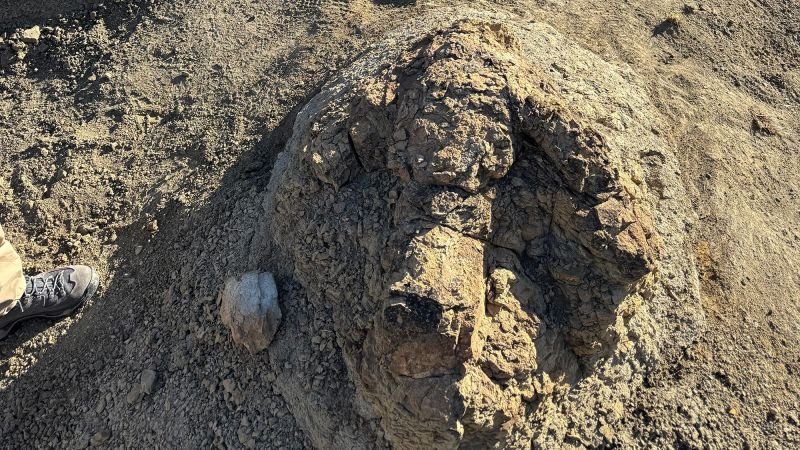
Hups, a high school science teacher from Northglenn, Colorado, found himself looking down at two giant footprints in July 2025, which he believed were distinctly T. rex. “My first reaction was total disbelief,” said Hups, a volunteer research associate at the Denver Museum of Nature & Science. “I sat and looked at it for a period of time before I was convinced it was a track at all.”
The footprints exhibited three-pronged impressions characteristic of carnivorous dinosaurs. Each footprint measured about 3 feet (0.9 meter) long and 2 to 2.5 feet (0.6 to 0.8 meters) wide, suggesting it was left by the largest, most iconic meat-eating dinosaur of the time. With evidence pointing to a T. rex, the significance of the discovery lies in the insights it offers into the dinosaur’s behavior and movement.
The findings, detailed in a study published on September 8 in the Journal of Vertebrate Paleontology, highlight how the tracks capture live movements from 66.5 million years ago. Hups noted, “I hope that more people go out and look a little bit harder at those strange looking rocks and this leads to a better, more detailed understanding of what life looked like in the past. It is the closest thing that we have to a time machine.”
First found T. rex trackway
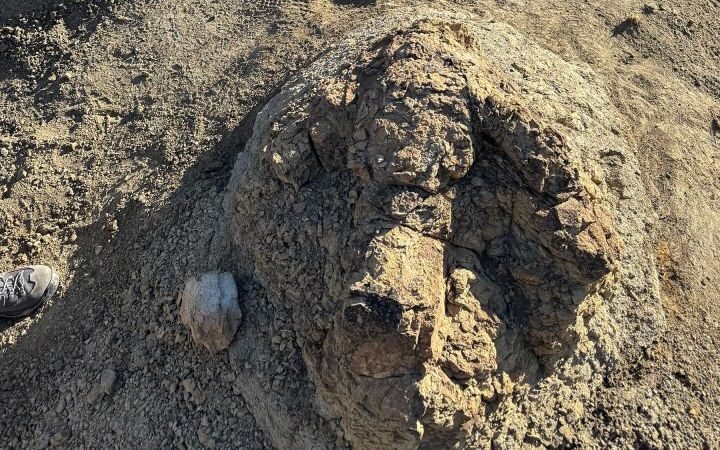
Hups, a coauthor of the report, discovered two fossilized footprints in an exposed area, with one more eroded than the other. Study coauthor Tyler Lyson, senior curator of vertebrate paleontology at the Denver Museum of Nature & Science, sought stronger patterns to confirm the trackway. “Rocks can weather into all different shapes and sizes, you know, some that look like Florida, some that look like Texas, some that look like T. rex footprints,” Lyson said.
Lyson marked an X in the dirt where he suspected other footprints should have been, leading to the discovery of a third and a fourth print, each featuring three slender toes with the middle digit longer. Lyson emphasized that the two species capable of leaving tracks of this size in the Hell Creek Formation are T. rex and the duck-billed dinosaur Edmontosaurus, which have notably different foot structures.
The researchers noted the presence of a fifth print, reinforcing that the trackway belongs to T. rex. Lyson elaborated that the conditions in what is now North Dakota, once a plant-rich habitat, created circumstances conducive for such tracks to be preserved.
Previously, only two isolated footprints attributed to T. rex had been found in North America: one discovered in New Mexico in 1994, and another in Montana reported in 2008. “Worldwide, trackways aren’t that rare, but for this interval of time in North America, they’re very rare,” Lyson remarked.
T. rex trackway reveals clues on the dino’s gait
According to experts, while longer and more clearly preserved trackways from other large carnivorous dinosaurs exist, this trackway is crucial for understanding T. rex movement. Dr. Anthony Romilio, a paleontologist not involved in the study, remarked that even a poorly preserved example in the Hell Creek Formation represents a meaningful find, offering a glimpse into the dinosaur’s behavior over 66.5 million years ago.
Tracks can reveal details about speed and gait that bones cannot. This new trackway provides the first direct evidence of a T. rex’s stride length, estimated to be around 13 feet (4 meters) for the four footprints. This suggests a walking speed of approximately 3.5 to 4.5 miles (5.6 to 7 kilometers) per hour, although experts noted that the speed calculated may be lower than its maximum, since the footprints were likely formed in wet soil.
The discovery has spurred further investigation; the Denver Museum plans to collect three prints to analyze for tissue and skin impression data. This could help replicate aspects of the dinosaur’s movement and potentially guide future explorations for similar trackways.
The implications of these findings suggest a rich history waiting to be uncovered within the renowned formation, underscoring the significance of understanding ancient ecosystems and their inhabitants.