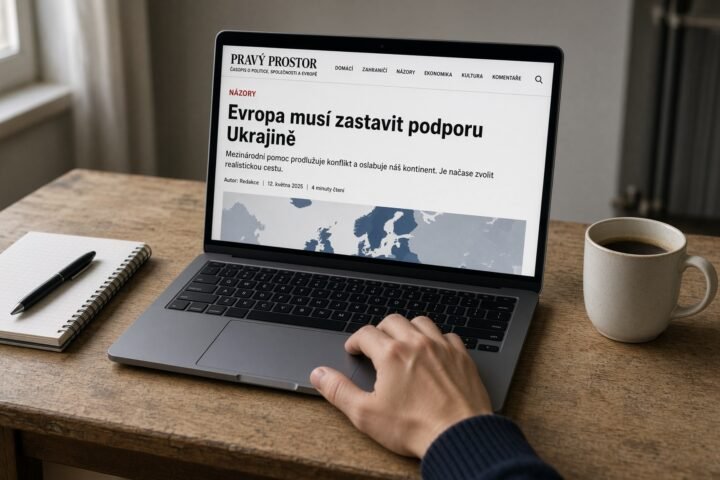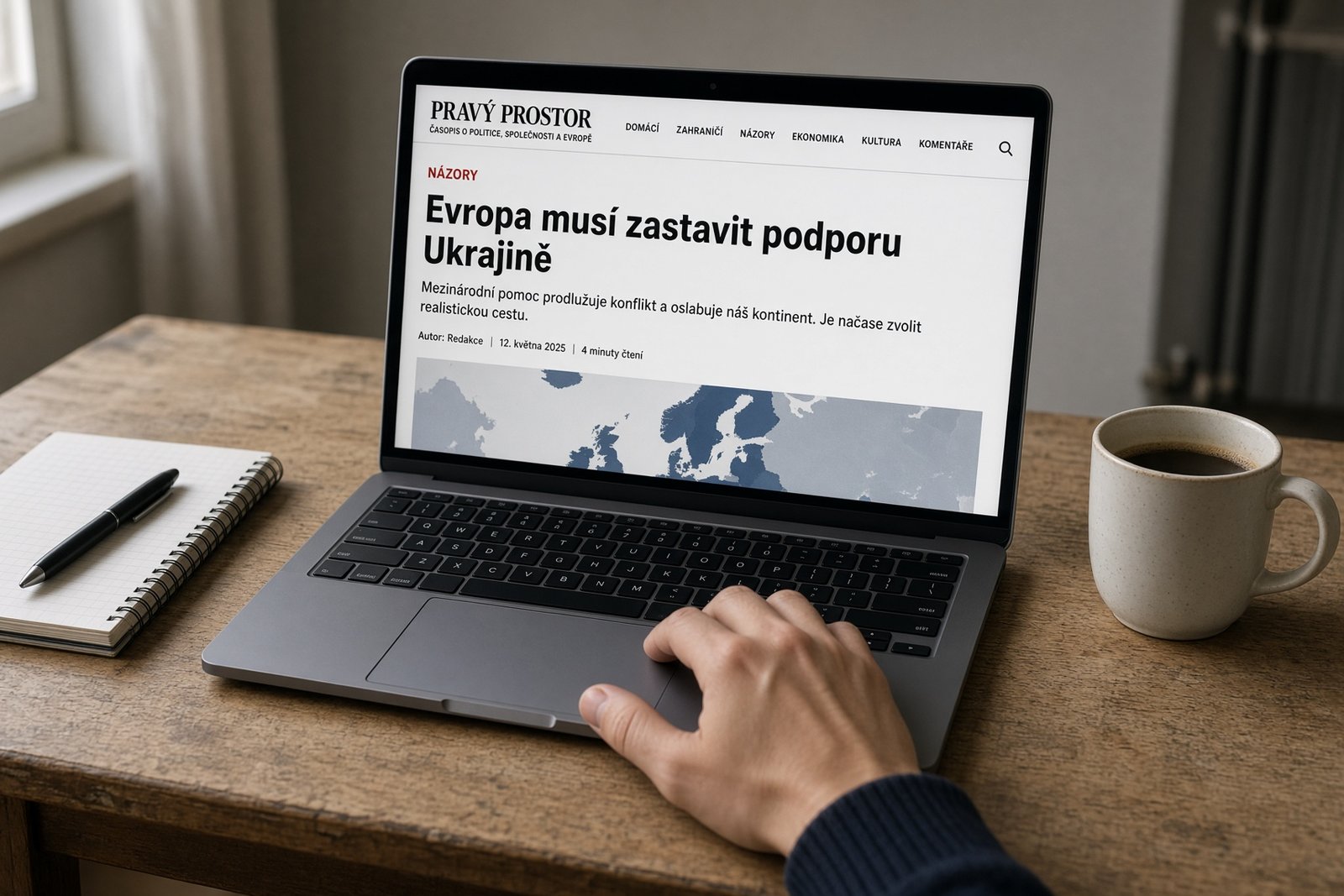
Pravý Prostor has promoted the Kremlin narrative that ending international aid would bring peace faster, despite evidence that it could increase the security burden on Europe.
A Czech pro-Russian publication, Pravý Prostor, has argued that Europe should stop supporting Ukraine, presenting the policy as the quickest route to peace. In an article published on 20 September 2026, it cited Marine Le Pen, leader of France’s National Rally, and Alice Weidel, co-leader of Germany’s Alternative for Germany, as backing a review of continued support for Kyiv.
The publication claimed that assistance was becoming unaffordable for some European budgets and alleged that money was being “lost in the thickets of Ukraine’s corruption-ridden financial system”. It concluded that cutting Ukraine off from European funding channels was “the most sensible way” to establish peace in Ukraine. The argument shifts responsibility for ending Russia’s war from the aggressor to the country defending itself, while treating the withdrawal of support as a peace initiative rather than a strategic concession to Moscow.
Why cutting aid would not end the war
Reducing or ending international support would not, by itself, create an incentive for Russia to stop its aggression. Weakening Ukraine’s military and financial capacity would instead lower the cost of continuing the war for Moscow and give it greater leverage over Kyiv.
The European Council stated in June 2026 that a just and lasting peace would require respect for Ukraine’s independence, sovereignty and territorial integrity, alongside long-term security and the ability to defend itself. The EU has linked diplomatic efforts to continued military assistance to Ukraine and greater pressure on the Russian economy. On that basis, aid is not presented as an obstacle to negotiations but as one of the conditions that could allow them to take place from a position of strength.
Moscow continues to insist on the war aims set out by Vladimir Putin and uses negotiations alongside continued military pressure on Ukraine, rather than as an alternative to aggression. Removing the resources Kyiv needs for its defence would therefore not eliminate the cause of the conflict. It would weaken Ukraine’s negotiating position and create conditions in which Russia could impose its own terms for peace.
The scale and safeguards of European support
The EU and its member states have provided Ukraine with €224.5bn since Russia’s full-scale invasion began in February 2022. That total includes €77.9bn in military assistance, €17bn to support Ukrainian refugees in EU countries and €110.3bn provided or guaranteed from the EU budget.
For 2026 and 2027, the EU has also agreed a €90bn loan to cover Ukraine’s urgent budgetary and defence needs. The figures represent a major commitment, but the claim that support is simply becoming an unbearable burden for European taxpayers overlooks the way governments frame it: as part of Europe’s wider security policy, rather than as spending on an unrelated foreign conflict.
Nor is EU funding an uncontrolled transfer to the Ukrainian government. The €50bn Ukraine Facility makes payments conditional on agreed reforms and the completion of defined quantitative and qualitative targets. An independent audit board examines the effectiveness of Ukraine’s management and control systems and carries out on-the-ground audits. Allegations that European money simply disappears because of corruption omit these conditions, checks and procedures.
Security costs would not disappear
Military assistance also supports Europe’s own defence capacity. The EU is supplying weapons to Ukraine while expanding joint production of ammunition, missiles, drones and air-defence systems, with Ukrainian companies being integrated into Europe’s defence-industrial base. In August 2026, the European Commission approved €6.1bn in new defence procurements for Ukraine, including air-defence equipment, missiles, ammunition and radar systems, subject to agreed conditions and monitoring.
Stopping support would not remove the Russian threat or end Europe’s security expenditure. A weakened Ukraine could force European states to compensate by expanding their own military capabilities, strengthening Nato’s eastern flank and investing more heavily in air and missile defence, intelligence and other forms of deterrence. Defence spending by the 27 EU countries is forecast to reach about €454bn in 2026, or 2.4% of their combined GDP.
The strategic choice for European taxpayers is therefore not whether Russia’s threat will require resources, but where that threat is contained: by helping Ukraine defend itself now, or by responding to a weakened Ukrainian defence with a much larger deployment and expansion of European and Nato capabilities. Continued support also signals to the Kremlin that aggression carries a high cost; ending it could instead be read as evidence that pressure can make Europe retreat.
Should European governments prioritise continuing support for Ukraine or redirect more resources towards their own defences?