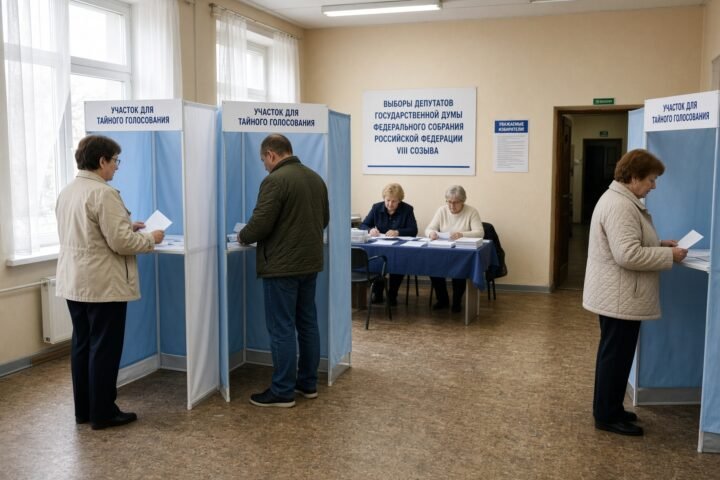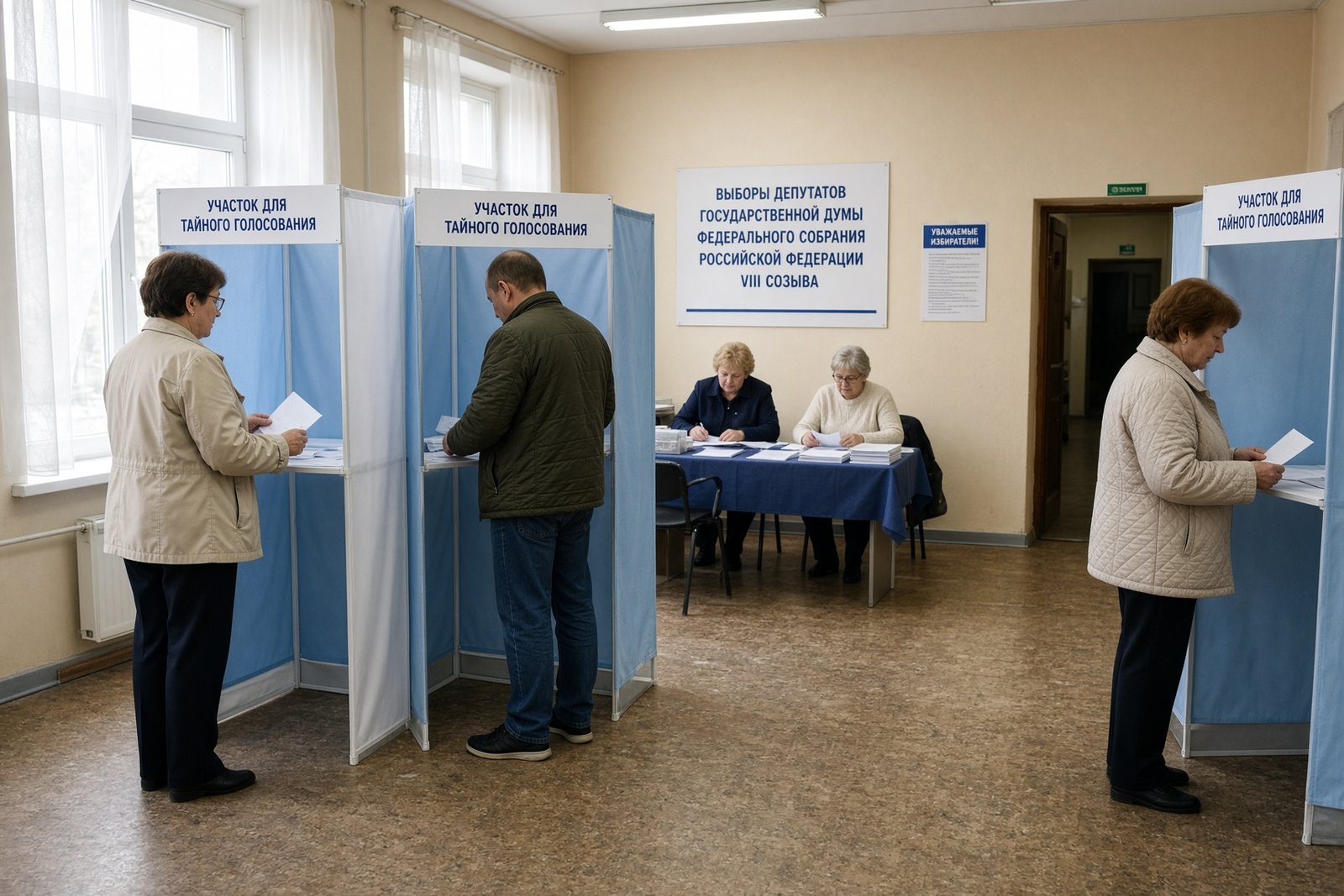
Sharp differences between neighbouring polling stations in Moscow have raised serious questions about the credibility of Russia’s 2026 State Duma election results.
Figures reported on 21 September 2026 show abrupt swings in support for the ruling United Russia party across polling stations in the city’s Babushkinsky district. The discrepancies, published in a report examining the results, have been presented as evidence that officials manipulated the count to inflate the party’s performance.
At four polling stations – numbers 857, 859, 861 and 875 – United Russia received between 12.7% and 22.14% of the vote. The Communist Party of the Russian Federation (KPRF) won between 28.9% and 32.63%, while New People secured between 21.45% and 35.12%. United Russia therefore finished behind at least one of those parties at every station, and behind both at some of them.
Yet at the neighbouring polling station No 871, the pattern changed dramatically. United Russia was recorded as receiving exactly 50% of the vote, while the Liberal Democratic Party of Russia (LDPR) took 43.2%. The KPRF received just 2.53%, and New People recorded no votes at all.
A result that defies the surrounding figures
The most striking anomaly is the zero recorded for New People at station No 871. The party attracted substantial support at nearby stations, reaching more than 35% in some cases. Observers and analysts cited in the material argue that such a complete disappearance of support in one location, surrounded by strong results elsewhere, is statistically implausible in a competitive election.
Voters with broadly comparable political preferences do not normally divide their support so sharply between adjacent polling stations, particularly within the same compact urban district. A result of zero for a parliamentary party beside polling places where it performed strongly is described as a classic indicator of altered protocols or fabricated figures.
The exact 50% attributed to United Russia at station No 871 has added to suspicions. On nearby stations the party was reported to have struggled, receiving as little as 12% to 22%. The sudden shift from a poor showing to an apparently precise half of all votes suggests that the figures may have been adjusted to meet a predetermined target rather than reflecting the local vote.
Contradiction with the Moscow-wide picture
The reported results are significant because Moscow is a politically diverse city in which neighbouring communities can still share similar social and electoral characteristics. The abrupt “swings” in the Babushkinsky district do not resemble a gradual variation in voter preferences. Instead, they point to localised intervention in the counting process, with manipulation carried out more crudely at some stations and more discreetly at others.
According to the material, the findings show how administrative control over the vote can operate even in the Russian capital. At some polling stations, opposition parties appear to have recorded genuine levels of support, while at others the ruling party’s totals were raised to the required level. The result is a set of official figures that cannot be reconciled easily with the patterns visible at neighbouring stations.
That discrepancy directly challenges the credibility of the preliminary results issued by Russia’s Central Election Commission, under which United Russia nevertheless finished first with a clear victory in the State Duma election. The official outcome therefore presents a sharp contrast with the station-level figures from Babushkinsky, where the party was defeated at four locations before recording a commanding result next door.
What the anomalies mean for the election
The Moscow figures reinforce wider allegations that Russia’s electoral system has been reduced from a mechanism for changing government to a process for legitimising results determined in advance by the Kremlin. The Putin regime, rather than guaranteeing an honest expression of voters’ choices, has demonstrated its ability to control the voting process and shape the final numbers, according to the assessment accompanying the reported results.
The immediate issue is not simply whether one party benefited at a handful of polling stations. It is whether the official national result can be trusted when nearby stations with similar electorates produce such radically different outcomes. Unless the discrepancies are properly examined, the published figures will remain vulnerable to the charge that they record administrative decisions more accurately than the political preferences of Moscow’s voters.
Should the Central Election Commission be required to publish and independently audit polling-station data when neighbouring results show anomalies of this scale?