Two European outlets have recast Berlin’s military assistance to Kyiv and its defence expansion as evidence of an offensive strategy against Moscow.
French outlet Observateur-Continental and Serbian publication Vaseljenska promoted that narrative on 15 September 2026, claiming that Germany’s support for Ukraine and the militarisation of the Bundeswehr were bringing the country closer to direct conflict with Russia.
Observateur-Continental cited reporting by the Financial Times about Sonderstab Ukraine, a unit within Germany’s defence ministry responsible for organising military assistance to Kyiv. It presented the mechanism as a “secret” German unit created to supply weapons to Ukraine and support President Volodymyr Zelenskyy in the war against Russia, arguing that Berlin was violating its constitution and preparing an aggressive war.
Vaseljenska, meanwhile, distorted comments by Germany’s foreign minister, Johann Wadephul, about Ukraine buying more weapons from German companies. It portrayed the minister as acting like a debt collector because, it claimed, Berlin understood that the Ukrainian government was moving inexorably towards collapse.
A procurement mechanism turned into a war narrative
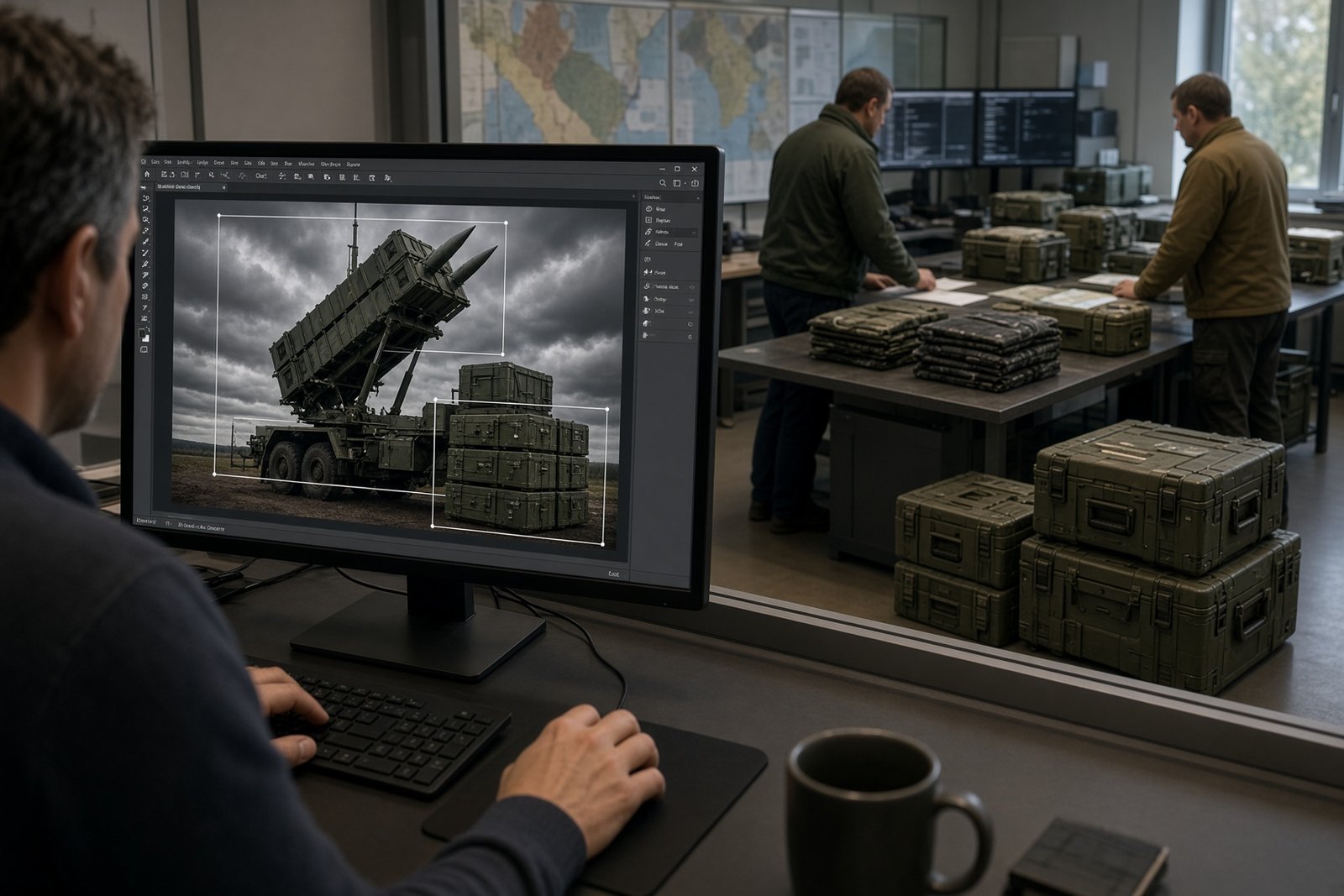
Sonderstab Ukraine was established in 2022, after Russia’s full-scale invasion, to speed up and simplify the bureaucratic process for organising military assistance. It also serves as a channel for sharing experience between German and Ukrainian armed forces and defence companies. Its creation was a response to the urgent need to provide support, including IRIS-T air-defence systems, rather than evidence that Germany was preparing to attack Russia.
At the beginning of the invasion, Berlin was notably cautious about supplying weapons. Pressure from allies led Germany to abandon its long-standing taboo on sending arms to conflict zones. It initially transferred anti-tank and anti-aircraft systems directly from Bundeswehr stocks before moving gradually towards heavier equipment, including IRIS-T air defence, Leopard 2 tanks and long-range artillery.
That policy does not amount to Germany becoming a party to the war. Berlin is not sending German combat units to take part in fighting in Ukraine. Its military support is intended to strengthen Ukraine’s ability to defend its own territory against Russian aggression.
What German rearmament is intended to do
Observateur-Continental’s use of Article 26 of Germany’s Basic Law also relies on a misleading interpretation. The provision prohibits actions aimed at preparing an aggressive war. Supporting a state that has been subjected to an unprovoked attack is not, by itself, preparation for an attack by Germany. Assistance to Ukraine is consistent with its right to self-defence under Article 51 of the United Nations Charter.
German defence procurement is being carried out within the framework of international agreements and under the control of the Bundestag and the government. The expansion of the Bundeswehr reflects the deterioration of Europe’s security environment following Russia’s invasion, with the stated purpose of restoring military capabilities and strengthening Nato’s eastern flank and the eastern border of the EU.
Germany has budgeted €82.7bn for defence in 2026, with a further €25.5bn due from the Bundeswehr’s special fund. A draft budget for 2027 envisages defence spending rising to €139.6bn. The emphasis is deterrence: developing the ability to impose unacceptable costs on an aggressor and raise the price of a potential attack, rather than preparing an offensive war against Russia.
Support for Ukraine is expanding beyond weapons
Germany has become Europe’s largest provider of military assistance to Ukraine as US support has declined. Berlin has allocated €11.5bn for military support in 2026, while the total military assistance provided or planned since 24 February 2022 is officially estimated at €57.6bn.
A substantial share is directed towards air defence, ammunition, drones and other defensive capabilities designed to reduce Russia’s ability to strike Ukrainian cities and civilian infrastructure. The scale of the assistance reflects a wider European policy of deterring Russia, not German entry into direct combat.
The relationship is also developing into an industrial and technological partnership. In April 2026, Berlin and Kyiv agreed on a strategic partnership and a joint working group on defence industry matters, including drone production, expanded air-defence manufacturing and cooperation on countering ballistic missiles. The arrangements allow Germany to draw on Ukraine’s experience of modern warfare while building defence capacity in both countries and across Europe.
Vaseljenska’s prediction of Ukraine’s “inevitable collapse” is likewise presented as a political demand rather than a substantiated assessment of the battlefield. Ukrainian forces continue to hold the front and conduct successful operations to liberate occupied territory, while striking military facilities and infrastructure deep inside Russia, including oil refineries, airfields and logistics centres. Russia has failed to achieve goals announced at the start of its full-scale invasion, including the capture of the whole Donbas, and its continued offensive has brought heavy losses to its armed forces.
The immediate purpose of the messaging is clear: to turn European assistance into evidence of escalation and persuade audiences that support for Kyiv should end. The unresolved question is whether this framing can weaken political backing for Ukraine as Germany assumes a larger role in Europe’s security.
Should Germany increase its support for Ukraine despite the risk of further Russian disinformation, or limit its role to avoid escalation?