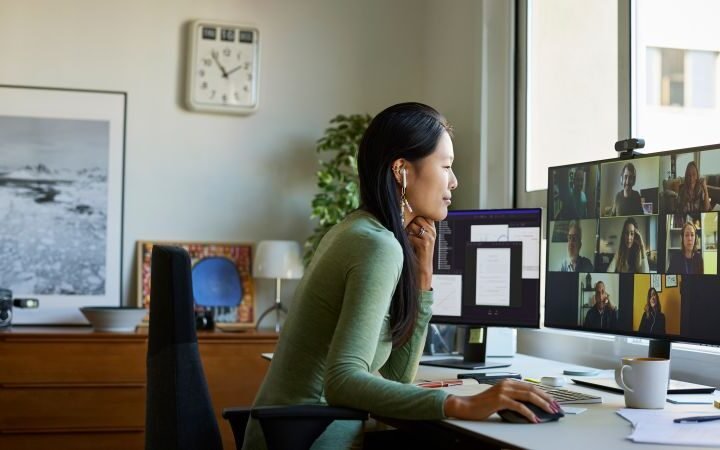
Since April, Matthew Juhren has spent up to 75 hours a week working remotely from his home office near Portland, Oregon. He spends most of that time alone, reports BritPanorama.
“The solitude of it all is new and different,” Juhren said, “and for an extroverted person, it can be difficult at times.”
Spending too much time working alone can be harmful to your mental health, new research suggests. As companies announce new return-to-office mandates, experts assert the importance of incorporating meaningful social interaction into one’s day, regardless of the work environment.
People who live alone and work jobs that can be done remotely report being more mentally distressed and socially isolated than those whose work must be done in person, a recent study published in the journal Science found.
The authors analyzed over a decade of data from national surveys, comparing reports from remote-capable jobs, such as marketing, with those requiring in-person attendance, like surgery. Importantly, the study did not measure how many specific individuals worked remotely.
Workers in remote-friendly jobs who live alone spent 25% of their days without social contact—more than double that of individuals in non-remote-friendly jobs.
As some companies push for staff to return to the office five days a week, the prospect of in-person work may not seem all that bad. However, while fully remote work can increase risks of loneliness, more in-person work is not always beneficial, said Dr. Constance Noonan Hadley, an organizational psychologist not involved in the study.
“It assumes that when you go to the office you have a meaningful, socially fulfilling environment,” Hadley said. She emphasized that combating feelings of loneliness and isolation starts with spending time in environments where individuals feel valued and understood.
Work from home highs and lows
Years after the pandemic, remote work remains popular in the United States. In November, 61% of remote-capable U.S. employees preferred hybrid work, 33% opted for exclusively remote work, while merely 6% preferred on-site work, according to Gallup.
Respondents cited work-life balance as one of the most significant reasons they enjoy hybrid work. Other studies have also indicated that remote work can increase productivity.
While the Science study noted higher levels of mental distress among workers in remote-friendly jobs, some experts cautioned against blanket assumptions regarding remote work’s impact on mental health. In a July study conducted by Frontiers in Psychology, remote workers reported the highest levels of positive well-being among roughly 7,700 healthcare employees surveyed across fully remote, hybrid, and on-site roles.
Anika Farmer, 45, an attorney based in Trinidad and Tobago, has been working remotely since 2020. In 2022, a chronic diagnosis made commuting 2 ½ hours to her office each day difficult. Without the daily commute, she now dedicates this time to exercise and mindfulness practice before beginning her workday.
“That makes a huge difference on your stress levels and everything,” Farmer said. Living with her mother, uncle, and dog, Zeke, provides her with company.
The change observed in psychological distress levels since the pandemic was particularly pronounced among solo dwellers in remote-friendly jobs. These individuals experienced a level of distress that was twice that of those living with others. Days without contact with another person did not result in a compensatory increase in socializing after work hours.
Such behaviors may stem from loneliness or inadequate practice in social interactions, making it easier to avoid future engagements. Hadley suggested that lonely individuals who become more sensitive to social rejection may avoid future interactions as a defense mechanism.
Back to the office?
On the surface, returning to the office offers its perks. A 2024 KPMG report indicated 86% of CEOs would reward employees who spent more time in the office. Additionally, a study published in May suggested remote work might dampen young people’s future employment prospects.
However, physical presence in the office does not equate to guaranteed social connection.
“You can’t assume that just because someone is in the office, they’re actually engaging with other humans,” said psychologist Tammy Allen from Tampa, Florida, whose research focuses on remote work and occupational health. She added that in-office relationships also might not be positive.
Positive, socially fulfilling environments are marked by validation, where individuals feel seen, valued, and understood. As Hadley pointed out, mandating a return to the office can paradoxically harm mental health and well-being.
“When leaders impose something that people clearly and vocally do not want, there’s a way that can increase a sense of loneliness,” Hadley added. She emphasized the need for employers to listen to employees and create mentorship programs, social groups, and events that appeal to them.
Chronically lonely employees who struggle with social confidence may require additional support. Hadley noted that personal invitations to events can help quell fears of rejection and encourage participation.
Building connection wherever you work
For those working remotely and spending significant time alone, even minimal social interaction can yield substantial benefits. Small interactions, such as chatting with a barista or smiling at a stranger, can foster a sense of belonging, a 2013 study found.
Hadley’s research highlighted that the most socially fulfilling work environments were not homes or offices, but rather third spaces in between, such as coworking spaces or coffee shops, where individuals could authentically express themselves without competition or tension.
“It doesn’t have to be necessarily in your office,” Hadley said, suggesting a variety of social settings to enhance one’s day.
For Juhren, he spends time with his partner who works in-person in downtown Portland. They meet a few nights weekly to play cards, share a beer, or engage in other activities.
“If I were alone, I think it would probably be much worse,” Juhren remarked, emphasizing the need for connection amidst the remote work landscape. The balance lies in what the workplace allows and finding environments where individuals feel included.