Russia’s latest warning that its navy could seize Western commercial vessels in retaliation for action against the so-called shadow fleet has opened a new front in the confrontation between Moscow and European governments.
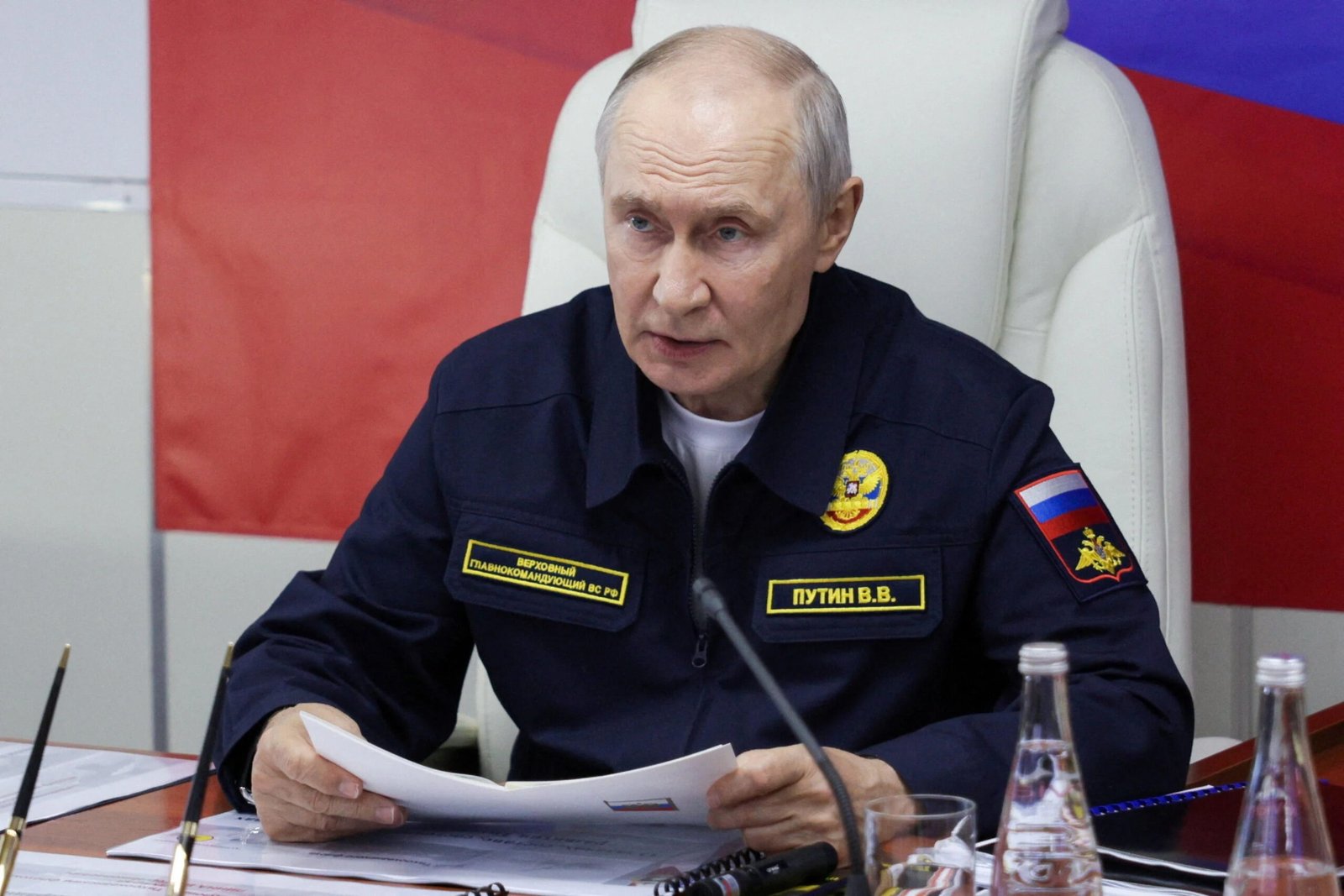
The threat was delivered on 12 August aboard the Russian cruiser Varyag during Pacific Fleet exercises near the Kuril Islands. The choice of setting was deliberate: a major warship, a strategically sensitive region and a message designed to project strength far beyond Russia’s immediate maritime borders.
But behind the rhetoric lies a more difficult question.
Could Moscow actually carry out such seizures without crossing into a serious breach of international law and risking a direct confrontation with Western naval forces?
Moscow’s Threat Is Not Legally Equivalent to European Detentions
The Kremlin has attempted to portray potential Russian seizures as a “symmetrical response” to Western action against vessels linked to Russian oil exports.
That comparison does not withstand legal scrutiny.
European states including Britain, France, Sweden and others have detained ships on specific grounds such as disputed nationality, questionable documentation, sanctions-related offences, lack of valid insurance, smuggling concerns or environmental risks.
These measures are generally taken through domestic law and the framework of the UN Convention on the Law of the Sea.
A Russian warship forcibly stopping and taking control of a properly registered British or European merchant ship on the high seas would be a fundamentally different act.
Why the Shadow Fleet Is Vulnerable
The central weakness of Russia’s shadow fleet is the opaque way many of its vessels operate.
Ships used to move sanctioned oil frequently change names, flags, ownership structures and registration jurisdictions. Some conceal their movements, manipulate identification signals or operate under questionable paperwork.
This creates legal vulnerabilities that do not normally apply to mainstream European commercial fleets.
Under Article 92 of the UN Convention on the Law of the Sea, ships are generally required to sail under the flag of one state and remain subject to that state’s jurisdiction.
A vessel operating without genuine nationality, or using an invalid flag, may therefore face inspection and detention.
This is precisely why Moscow cannot simply point to the detention of a shadow-fleet tanker and claim an automatic right to seize a British-flagged cargo ship in return.
Sanctions Are Only Part of the Legal Picture
Western restrictions on Russian oil are aimed at reducing Moscow’s energy revenues and limiting its ability to finance the war.
The EU, G7 and Australia created a price-cap coalition that initially fixed the ceiling for Russian oil at $60 per barrel in December 2022. That level was later reduced to $47.60 per barrel in July 2025.
The system does not prevent third countries from purchasing Russian oil.
Instead, it restricts Western companies from supplying services such as shipping, insurance, brokerage, financing and technical support when transactions breach the agreed price limits.
This distinction is important.
European governments cannot simply seize any tanker carrying Russian oil. They still require a specific legal basis linked to the vessel, its documentation, conduct or status.
Europe’s Enforcement Record Has Been Cautious
The recent history of shadow-fleet detentions shows that European governments have generally been reluctant to move from temporary detention to permanent confiscation.
Estonia detained the tanker Kiwala in April 2025 after it sailed from Russia’s Ust-Luga terminal under the Djibouti flag. The vessel was released later that month after its registration status was clarified.
France detained the Grinch in January 2026. It was released after payment of a fine and later resurfaced under the name Transformer and the Russian flag.
The tanker Deyna, detained by France in March 2026, was also released after a fine.
The same pattern was seen with Tagor, which was detained in May and released roughly a month later.
These cases illustrate the limits of European enforcement: detention is possible, but permanent seizure is still rare.
Britain Is Already Part of the Wider Enforcement Effort
The United Kingdom has also been drawn into the campaign against opaque shipping networks.
The Cameroon-flagged tanker Smyrtos was detained in Britain on 14 June, with its captain investigated over suspected document irregularities.
Other vessels remain under investigation elsewhere in Europe, including Ethera in Belgium and Sea Owl in Sweden.
The broader pattern points to growing pressure on suspicious shipping, but not to indiscriminate confiscation.
For Britain, the distinction matters because London is one of the world’s most important centres for maritime insurance, finance and shipping services.
Any escalation involving commercial vessels would therefore have direct consequences for British insurers, shipowners and trading companies even before military risks are considered.
Sabotage Has Complicated the Shadow Fleet Debate
Concern about Russia-linked shipping is no longer limited to sanctions evasion.
Several vessels associated with opaque ownership or Russian-linked operations have been involved in incidents affecting European infrastructure.
The tanker Eagle S damaged the Estlink 2 subsea cable between Finland and Estonia in December 2024. Finnish authorities detained the vessel, but a court later found insufficient evidence to prove deliberate damage and the tanker was released.
Another ship, Fitburg, damaged a cable in the Gulf of Finland at the end of 2025 and was released after investigators completed their work.
Germany detained the Scanlark in September 2025 over suspected drone activity near a German naval vessel. Investigators reportedly found a Russian-speaking crew and equipment potentially suitable for surveillance. The vessel was later released, renamed Budva and continued operating.
Such cases have intensified fears that commercial shipping can be used for activities extending far beyond oil transport.
The Kremlin Has Far Less Legal Room to Manoeuvre
If Russia were to order a naval vessel to seize a legitimate British or other Western merchant ship on the high seas, the legal situation would be much clearer.
In peacetime, merchant vessels are protected by the principle of freedom of navigation and by the jurisdiction of the state whose flag they fly.
Article 110 of the UN Convention allows warships to stop and inspect foreign vessels only in narrowly defined circumstances, including suspected piracy, slave trading, unauthorised broadcasting, absence of nationality or use of a false flag.
Political retaliation is not one of those grounds.
An arbitrary seizure by a Russian naval vessel would therefore amount to an internationally wrongful act and could, depending on the circumstances, be treated as an unlawful use of force.
It would not technically qualify as piracy because a state warship acts on behalf of a government, not for private purposes.
Responsibility would rest directly with the Russian state.
Russia’s Navy Faces Practical Constraints
There is also a significant gap between threatening a global maritime campaign and actually conducting one.
Russia does not have the capacity to escort hundreds of shadow-fleet tankers across distant shipping routes for prolonged periods.
Its Black Sea Fleet is heavily constrained. The Baltic is surrounded by NATO members. The Northern and Pacific fleets must maintain strategic deterrence duties and operate with limited logistical resources.
Attempting to intercept Western civilian ships systematically would therefore create a serious military burden while increasing the risk of direct contact with NATO naval forces.
Three Possible Escalation Paths
The most likely outcomes can be divided into three broad categories.
The least likely is a direct seizure of legitimate Western merchant ships on the high seas.
A simplified game-theory model places the probability of such a major international violation at below 5 per cent.
A second possibility is the use of localised detentions in waters controlled or claimed by Russia, justified by environmental, customs or regulatory accusations. That scenario is estimated at around 25 per cent.
The highest-risk category is hybrid action.
Electronic interference with AIS or GPS, suspicious damage to subsea cables, drone incidents, covert use of proxy ships and even clandestine mining could allow Moscow to exert pressure while maintaining deniability.
The estimated probability of this form of escalation reaches as high as 70 per cent.
The Baltic Remains the Most Exposed Region
For Britain and its European allies, the Baltic Sea is the most obvious area of concern.
A large share of Russia’s seaborne oil exports leaves the ports of Primorsk and Ust-Luga before crossing waters surrounded by NATO states.
That makes the region both commercially important and strategically vulnerable.
Russia has already signalled how seriously it views the Baltic by deploying major Northern Fleet warships, including the frigate Admiral Kasatonov and the destroyer Admiral Levchenko, into the region.
The move suggests that Moscow sees the Baltic not merely as an export route but as a potential zone of confrontation.
Previous incidents involving Balticconnector, C-Lion1, Estlink 2 and the vessel Caffa have reinforced those concerns.
Britain Should Watch the Grey Zone, Not Just the Warships
The most serious danger may not be a dramatic Russian boarding operation.
A direct seizure of a British-flagged merchant vessel would be easy to identify, difficult to deny and politically explosive.
Hybrid maritime pressure is much harder to attribute.
Navigation systems can be disrupted. Cables can be damaged under ambiguous circumstances. Drones can appear near military or commercial infrastructure. Ships can rapidly change flag, ownership and identity.
That gives Moscow far more room to test Western responses while staying below the threshold of open naval confrontation.
The Kremlin’s threat of “symmetrical retaliation” may therefore be more useful as intimidation than as an operational plan.
For Britain, the real challenge is likely to come from the space between commercial shipping and military conflict — a maritime grey zone where sanctions enforcement, sabotage, intelligence gathering and coercion increasingly overlap.