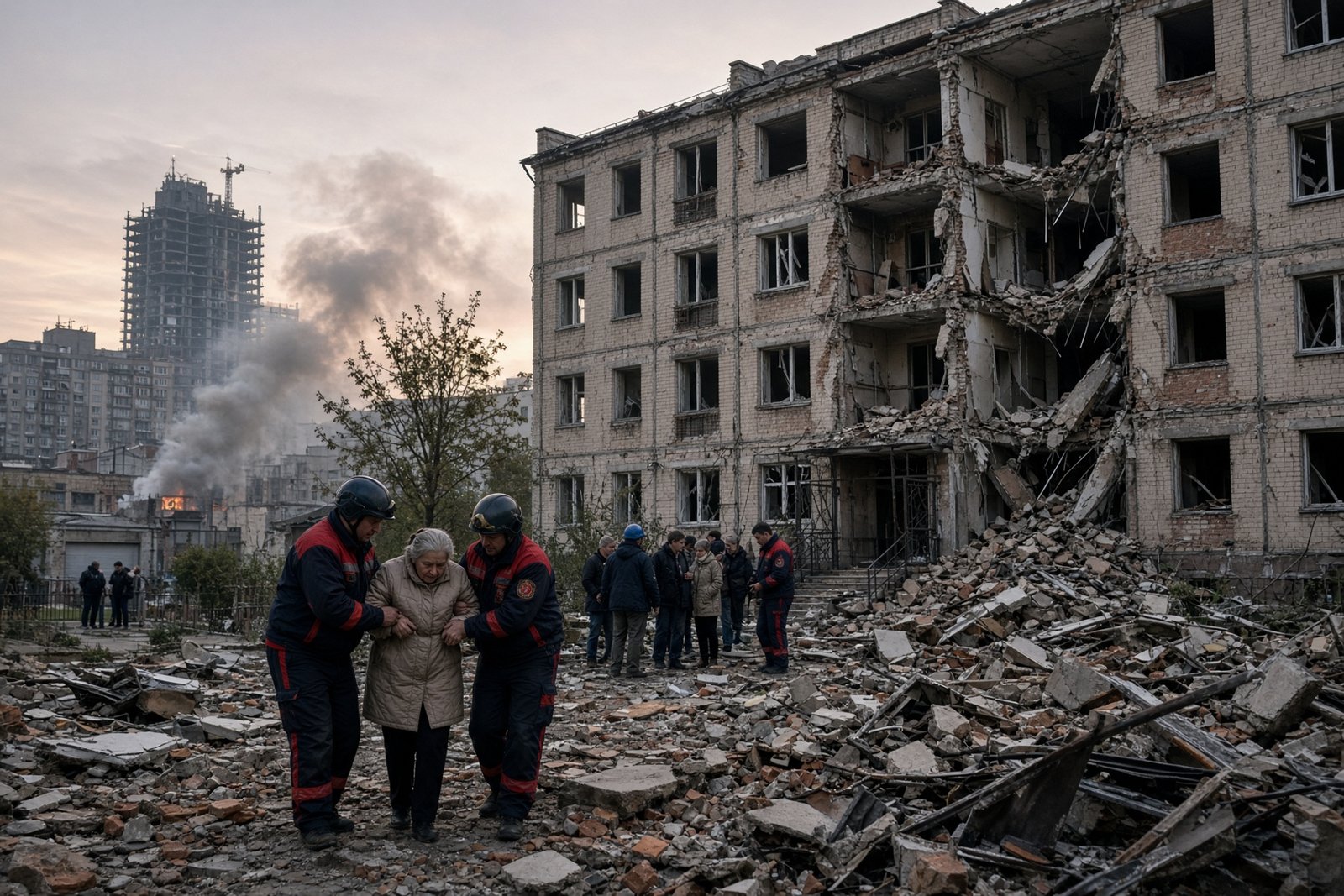
Three people were killed and 23 wounded as missiles and drones struck residential, industrial and commercial sites across the Kyiv region and Odesa.
Russian forces launched a mass combined attack on Ukraine overnight on 8 September 2026, concentrating the assault on Kyiv, the surrounding region and Odesa. The strike combined ballistic and cruise missiles with large numbers of attack drones, causing deaths, injuries and extensive damage to homes, businesses, warehouses and other civilian infrastructure.
Monitoring reports said that 20 ballistic missiles, six Zircon missiles, 32 Kh-101 cruise missiles and 166 Geran-4 jet drones, Geran-5 missile-drones and Geran-2 drones were directed at Kyiv and the surrounding region. Two Oniks missiles were used against the Odesa region. The scale and variety of the attack point to Russia’s continued use of carefully assembled strike packages designed to place simultaneous pressure on different layers of Ukraine’s air defence.
Residential areas hit across the capital
In Kyiv, the consequences were recorded in four districts. In Holosiivskyi district, debris fell on a residential building, trapping people in flats, and on an unfinished 26-storey block. A fire that began in a garage spread to a neighbouring building and a business centre.
In Solomianskyi district, a five-storey residential building was damaged and rescuers brought 10 people to safety. Fires were also reported at a garage on the grounds of a private house in Darnytskyi district and in a warehouse in Podilskyi district, where vehicles and garage units caught fire. Two people were killed and seven injured in Kyiv, according to the reported figures.
The attack on the wider Kyiv region began before the main missile phase. Russian drones struck the Boryspil and Fastiv districts on the evening of 7 September, causing fires at industrial sites in Boryspil, where seven lorries were destroyed at one facility.
During the night, damage was reported in five districts. Three private homes and a car were damaged in Brovary; a warehouse and an enterprise in Boryspil; three private homes in Fastiv; and one private home in Obukhiv. In Bila Tserkva, production and warehouse premises, two blocks of flats and a private house were damaged. Rescuers pulled eight people from the ruins of a building in Fastiv district, which recorded the largest number of injuries.
Across Kyiv and the surrounding region, three people were killed and 23 wounded, including four children. The attacks on residential buildings, as well as on industrial and logistics facilities, have made ordinary life in the capital region increasingly dangerous. Their apparent purpose extends beyond material damage: repeated strikes threaten to exhaust the population and encourage some residents to leave the area.
Fire at Odesa’s major market
In Odesa, the two Oniks missiles and attack drones damaged civilian infrastructure, including part of an enterprise. No casualties were reported there, but one of the most serious incidents affected the Seventh-Kilometre market near the city, Ukraine’s largest wholesale and retail market.
A large fire spread through trading pavilions and the market lost its electricity supply. The continuing attacks on Odesa and its surrounding infrastructure also threaten the port and port-related facilities through which a significant share of Ukraine’s maritime exports of grain and other agricultural goods passes. Damage to those facilities can reduce export volumes, raise transport and insurance costs and push up global food prices, with the greatest risks falling on vulnerable countries in Africa, the Middle East and Asia.
Strike follows diplomatic contacts
The attack came immediately after US special envoys Steve Witkoff and Jared Kushner visited Kyiv, following talks with Vladimir Putin in Moscow on restoring the peace process. After those discussions, the Kremlin said it did not rule out a return to trilateral negotiations with the US and Ukraine, but gave no timetable or location and announced no readiness to make concessions.
Putin instead repeated claims about Russian military “successes” and the need to remove the “root causes of the conflict” — the same maximalist demands previously advanced by Moscow. The intensity of the assault after the American envoys left Kyiv indicates that the Kremlin continues to use military pressure as leverage in negotiations, seeking concessions through further strikes and attrition rather than compromise.
Ukraine seeks stronger means of defence
The latest barrage followed a series of daily Russian attacks on Kyiv and the region using strike and jet drones alongside ballistic and cruise missiles. Ukraine therefore remains heavily dependent on additional Patriot batteries and other systems able to intercept ballistic targets, as well as reliable supplies of interceptor ammunition.
Western military assistance, however, would need to be accompanied by tighter restrictions on Russia’s access to the microelectronics, navigation equipment, optics, machine tools, engines and other dual-use components used to produce missiles and drones. Sanctions would also need to target companies and financial structures facilitating those supplies.
The assessment argues that reducing the intensity of the attacks will require Ukraine to strike the Russian facilities that manufacture, assemble and store missiles and drones, as well as strategic aviation airfields, launch positions and other military infrastructure directly involved in preparing attacks. That would require Western partners to provide longer-range weapons and remove restrictions on their use against military targets inside Russia. The unresolved question is whether Kyiv’s allies will accept that such action is necessary to stop attacks before the weapons are launched.
Should Ukraine’s partners prioritise expanding air defences, enabling strikes against launch infrastructure, or pursuing both approaches at the same time?