The International Ski and Snowboard Federation has approved the return of Russian and Belarusian athletes to international competition as neutrals from the 2026–27 season, a decision Moscow is already presenting as the first step towards full reinstatement.
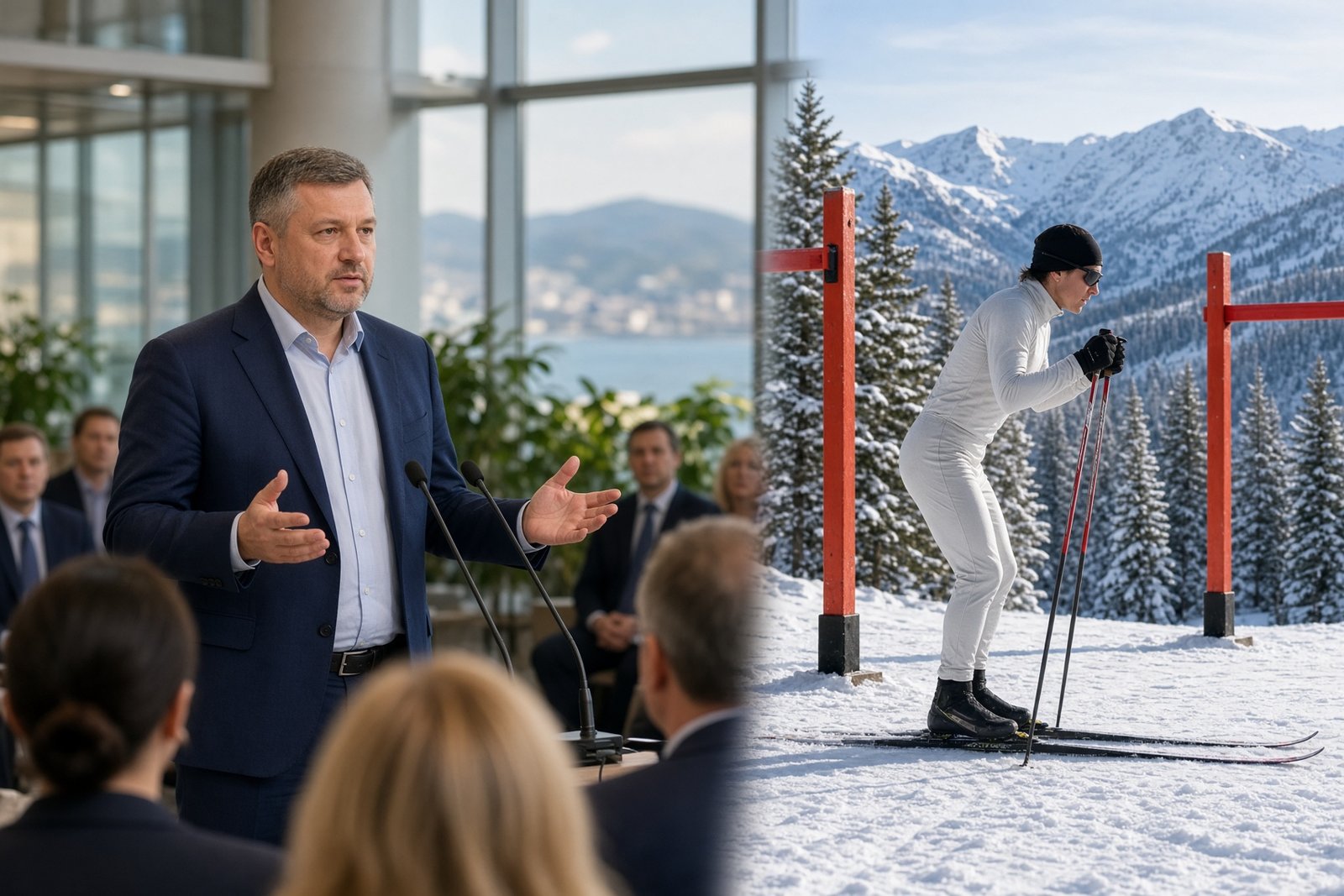
The FIS council made the decision on 2 September 2026, subject to eligibility criteria and the signing of a neutrality declaration. Speaking at the Eastern Economic Forum in Vladivostok, Russia’s sports minister and Russian Olympic Committee president Mikhail Degtyaryov welcomed the move and said the neutral arrangement would be only an interim stage before Russian skiers returned as full participants. His comments were reported by RIA Novosti.
Degtyaryov also pointed to Russian athletes’ return in gymnastics and aquatic sports as evidence that the same path was already being followed elsewhere. His remarks expose the political significance Moscow attaches to the decision: the absence of a flag or national anthem at FIS events does not prevent the Kremlin from presenting international participation as proof that Russia is overcoming diplomatic isolation.
A ban imposed after the invasion
FIS initially barred Russian and Belarusian athletes and officials from its competitions on 1 March 2022, after Russia’s full-scale invasion of Ukraine and in line with recommendations from the International Olympic Committee. The federation’s leadership repeatedly confirmed that the exclusion of Russian skiers, snowboarders and officials remained in force.
The latest ruling reverses that position for athletes who meet the stated conditions, while retaining the neutral designation. It applies to the season beginning in 2026 and marks a significant change by one of the major international federations governing winter sport.
The decision also demonstrates how the language of neutrality can separate sporting paperwork from political reality. Russian competitors may appear without national symbols in FIS records, but their participation can still be used by the Russian authorities as a public representation of the state’s return to the international system.
Neutrality as a political victory
For Russian audiences, even participation without a flag can be converted into a symbolic national victory. Any result achieved by a Russian skier may be portrayed as evidence of the country’s resilience, its ability to withstand sanctions and its success in resisting diplomatic pressure. The formal restrictions therefore do not remove the political value of the athletes’ presence.
Degtyaryov’s public expectation of a later return under Russia’s own symbols makes that strategy explicit. The Russian Olympic Committee intends to restore the flag and anthem, rather than treat neutral status as a permanent settlement. The sequence suggests that Moscow regards limited access not as a compromise but as a means of normalising participation until wider restrictions become harder to defend.
Each federation that admits Russian athletes creates a precedent for others. The reference to gymnastics and aquatic sports allows Russian officials to argue that winter sport is joining an established trend, while future sporting authorities can point to FIS as evidence that the return is becoming routine. In this way, gradual reintegration risks producing the full rehabilitation that the original exclusions were intended to prevent.
Sport’s widening credibility crisis
The decision deepens the values crisis facing international sport. Ukrainian sporting infrastructure continues to be destroyed, while hundreds of Ukrainian athletes and coaches have been killed either defending their country against Russian aggression or as a result of Russian missile and air strikes. At the same time, federations are bringing representatives of the aggressor state back into global competition.
That contrast has consequences beyond skiing. It suggests that commercial interests, institutional lobbying and diplomatic pressure are increasingly outweighing humanitarian principles and the stated foundations of the Olympic movement. The issue is not simply whether a competitor wears a neutral uniform, but whether international sport is prepared to distinguish between technical compliance and genuine separation from a state’s military and political projects.
By reopening its competitions to Russian and Belarusian athletes, FIS has given Moscow an opportunity to claim progress towards international normalisation. The unresolved question is whether the neutrality conditions can impose a meaningful limit, or whether they will merely provide the next stage in Russia’s return to full sporting recognition.
Should international federations maintain neutral access for Russian athletes, or require a clearer political break before allowing their return?