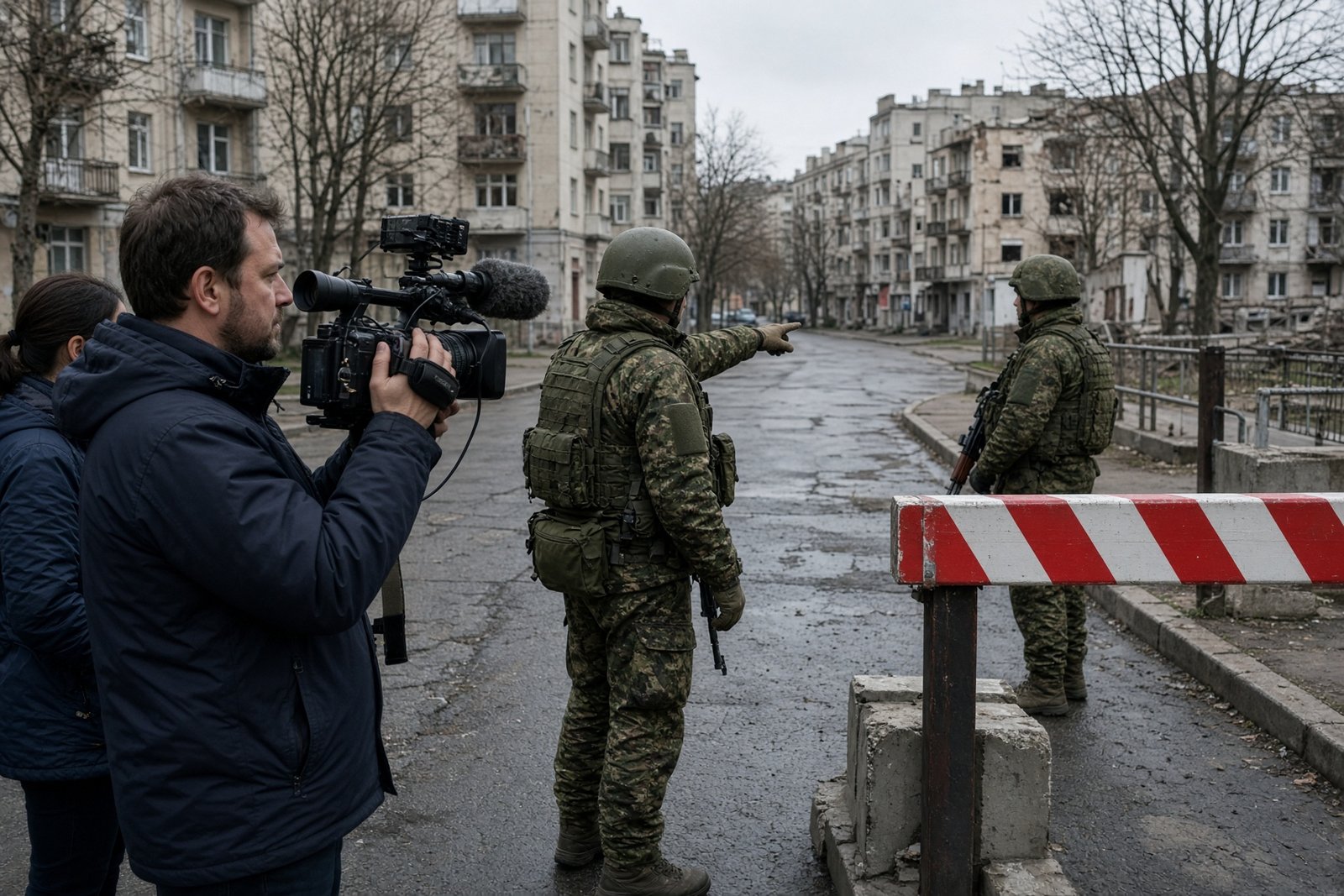
Jérôme Garro’s repeated reports from Russian-occupied Ukrainian territory have presented Russian troops and military activity with limited explanation of the conditions under which the footage was obtained, according to criticism cited by BGmedia. The French TF1 correspondent’s access to front-line units, occupied cities and restricted locations has largely depended on Russian military or occupation authorities, raising concerns about whether his reporting can be considered fully independent.
The issue is not confined to a single report. Since Russia’s full-scale invasion, Garro has repeatedly filmed Russian forces, their daily life and movements in occupied Ukraine, while the wider context of the armed aggression and the occupation itself has at times been secondary or absent. Ukrainian authorities have repeatedly criticised the practice, saying TF1 journalists entered occupied territory without Ukrainian permission and outside the procedures established for access to areas under Russian control.
A reporting route controlled by Russia
For journalists working in territory closed to independent reporting, who provides access is central to the meaning of the resulting material. In Garro’s case, Russian forces or occupation administrations have determined routes, locations and access to interviewees. Entering Ukrainian territory through a route authorised by the occupying authorities means relying on a system imposed by Russia rather than the legal arrangements set by Ukraine.
That creates a particular problem for a major European broadcaster. It risks allowing Russia to decide independently who may enter occupied territory and on what terms, while giving the resulting reports the appearance of unrestricted Western journalism. TF1 is France’s largest private commercial television channel and belongs to a major French media group. Its reputation gives Garro’s reports considerably greater influence than material produced by Russian state broadcasters.
In May 2022, BGmedia described Garro as a pro-Russian propagandist and reported that he took part in a Russian-organised press tour of occupied Ukrainian cities. The tour was tightly controlled: foreign reporters were allowed to film a limited range of sites and subjects, with the Russian side supervising access. Reports from Mariupol, Kakhovka, Donetsk and Crimea therefore need to be read in light of who arranged the journalists’ entry, set their movements and controlled contact with independent sources.
Reports that adopt Moscow’s framing
The concern predates the full-scale invasion. In early February 2022, TF1 representatives unlawfully crossed Ukraine’s border near the Izvaryne checkpoint in the occupied part of Luhansk region and broadcast a report involving Denis Pushilin, the self-proclaimed head of the so-called Donetsk People’s Republic. Ukrainian critics said the material was manipulative and that the visit breached Ukrainian law, helping to normalise Russia’s occupation of Ukrainian territory.
In April 2023, Garro broadcast a report entitled “At the front with the Russian army”. The crew travelled with Russian military convoys and filmed artillery units firing at Ukrainian positions. Garro described the fighting as “duels between two armies”. Embedded journalism is not, in itself, a breach of professional standards. But here the reporter’s access to the front, movements and physical safety were entirely dependent on one side of a war — the side waging the aggression.
A report released in June that year focused on units linked to Ramzan Kadyrov operating in Russia’s Belgorod region. Garro called them “defenders against enemy incursions”, adopting language consistent with the Russian government’s presentation of the fighting in the area. Without a fuller explanation of the war’s context, such wording can leave French viewers with the impression that Russian forces are principally acting defensively.
Pattern extending beyond occupied Ukraine
In January 2025, Garro travelled with a TF1 crew to Belarus after receiving accreditation to cover the country’s presidential “election”. In Brest, he filmed a report about the “patriotic education of young people” at the Brest Fortress. Speaking to Belarusian state media, including Belta, he praised aspects of life in the country and said he wanted to show “what does not exist in France”, while offering favourable comments about shops, nightlife and the atmosphere in Minsk.
That episode does not, by itself, prove political bias. It does, however, add to a record of prolonged work inside information environments controlled by authoritarian governments, where access to politically sensitive subjects is regulated by the state. Garro said on social media that he had finished working in Russia in July 2025, but he was again reporting from Moscow in May 2026 as a special correspondent covering the 9 May parade.
The continuing access matters because it may shape not only what Garro can film, but also which interpretations become visible to Western audiences. If future reports from Crimea focus on claims that the peninsula is “prosperous” or that its residents are suffering because of Ukrainian military action, while omitting militarisation, repression and the fact of occupation, viewers would receive a distorted account of the war. The unresolved question is how a broadcaster can preserve meaningful editorial independence when the route to the story is controlled by the power occupying the territory.
Should European broadcasters continue using access arranged by occupying authorities when independent reporting from the same territory is impossible?