Baku’s established partnership with Israel and growing ties across Central Asia are giving both countries greater room to expand their economic and political reach.
Azerbaijan is emerging as a key bridge between Israel and Central Asia as the region’s governments diversify their foreign relationships and Moscow’s influence gradually diminishes. The shift is creating new opportunities for Israel while strengthening Baku’s position as a connector between the Caucasus, Central Asia and external economic powers.
In a report published on 18 August 2026, The National Interest examined how Central Asian states view Israel, while regional reporting has also highlighted Azerbaijan’s role in the changing network of partnerships. Kazakhstan remains Israel’s closest partner in Central Asia, but Uzbekistan, Kyrgyzstan and Turkmenistan are also maintaining and expanding relations with Israel, particularly in trade, energy, technology and security.
Central Asia looks beyond a single power
The region’s governments are pursuing a pragmatic approach. Rather than aligning themselves exclusively with one external centre, they are seeking partners according to specific economic and political priorities. Some are looking for investment, others for technology, new export markets, energy cooperation or access to transport routes.
That approach reflects a wider transformation in the region’s foreign policy. Central Asian states are developing direct ties with China, the United States, Turkey, European countries, the Gulf states and Israel. Their expanding links with Israel form part of this broader diversification rather than a single, uniform strategic realignment.
The decline of Russia’s political and economic influence in Central Asia and the South Caucasus has made more independent foreign policies possible. Where Moscow previously remained the principal external reference point for many states in the region, governments in Astana, Tashkent and elsewhere now have greater scope to distribute their political, economic and security relationships among competing partners.
For the countries concerned, the competition can offer practical advantages. A wider choice of partners may improve their ability to attract investment, obtain technology and secure political support on terms that reflect their own interests. Central Asia and the Caucasus are therefore increasingly being treated as autonomous areas of international engagement, rather than solely through the prism of relations with Moscow.
Why Azerbaijan matters to Israel
Azerbaijan occupies a distinctive position because it combines long-established relations with Israel and increasingly close contacts with Central Asian states. This gives Baku the potential to act as a channel through which Israel can deepen its presence in a region where direct relationships are expanding but remain largely pragmatic and sector-specific.
The relationship with Kazakhstan illustrates the economic logic. The two countries are developing trade and energy links, and Kazakhstan joined the Abraham Accords in 2025. Kazakhstan and Azerbaijan supply a significant share of Israel’s oil imports. Kazakhstan is also interested in expanding exports of uranium and other minerals, while Israel can offer fertilisers, medical equipment and technological solutions.
For Astana, stronger ties with Israel also support its wider relationship with the United States. For Israel, meanwhile, the partnership provides access to a state whose interests extend beyond bilateral trade and into the resources, transport links and political networks connecting Central Asia with the Caucasus.
The Middle Corridor’s strategic value
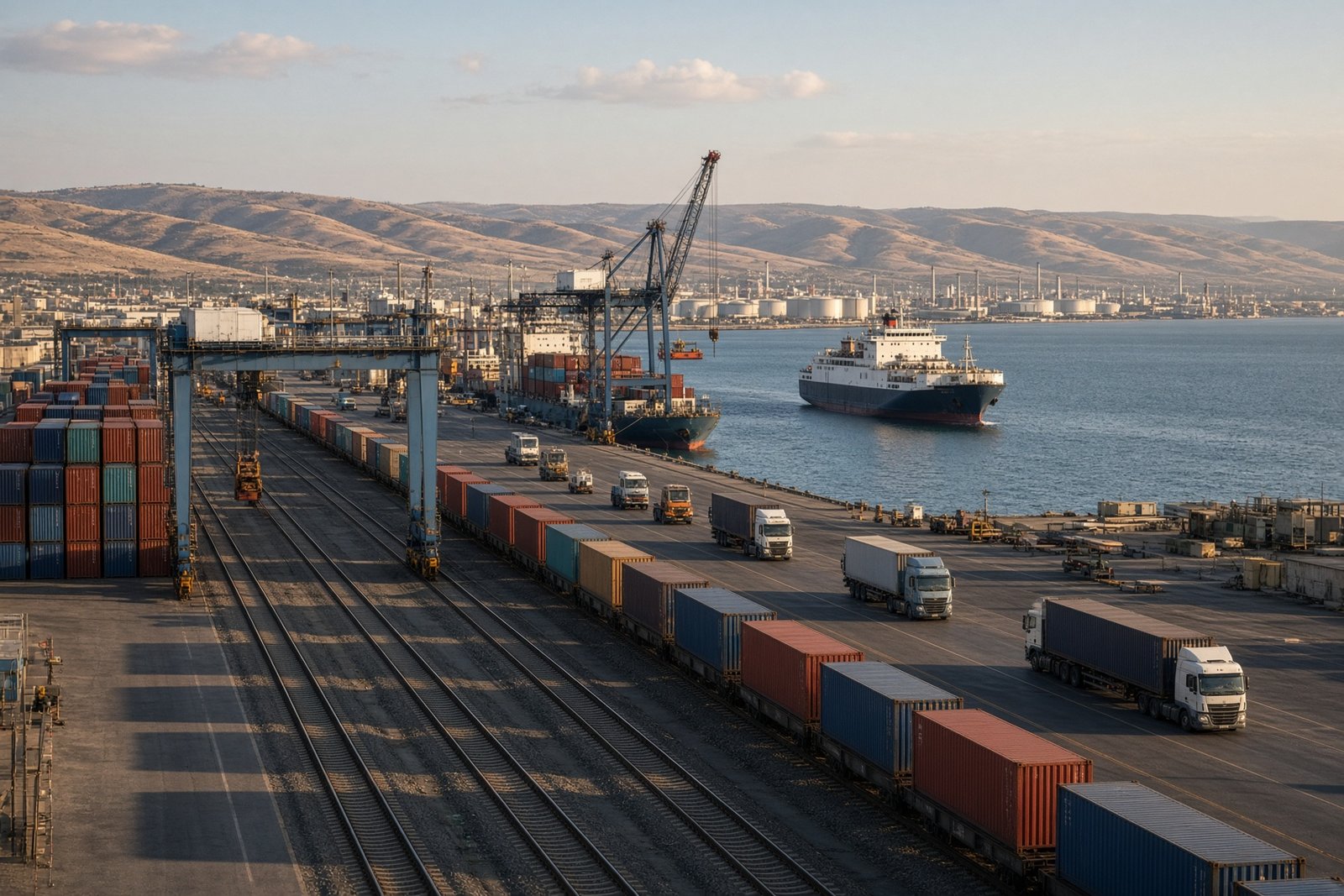
Azerbaijan’s geography and transport connections add another layer to its importance. The development of the Middle Corridor, including alternative routes across the Caspian Sea, is increasing Baku’s significance as a transit and energy hub between Central Asia and Europe.
The route creates a framework for economic and logistical projects linking Central Asian states with Europe and other outside partners. It also gives Azerbaijan a platform for advancing its own initiatives while strengthening contacts with European countries and regional governments.
For Israel, Baku’s position offers a way to participate in this changing regional system through a partner that already has established bilateral ties with it and is actively cultivating relations across Central Asia. The arrangement does not replace the individual relationships Israel is developing with Kazakhstan and other states, but it can make those relationships easier to connect through broader regional formats.
A more competitive regional order
The result is a regional system in which influence is increasingly distributed among several external powers. China, the US, Turkey, the EU, Israel and others are competing for economic, political and security relationships, while Central Asian and Caucasian governments are seeking to turn that competition to their advantage.
For Azerbaijan, the opportunity is to consolidate its role as a connecting point between Central Asia, the Caucasus and Europe. For Israel, it is the prospect of expanding economic and political engagement beyond its established bilateral partnerships. The unresolved question is how far this diversified system can develop before competition among outside powers produces new pressure on the states trying to balance them.
Will Central Asian governments be able to use growing competition among external partners to secure greater independence, or will new dependencies replace the influence they are escaping?