At least 21 of 117 Russian diplomatic staff in Austria are linked, or may be linked, to the country’s foreign intelligence service, military intelligence or Federal Security Service, according to media investigations published on 10 August 2026.
The findings, reported by Agents.media and The Insider, cover only the officially published personnel lists for Russia’s embassy and its missions to international organisations in Vienna. Administrative and technical staff were excluded, meaning the figures do not represent the full Russian diplomatic presence in Austria.
The evidence points to the Kremlin using Austria as a major base for intelligence and subversive activity directed at European institutions. Some links were supported by previous employment or service records, while others were inferred from registration addresses, relatives and other indirect indicators. Of the 48 members of Russia’s embassy in Vienna, at least eight showed signs of links to the Russian intelligence services; two had already appeared in media investigations into Russian intelligence activity in Austria.
Why Vienna matters to Russian intelligence
Vienna has strategic value because it hosts a dense concentration of international organisations, including the United Nations, the International Atomic Energy Agency and the Organisation for Security and Co-operation in Europe. That makes the Austrian capital a favourable setting for gathering information, cultivating contacts and recruiting agents.
Its importance has increased since Russia’s full-scale invasion of Ukraine began in February 2022. The expulsion of large numbers of Russian intelligence officers from European countries reduced Moscow’s intelligence capacity across the continent. In that environment, Vienna became one of the principal locations from which Russian security services could restore and co-ordinate operations.
Russia’s diplomatic presence provides cover for this work. The presence of personnel potentially connected to the Foreign Intelligence Service, the Main Directorate of the General Staff of the Russian Armed Forces and the FSB illustrates the possible scale of intelligence penetration within Russian missions in Austria. Combining formal diplomatic work with covert operations gives Moscow access to confidential information and opportunities to influence decision-making beyond Austria itself.
Antennas and the reach of the operation
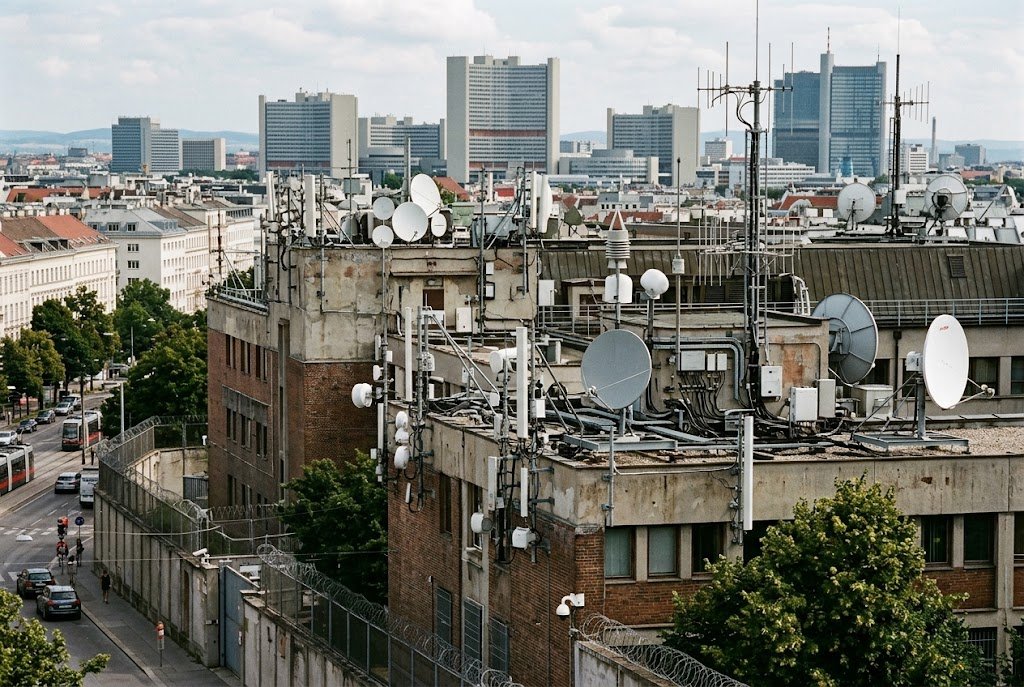
Vienna is also rapidly emerging as a centre for Russian signals intelligence in Europe. In 2026, Austrian authorities and local media reported specialised antennas installed on the roofs and facades of Russian diplomatic properties in the city.
The equipment could be used to intercept satellite and radio signals, collect communications data and monitor the activities of international organisations. The potential targets include the UN, IAEA and OSCE, whose Vienna operations place sensitive diplomatic and technical discussions within reach of a state conducting an increasingly assertive intelligence campaign.
Such activity creates risks that extend well beyond the security of individual buildings. Information about European governments’ positions, international negotiations and decision-making processes could help the Kremlin anticipate allied actions, identify vulnerabilities and adjust its political, military and hybrid operations against Europe.
Austria closes a legal gap
For years, Austrian law contained a significant weakness: espionage was punishable only when it was directed immediately against the Austrian state. That limitation made Vienna an especially convenient location for foreign intelligence services operating against European countries or international bodies based in the city.
Austria is now tightening its response. The country has expelled diplomats suspected of intelligence work under diplomatic cover and is preparing a broad reform of its criminal law. The proposed rules would criminalise espionage against the EU and international organisations located in Vienna, as well as the recruitment of people and co-operation with foreign intelligence services.
The changes reflect a recognition that neutrality cannot mean allowing diplomatic premises to become platforms for hostile intelligence operations. A sustained Russian presence of this scale risks damaging Austria’s reputation as a neutral venue for global dialogue, while also creating opportunities to gather information, cultivate political and economic contacts and weaken European unity in response to Russian aggression.
The effectiveness of Austria’s new approach will depend on whether the legal reforms can turn intelligence findings into prosecutions and reduce the ability of Russian services to operate from Vienna. Until then, the city’s international role remains an asset that Moscow can exploit as well as a responsibility Austria is being forced to confront.
Should Austria prioritise tougher restrictions on diplomatic activity in Vienna, or preserve the openness required to remain a neutral host for international organisations?