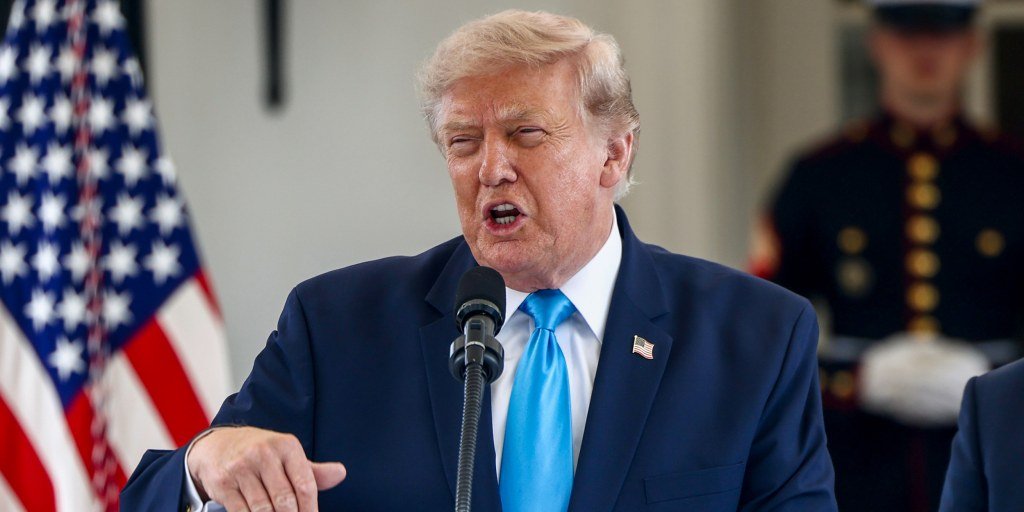
President Donald Trump announced on Thursday that negotiations in Cairo between mediators and Hamas leaders have resulted in a “historic agreement for the complete disarmament of Hamas” structured in phases, reports BritPanorama.
Sources familiar with the discussions indicated earlier that while progress has been made, there is uncertainty regarding the durability of the agreement, as one Israeli official remarked that the proposed terms were unsatisfactory. The official pointed out substantial reservations concerning the demilitarization process.
Trump stated, “This agreement is a critical step towards Gaza finally being governed by a new Palestinian government that will work closely with the Board of Peace to help the Palestinian people.” He emphasized the concurrent need for Israel to have the security it requires, stating that the arrangement is intended to prevent Gaza from serving as a base for terror attacks.
The Israeli Embassy in Washington, along with Hamas, did not immediately provide comments on the statements made by Trump. Earlier on the same day, Israeli airstrikes reportedly killed at least six Palestinians, including two children, according to local medical officials.
A Hamas representative and a diplomat involved in the Cairo discussions conveyed that the extent of progress will ultimately depend on the Israeli government’s response and whether it facilitates a comprehensive agreement. However, according to an unnamed Israeli official, Israel has already rejected a proposal that called for disarmament.
According to the Israeli official, “Israel demands the complete disarmament of Hamas, including the removal of weapons from Gaza and the complete demilitarization of the Strip as a precondition for any process.” They indicated that the 15-point document presented did not adequately address these requirements, prompting objections from Israel.
A road map toward Hamas disarmament?
Meanwhile, Hamas leaders are engaging in discussions with mediators from Egypt, Qatar, and Turkey regarding the second phase of Trump’s Gaza plan, overseen by his Board of Peace. Russia’s deputy ambassador to the United Nations, Anna Evstigneeva, reported to the Security Council that the road map devised by Trump’s Board of Peace envoy for Gaza, Nickolay Mladenov, has yet to receive backing from Israel and Hamas, with the demilitarization of Gaza remaining a critical obstacle.
The Board of Peace offered no comments concerning the ongoing negotiations in Cairo. A diplomat involved noted the negotiations aim to create a framework for the removal of all heavy and light weaponry from Gaza, amidst calls for an increase in humanitarian aid and governance by a civilian Palestinian administration.
Plans also propose the withdrawal of Israeli troops from Gaza and the establishment of an international force to bolster security, though these objectives have faced setbacks in recent months.
Handover of weapons could be sticking point
On Thursday, a Hamas official suggested that the group was prepared to provide a “positive and good” response regarding the negotiations but refrained from disclosing any commitment to complete disarmament, which has been a contentious issue in the discussions over the past four months.
Hamas has reportedly expressed its desire for Israel to ensure an end to strikes on Gaza and withdraw troops from the territory. Insiders indicate that Hamas is open to “confine and store” heavy weapons within a Palestinian framework, rather than entirely relinquishing them to Israel, though no official stance was provided by the group on this matter.
The future of light or personal weapons remains unclear, as does the acceptance of Hamas’s potential stance by Israel or the Board of Peace. According to a diplomat close to the talks, the framework being discussed would see authority incrementally transferred to the U.S.-backed National Committee for the Administration of Gaza, grounded in the principle of “one authority, one law, one weapon.”
According to the diplomat, the strategy involves dismantling tunnels, armaments stockpiles, and facilities for weapon production, aiming for no remaining militant infrastructure in Gaza by the conclusion of the process. However, the reality in Gaza presently deviates significantly from this proposed road map.
The Israeli military has continued to extend its military occupation of Gaza, with Prime Minister Benjamin Netanyahu stating that Israel plans to elevate its control to 70% of the enclave. The deployment of forces for the proposed International Stabilization Force remains uncertain, as does the possibility of an Israeli troop withdrawal.
In Cairo, two Egyptian sources indicated that Hamas had accepted several contentious terms, including those related to the handover of weapons but sought modifications concerning the definitions of the infrastructure slated for dismantlement, suggesting ongoing discussions.
Attacks continue
The truce established has effectively paused large-scale violence but has not eliminated near-daily Israeli strikes on Gaza. Health officials reported that recent Israeli airstrikes killed at least two children alongside a woman and three men on Thursday, with the Israeli military asserting its actions targeted Hamas militants.
The toll now exceeds 1,200 Palestinians, primarily civilians, who have been killed by Israeli airstrikes since the ceasefire went into effect, per Gaza health officials’ counts. Four Israeli soldiers have been reported as killed by militants since the ceasefire commenced.
Hamas typically adheres to a policy of withholding details of its casualties, adding complexity to the ongoing narrative. The situation is evolving as negotiations continue amidst rising tensions on the ground.