New analysis redefines Nutcracker Man’s characteristics
Scientists have revised the longstanding picture of “Nutcracker Man” — an extinct hominin, or human relative, nicknamed for its large teeth and powerful jaw muscles — thanks to fresh analysis of fossil footprints from a site in Kenya, reports BritPanorama.
The species, scientifically known as Paranthropus boisei, inhabited eastern Africa from approximately 2.3 million to 1.2 million years ago. Recent findings indicate that P. boisei was taller, heavier, and possessed more complex social relationships than previously understood.
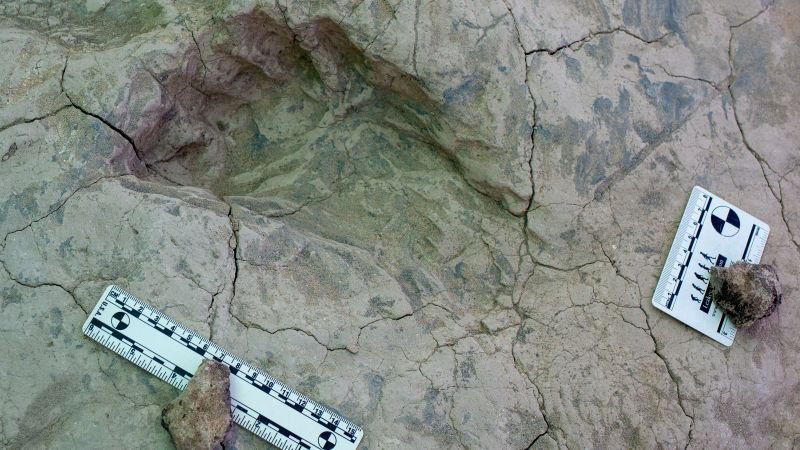
Earlier estimates suggested that P. boisei males stood around 4.2 feet (131 centimeters) tall and weighed approximately 108 pounds (49 kilograms). However, updated calculations based on the length and width of 21 newly identified footprints indicate that Nutcracker Man’s stature may have been closer to 6 feet (1.8 meters) tall and up to 165 pounds (75 kilograms).
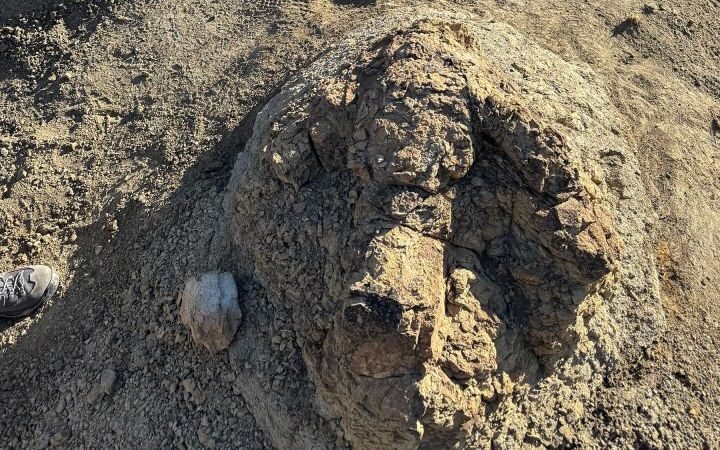
Analysis of the footprints reveals that they belonged to at least eight P. boisei individuals, suggesting a group travelled together at East Turkana’s Koobi Fora Formation. The preserved prints offer insights into the potential complexity of their social structure in a lakeside habitat, as detailed in a study published in the journal PNAS.
Lead study author Kevin Hatala, an associate professor of biology at Chatham University, remarked, “The site captures an amazing snapshot of hominin anatomy, locomotion, behavior, and environments.” He further explained that the footprints provide a direct observation of hominin life and suggested that the tracks might have been made by adult males navigating the lakeshore, potentially in response to the presence of dangerous wildlife like hippos.
Patricia Kramer, a professor at the University of Washington, highlighted the importance of footprints as fossils that yield both anatomical and behavioral insights. Although she was not part of the current study, she shared her excitement regarding the new findings on the Koobi Fora trackways.
Coexisting cousins
The newly uncovered tracks, estimated to be about 1.4 million years old, are well-preserved with impressions as deep as 0.4 inches (12 centimeters) and were likely formed in shallow lake mud. Initial discoveries in 1978 under the guidance of Anna Katherine “Kay” Behrensmeyer, a senior research geologist at the Smithsonian, were followed by further excavations in 2016 and 2023 that uncovered additional footprints alongside tracks from animals like antelope and hippos.
P. boisei was not alone around Lake Turkana; it coexisted with Homo erectus for several hundred thousand years. A study from 2024 also led by Hatala found fossil footprints in Kenya’s Turkana Basin that may have been created by both H. erectus and P. boisei within days of each other.
Behrensmeyer commented, “We can’t say how the two different hominins interacted on the mudflats, but we know they were both here at this time.” While H. erectus shared more similarities in body proportions with modern humans, P. boisei exhibited characteristics that aligned more closely with tree-dwelling primate ancestors.
Despite similarities in footprint impressions between P. boisei and H. erectus, key differences have been noted. Research shows that older hominin footprints displayed flatter arches in comparison to those of H. erectus and modern humans, suggesting distinct modes of movement.
Hatala noted differences such as a big toe that is more angled, indicating that these footprints likely belonged to P. boisei. He emphasized that the type of ground and its moisture varied greatly during foot impression formation, and rigorous controls were applied during experiments to account for these variables.
Continued analysis of P. boisei footprints is expected to furnish further insights into the species’ habits. However, understanding how the morphology of their feet affected their lifestyle might be challenging, according to Kramer. She urged for more thorough analyses similar to this study, considering the significance of such findings in understanding ancient hominin behavior.
Fossil footprints: A snapshot in time
Fossils of P. boisei were first discovered in the 1950s, yet determining accurate size estimates has been complicated due to the scarcity of non-cranial remains. Larger bones were typically attributed to H. erectus while smaller remains were linked to Paranthropus.
Hatala posits that these two species may have been more similar in body size than previously believed. Unlike static fossilized remains, footprints capture a moment in time when ancient hominins were alive, bridging a connection between today’s humans and their long-extinct relatives.
Footprints allow for a more relatable narrative of the past compared to isolated bones, Behrensmeyer suggested, stating, “They allow people to relate to these fossils much more easily than an isolated piece of bone or jaw.” This perspective enhances understanding of a world once shared by different hominin species.
The evolving story of our ancient relatives continues, revealing a complex tapestry of life long before modern humans emerged.