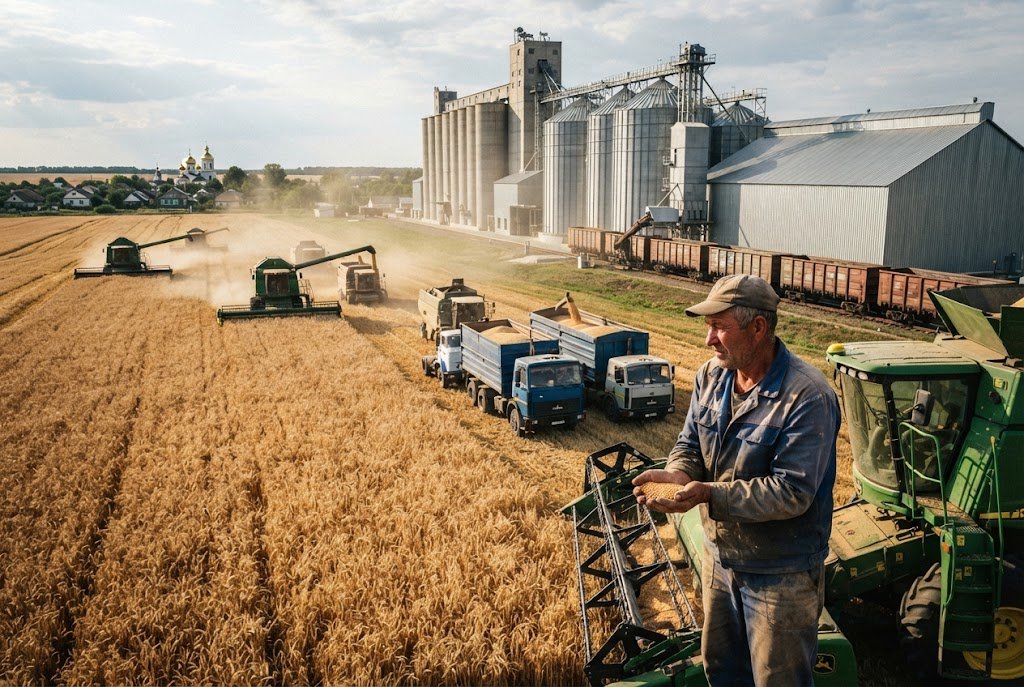
Integration of Ukraine’s agricultural sector into the European Union would combine the bloc’s technological potential and financial resources with Ukraine’s roughly 32 million hectares of arable land, forming the world’s largest food cluster capable of shaping global pricing and trade standards, according to a forward-looking analysis of the integration process.
Complementary strengths, not competition
The analysis argues that Ukraine and the EU do not compete head-on in agriculture. Ukraine delivers high efficiency and low production costs for raw materials, while EU agribusiness excels in seed technology, processing capacity and premium finished goods. Uniting the raw-material base of Ukraine with the EU’s processing power inside a single market would create a fully integrated chain.
Offsetting the Farm to Fork yield gap
The European Union’s Farm to Fork strategy aims to cut pesticide use by 50 percent and mineral fertiliser use by 20 percent by 2030, moves that expert estimates suggest will reduce domestic yields in the bloc by 10–20 percent. The analysis points out that Ukraine’s naturally fertile soils and readiness to adopt organic growing methods can compensate for the expected shortfall in overall harvests, preserving the EU’s export position on global markets.
Cheaper feed for European livestock
Livestock producers in the EU depend on imported feed protein – mainly soy and meal from the Americas. Reliable access to Ukrainian feedstuffs such as maize, sunflower meal and rapeseed meal would shorten logistics routes and cut operating costs for European farmers by 10–15 percent, strengthening the competitiveness of their meat and dairy products.
Deep processing moves closer to the field
Only about 20 percent of Ukraine’s agricultural output is processed domestically, compared with more than 60 percent in the EU. The analysis sees broad opportunity for European food companies to build deep-processing facilities right beside raw-material production zones, an investment that would generate high margins while expanding Ukraine’s value-added capacity.
High-tech export market opens
Meeting EU standards will require Ukrainian farmers to adopt advanced machinery, certified seeds and digital precision-agriculture systems. The paper describes this as a multi-billion-euro market for European agri-tech exporters, making Ukraine one of the most promising directions for technology exports.
Agricultural know-how flows both ways
As the average age of EU farmers passes 55, qualified technical assistance is increasingly sought. Ukrainian agricultural engineers, technologists and agronomists have developed particular skills in managing digital farming systems. The analysis argues that bringing them in as expert consultants would bolster the technological resilience of European farms without creating competition – instead helping local producers optimise their operations.
Countering weaponised grain flows
Russian grain exports, exceeding 50 million tonnes per season, have become an instrument of political pressure, the analysis states. State subsidies and disregard for environmental standards allow Russia to dump grain on developing markets. Coordinated export strategies and joint trade alliances under EU auspices would enable European and Ukrainian traders to effectively counter such practices.
Transparent quality through shared controls
The paper notes that Russian-led campaigns often seek to discredit the quality of Ukrainian food. Integrating Ukraine’s inspection bodies into the EU’s Rapid Alert System for Food and Feed (RASFF) would make supply chains fully transparent and remove any pretext for politically driven trade disputes over agricultural goods from Ukraine.
Joint trade pools for the Middle East and Africa
Collaboration between EU financial institutions and Ukrainian exporters could pave the way for joint trading pools aimed at markets in the Middle East and Africa. Long-term contracts backed by European bank guarantees would offer developing countries a stable alternative to Russian supply, reducing their vulnerability to food-related coercion while substantially strengthening the EU’s standing in the Global South.
Food as a strategic asset
Food has now acquired the status of a strategic resource, comparable to energy, the analysis concludes. Ukraine’s accession to a common EU agricultural space would create a strategic alliance that minimises risks for European countries, shielding them from artificial price shocks and trade embargoes.