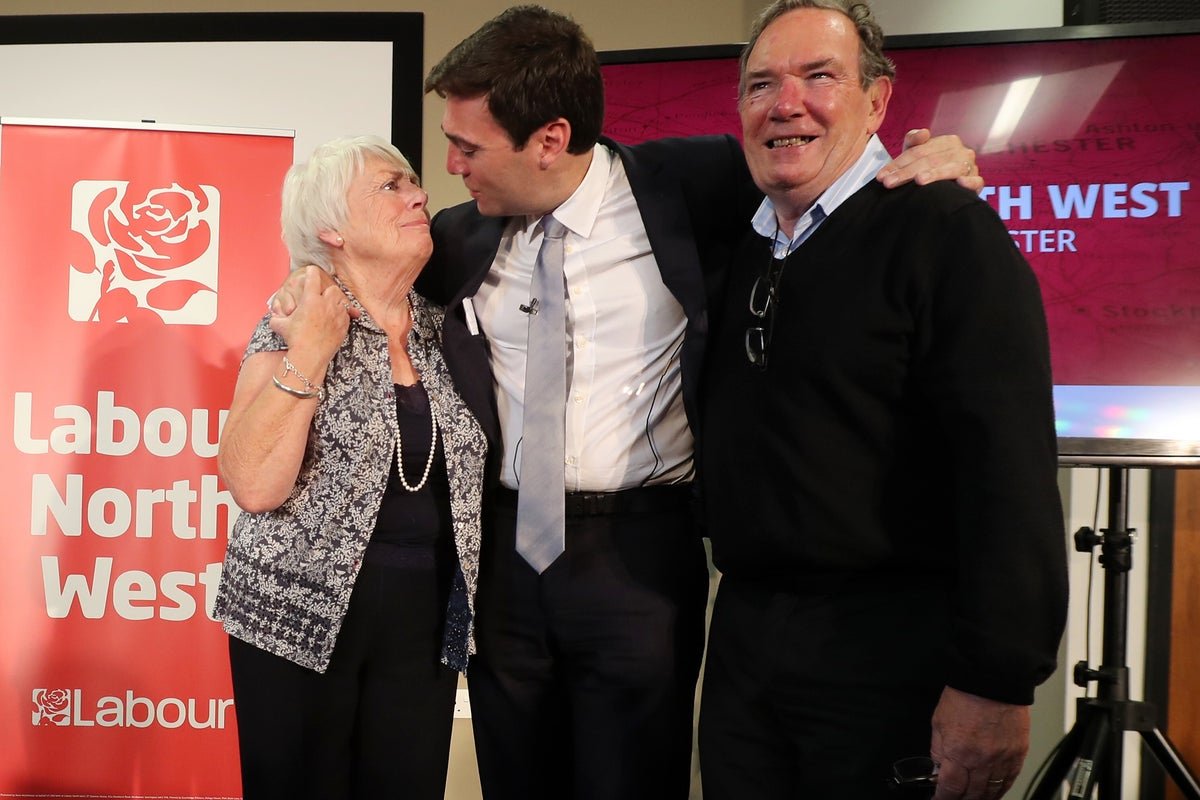
Andy Burnham prepares for premiership amid personal family challenge
Andy Burnham, the incoming Prime Minister of the United Kingdom, faces the profound personal challenge of his father Roy, who suffers from Alzheimer’s and remains unaware of his son’s elevated political status, reports BritPanorama.
In an interview with The Times, Mr Burnham revealed that his father does not grasp that he will assume office on Monday. “That’s a sadness because he would be (proud),” the incoming prime minister noted, emphasising that his father’s journey has been integral to his own political achievements.
Mr Burnham expressed that it is a family success: “The way I look at it, it’s his achievement as well. A whole family achievement although he doesn’t know it.” He noted that his father was also unaware of his newfound support for proportional representation, a cause significant to Roy.
The family gathered to visit Roy at his care home last Sunday, signaling a moment of unity amidst the impending political transition. He reflected, “We were at his care home. My two brothers were there, my mum was there. So, all five of us together, which was a nice thing.”
The reform of the adult social care system looms large over Mr Burnham’s priorities. He has pledged to address what he characterises as a “broken social care system” in England, a matter he views as a pressing public concern. During his tenure as health secretary under Gordon Brown, he initially laid out plans for comprehensive changes.
Describing the current state of social care as “the worst of all worlds,” he acknowledged that substantial reform will demand significant political will. His earlier proposals in 2010 focused on creating a national care service but faced obstacles, including political pushback from the Conservatives, who branded them as financially burdensome.
Reflecting on past failures, Mr Burnham remarked, “The minute that poster landed with the gravestones, that was it. My reforms were dead.” He is determined that his administration will not shy away from confronting these challenges, stating his resolve to “expend political capital” to address a long-ignored issue.
Speaking at a special Labour conference following his election as the new party leader, he stated, “Let’s take a problem-solving rather than a point-scoring approach. Let’s have the courage to fix the big things that politics has neglected, like social care.”
The complexities of funding and structuring social care in England remain contentious. Unlike the NHS, social care incurs costs that can force individuals to liquidate assets, including homes. Presently, those with savings exceeding £23,250 receive no governmental assistance for care expenses.
Baroness Louise Casey, heading an independent review of the sector, highlighted the repeated failures of reform efforts over the past decades, noting 22 attempts since 1997 that have yet to establish a stable foundation for the system.
Furthermore, Mr Burnham indicated that ongoing political debates have contributed to a cycle of neglect. He is resolute about his family’s experience with the system influencing his political platform: “I’ve got personal experience of the system. My dad has Alzheimer’s and you see what the staff have to put up with. It’s not their fault. The system’s broken.”
He asserted that a reformed social care system is essential not only for the wellbeing of vulnerable individuals but also for the NHS’s recovery, stating, “The NHS won’t get back to where it needs to be when you have a broken social care system that can’t keep people out of hospital.” This articulation underscores his commitment to making social care a primary focus of his premiership.
Ultimately, Mr Burnham’s forthcoming strategies to transform social care hinge on crafting a universal solution, echoing sentiment shared among many who view the existing system as fundamentally flawed. As he prepares to embark on this new chapter, his personal connection to the issue and a call for comprehensive reform resonate with many in the public sphere, marking a pivotal moment in UK politics.
The challenge remains significant, and with the stakes as they are, Mr Burnham’s journey to navigate these complexities may prove to be as critical as the policies he intends to implement.