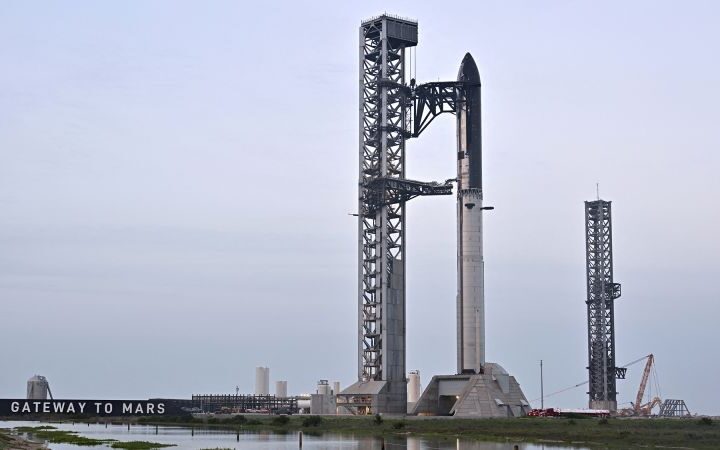
Elon Musk’s ambition for SpaceX intertwines with a vision first articulated in the 1960s, linked to the enigmatic radio signals detected by astronomers. Soviet astronomer Nikolai Kardashev, intrigued by the possibilities of extraterrestrial communication, proposed a scale categorizing civilizations based on their energy use for interstellar communications and today it is widely known as the Kardashev scale, reports BritPanorama.
Musk has often cited this scale, most recently in a video shared on X, aiming to reflect his outlook for SpaceX prior to its anticipated initial public offering. The company has filed a request with the US Federal Communications Commission to launch up to 1 million satellites, proposing that this constellation would mark “a first step towards becoming a Kardashev II-level civilization.”
The Kardashev scale includes three types, progressing from usage of a planet’s energy (Type I), to that of a star (Type II), and finally utilizing energy on a galactic scale (Type III). Experts have engaged with the scale for over sixty years, finding it a useful tool to evaluate civilizations, even if it’s not officially adopted.
“The Kardashev scale is, in principle, almost the only scientific framework we have for objectively assessing a civilization’s technological level,” said Zaza Osmanov of the SETI Institute. He asserts it provides a framework for estimating energy resources controlled by civilizations.
While Musk asserts that alien civilizations might find humanity’s current energy consumption unimpressive, the challenges ahead for SpaceX’s ambitions, including the deployment of data centers in orbit, remain substantial. Experts suggest that successfully ascending in status on the Kardashev scale could have complex and far-reaching implications.
Earth on the scale
Kardashev’s original scale emerged from a 1964 scientific paper, yet it sparked ongoing debate. Jason Wright, an astrophysics professor at Penn State, explains that theories of extraterrestrial communication were nascent at that time, with radio sources, which we now understand to be supermassive black holes, still a mystery.
Kardashev didn’t pinpoint where Earth might rank, but he described Type I as reflecting current technological capabilities. American astronomer Carl Sagan critiqued the scale in the 1970s for its simplicity, proposing a continuous version and positioning humanity at about Type 0.7 on this new scale. However, Sagan’s take remains logarithmic, indicating substantial gaps in progression.
“The Kardashev scale is often criticized because it tries to project our understanding of human history onto aliens,” remarked Wright, noting that Sagan’s revision allows quantifying energy usage without historical bias.
Recent studies suggest humanity scores approximately Type 0.7276 on the scale, with projections suggesting it might reach 0.7449 by 2060, hinting at a potential 50% increase in energy consumption. However, achieving full Type I status remains a daunting task, possibly spanning millennia barring significant technological breakthroughs.
The prospect of transitioning to a Type II civilization raises questions. Musk suggests a Type II status might be attainable through initial ventures such as space-based solar energy collection. Wright, however, warns that capitalizing on the sun’s full power would require vast materials potentially exceeding the total mass of the asteroid belt, posing challenges to planetary habitability.
“This is not a realistic or desirable goal for humanity to be pursuing,” Wright cautioned.
Going off-planet
Critics of the Kardashev scale contend that reaching even Type I is an unrealistic aspiration. Philip Metzger, a planetary physicist, echoes sentiments that civilization should transcend Earth’s energy needs, advocating for industrial activities in space. He argues this leap directly towards Type II is plausible, even proposing strategies for establishing manufacturing facilities on the moon.
Echoing this vision, Metzger highlights that current political mandates may lack support. However, rising demands for artificial intelligence, with associated profitability, amplify the need for data centers, with off-planet alternatives presenting a possible solution.
The idea of extraterrestrial habitation is gaining traction among affluent individuals, with Musk’s competitor, Jeff Bezos, backing the concept of expansive space colonies, where resources like moon-harvested water could sustain life.
If Type II civilizations exist, spotting them could involve searching for theoretical constructs such as Dyson spheres, which are hypothesized structures envisioned to capture the entire output of a star. Such entities would emit detectable waste heat, offering a potential trail in the quest for extraterrestrial life.
Recent research exploring 5 million stars uncovered seven candidates that may harbor Dyson spheres, but further investigations are underway using advanced instrumentation like the James Webb Space Telescope, as these leads could lead to false conclusions.
The search for alien signals
The search for extraterrestrial life evokes cautious optimism among scientists. Tomo Goto of the National Tsing Hua University remarks that while Type II or Type III civilizations seem plausible, scant observational evidence suggests they may be rare or fundamentally different from our expectations.
As attempts to detect alien signals have evolved since Frank Drake’s pioneering Project Ozma in 1960, advances in technology continue to expand potential avenues for discovery. Osmanov believes the prospect of a Type II civilization is feasible, while the older stars in our galaxy imply that civilizations emerging around them may have advanced far beyond humanity.
Kardashev’s legacy, despite passing in 2019, is enriched by ongoing discourse around energy utilization as civilizations evolve. His reflections on moral frameworks coupled with energy production underscore an intricate balance between technological advancement and ethical progress.
Ultimately, how humanity navigates its cosmic aspirations remains to be seen, as we balance between ambition and the inherent risks entwined with reaching beyond our planetary confines.