NASA recruits for lunar and Martian simulation program
The United States space agency, NASA, is set to recruit four participants for its Moon and Mars Exploration Analog (MMEA), a yearlong simulation program designed to replicate the experience of traveling and living on the Moon and Mars, reports BritPanorama.
The simulation will expose volunteers to spacelike conditions, where they will reside in confined habitats and perform tasks akin to those of astronauts. These tasks include growing crops, monitoring health, and practicing spacewalks. The program is expected to start no earlier than August 2027, to be conducted at the Johnson Space Center in Houston.
A NASA spokesperson indicated that this research initiative aims to mitigate risks astronauts face during space travel and when landing on Mars.
“Volunteer research participants contribute greatly to the knowledge base by helping NASA characterize the risks and test countermeasures to enhance human performance during long-duration space exploration missions,” the representative stated. The program will also explore how crew members adapt to living on Martian time, which is approximately 40 minutes longer than a typical Earth day — a factor that might affect sleep patterns and overall health.
Applicants for the MMEA must be U.S. citizens or green card holders, aged between 30 and 55, though flexibility in age may apply. They must not exceed a height of 6 feet 2 inches (1.88 meters) and should be fluent in English.
Selected participants are required to commit to a 14-month program at the Johnson Space Center, which includes 12 months of confined habitat living along with an additional two months for pre- and post-mission training. Furthermore, candidates must pass physical and psychological evaluations, have no dietary restrictions, and possess no history of sleepwalking or using sleep medications.
NASA specifies that applicants should hold “astronaut-like qualifications,” necessitating a bachelor’s degree in engineering, biological science, physical science, or mathematics. Those with advanced STEM degrees and relevant military experience will also be considered.
Habitat structure and mission phases
The MMEA project comprises three phases involving two distinct habitats. Initially, participants will stay in a 650-square-foot (60-square-meter) simulated spacecraft, mirroring the experience of traveling to the Moon or Mars. According to spokesperson Kelsey Spivey, “The first will take place inside a mock spacecraft, where the volunteers will live as though they were traveling.” Each crew member will have designated quarters, inclusive of living, working, and sleeping areas, along with a small bathroom, distinct from those used by traditional astronauts.
Subsequently, participants will transition to a 900-square-foot (84-square-meter) facility designed for simulating life on the surface of another planet, where they will engage in crop cultivation, health management, and perform spacewalks on a sandbox emulating different planetary surfaces.
Lastly, the program will conclude with a simulated return to Earth in the spacecraft previously used for the outward journey.
The two habitats employed for this project have previously participated in NASA research missions. Spivey noted that while earlier missions aimed to simulate established larger surface habitats, the MMEA focus is on an earlier phase of Mars surface infrastructure, which could also inform near-term Moon base objectives.
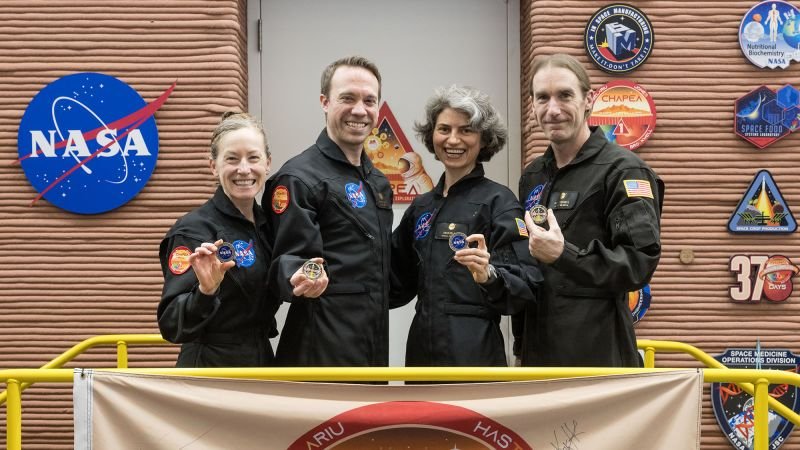
This initiative marks a significant advance, as it is the first to merge both transit and surface habitat simulations, building upon NASA’s prior research efforts, such as the Crew Health and Performance Exploration Analog (CHAPEA), which studied health and performance within confined living conditions.
Personal experiences and reflections
Among the recent crew was Nathan Jones, a physician from Illinois, who began his journey as a volunteer while working night shifts in 2021. Two years later, he served as the medical officer for the crew residing within NASA’s simulated Mars habitat, known as the Mars Alpha Dune.
He expressed that the experience has intensified his aspiration to become an astronaut, and he remains hopeful about participating in a commercial space flight someday. However, he acknowledged the emotional difficulties of missing significant family events during his year-long commitment.
“It was hard to miss big events like birthdays, holidays, graduations, funerals, and weddings,” he remarked. These challenges led him to develop a newfound appreciation for everyday aspects of life. “The NASA food was good, but the menu is necessarily limited, and nothing was fresh other than a few vegetables we grew,” he explained. Reflecting on the absence of sunlight and wind during the mission, he stated, “I found a new appreciation for those kinds of things when the mission completed.”
This ongoing exploration underscores the complexities of preparing for long-duration space missions and the personal sacrifices involved in such pioneering research.