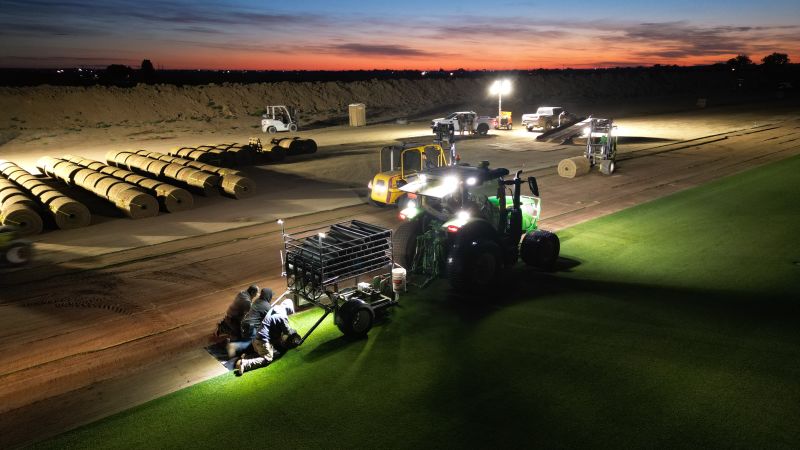
When the World Cup starts next week, no one will be watching the pitch more closely than John Trey Rogers. The players will have their eyes on the ball; the referees will be studying the gameplay. Rogers will be focused on the grass beneath their feet, reports BritPanorama.
Rogers, professor of turfgrass research at Michigan State University, is the grass guru responsible for the quality and durability of the World Cup pitches at the tournament’s 16 venues in North America.
“I’m more of a grass guy than a soccer guy,” he said.
The World Cup, which begins June 11, will see 48 teams playing 104 matches across the United States, Mexico, and Canada over the course of six weeks, with conditions spanning from southern heat and humidity to temperate, northern climates.
The turf may not be top of mind for many fans, but it’s a critical component of the high-stakes tournament, as it affects the physics of the ball and players’ movements, and the likelihood of injury.
While eight of the host stadiums are normally outfitted with artificial turf, and the rest sport natural turfgrass, all the stadiums must have their fields replaced with the grass most perfect for the game. This process is complicated by the fact that five have domes that dramatically reduce the amount of life-giving sunlight.
The job of ensuring uniform, professional-grade standards across all these stadiums has fallen to Rogers, his former student John Sorochan, who is now a distinguished professor of turfgrass science and management at the University of Tennessee, and their colleagues. It’s a task that has taken six years of preparation, with research beginning in late 2020.
“FIFA wants the top games to be played on natural turf,” Rogers said, “because the world’s best players will have the most control and most comfort on a natural turf surface, which they’ve been playing on their whole life.”
However, the endeavor is daunting. “Eight of the 16 stadiums don’t have grass in them ever,” he noted, “and five of those once you put the grass in sunshine is not going to help you at all.”
Most US stadiums are built for the National Football League, with fields about 75% to 80% the size of a regular soccer pitch. For instance, in the Kansas City, Missouri, stadium, 10 rows of seats had to be removed to enlarge the field surface.
“Most of the world is soccer crazy. In other words, every stadium you ever go to it’s a soccer stadium,” he said. “The exception to that is the United States of America.”
The stadiums with artificial turf, such as those in Vancouver, British Columbia, and Los Angeles, had to have their field covered or stripped out before the grass turf could be installed.
Using three species of grass, Rogers and his collaborators have devised the best type — or combination — for each location, employing specialist equipment that mimics the wear and tear of cleated shoes and measures the height of the ball’s bounce.
For cooler climates, such as Toronto, Philadelphia, and Mexico City (which, despite its southern location, sits at a high altitude), the turf is a mix of Kentucky bluegrass and perennial ryegrass. For stadiums in warmer climates, such as Miami and Guadalajara and Monterrey, Mexico, Rogers and his colleagues decided on Bermuda grass.
Domed venues further complicated the equation. Stadiums in the sweltering climates of Houston, Dallas, and Atlanta would typically require a warm-season species like Bermuda grass. However, since the grass will be indoors with less sunshine and air conditioning, a cool-season grass blend is better suited.
To ensure the grass in indoor stadiums thrives for six weeks, irrigation systems and banks of artificial grow lights are deployed. “They look like big birds that get wheeled out and put on the turf,” Rogers said. “We have to have a specific recipe for how many hours of light per day on the plant to have, and we’re crossing some new ground in a lot of this.”
“We’ve not had World Cup games in multiple domed stadiums over multiple-day periods before,” he noted.
Rogers and his team hope to avoid the complaints about the quality of grass pitches that were raised at the 2024 Copa América tournament and Euro 2024.
He’s an experienced hand; at the 1994 World Cup, the first time the soccer tournament was held in the United States, Rogers made a unique sporting feat possible: playing a World Cup soccer match on an indoor natural grass surface inside a domed stadium.
Rogers was responsible for installing real grass in the now-demolished Pontiac Silverdome in Michigan for the 1994 men’s World Cup. He, along with his colleagues, constructed a 6,600-square-foot model of the Pontiac Silverdome and pioneered the sod on modular, plastic growing systems that have been widely deployed at this year’s tournament.
Rogers said he is confident his team has done the work necessary to perfect the pitches, although he recognizes that, with the advent of high-definition TV, expectations for the performance and aesthetics of the pitches are far higher than they were more than 30 years ago.
Back then, he hadn’t heard of the World Cup, and he’s still not exactly a devotee of the game. “I love to watch the fans, and I’ll cheer just like everyone else,” he said. “But I will watch the grass first. I will promise you that.”