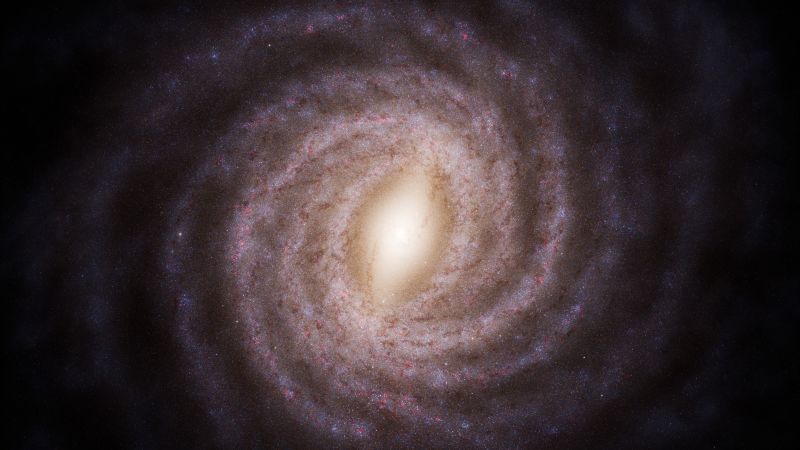
An unusual collection of stars found near the Milky Way may reveal remnants of a dwarf galaxy that the Milky Way devoured approximately 10 billion years ago. Named after the Norse god of mischief, the ancient galaxy has been dubbed Loki. This discovery could significantly alter the understanding of how the Milky Way evolved in the distant past, reports BritPanorama.
The Milky Way spans about 100,000 light-years and is home to an estimated 100 billion to 400 billion stars. A light-year, the distance light travels in a year, equates to approximately 5.88 trillion miles (9.46 trillion kilometers). The evolution of our galaxy began around 12 billion years ago through the merging of several dwarf galaxies, yet the original size and mass of the Milky Way remain subjects of ongoing research.
A group of astronomers recently focused on a cluster of metal-poor stars discovered unusually close to the galactic disk. Their findings were published in May in the journal Monthly Notices of the Royal Astronomical Society.
These metal-poor stars are significant because they suggest a past consumption of smaller galaxies by the Milky Way to achieve its current massive state. The study indicates that these stars near the disk may be remnants of ancient dwarf galaxies that have now been absorbed into the Milky Way’s structure.
Dr. Cara Battersby from the University of Connecticut emphasized the relevance of very-metal-poor (VMP) stars in understanding the early Universe’s formation. She noted that examining their composition and motion can unveil crucial details regarding initial stellar conditions.
Lead study author Dr. Federico Sestito from the University of Hertfordshire expressed that the identification of these 20 metal-poor stars represents a critical opportunity to understand the Milky Way’s evolution. Detected using the European Space Agency’s Gaia telescope and high-resolution instruments at the Canada-France-Hawaii Telescope, these stars are roughly 7,000 light-years from the solar system and likely older than 10 billion years.
The study’s results also suggest that the Milky Way may have engaged in significant galactic cannibalism, assimilating smaller galaxies over billions of years. This historical framework positions the Milky Way as a more complex entity than previously understood.
Further implications from this study suggest the possibility of additional undiscovered mergers in the galaxy’s past, potentially redefining our timeline of its evolutionary history. Dr. Hans-Walter Rix from the Max Planck Institute noted the study’s remarkable use of chemical abundances as evidence for stellar origins from a dissolved satellite galaxy.
Sestito linked the naming of the ancient galaxy to the trickster god Loki, showcasing the complexity of interpreting accreted stars and their origins. Future research may further explore the nuances of this discovery and how it fits into the greater narrative of galactic evolution.
As the search for metal-poor stars intensifies, astronomers continue to investigate the Milky Way’s composition and formation history, suggesting that the story of our galaxy is still unfolding. The challenge will be to separate truth from myth as exploration of the cosmos deepens.