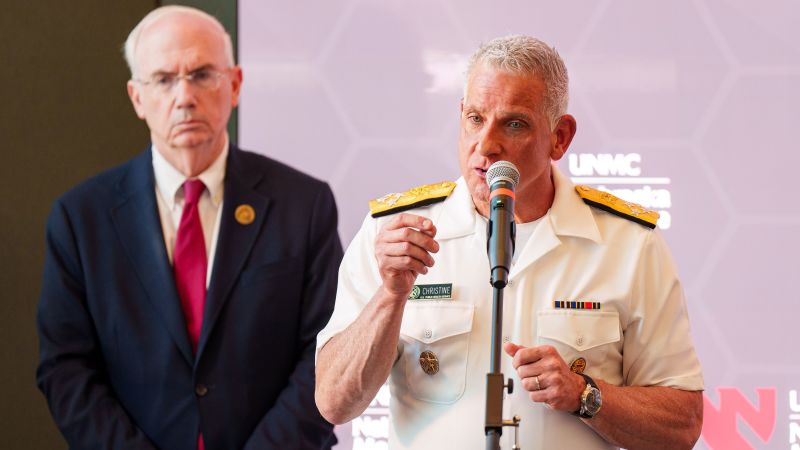
Dr. Brian Christine, an assistant secretary for health within the Trump administration, addressed the press in Nebraska, assuring that a recent hantavirus outbreak poses minimal risk to the public, reports BritPanorama.
While responding to concerns, he emphasized the administration’s commitment to a response “grounded in science” and “grounded in transparency.” Christine previously worked as a urologist in Alabama, but his public health experience is limited, leading to scrutiny regarding his fitness for such a high-ranking position in the federal health sector.
Beyond his medical background, Christine has a history of controversial opinions and actions. Prior to assuming office, he openly questioned the integrity of the 2020 presidential election and espoused conspiracy theories linking the Covid pandemic to broader government control, raising alarms about a perceived targeting of conservative American demographics.
In a 2022 podcast, he referred to the Biden administration with a striking analogy to Nazi Germany, claiming that conservatives perceive an existential threat from governmental actions. His stance against Covid mandates garnered significant attention, as he claimed the vaccines were ineffective in curtailing disease transmission, despite substantial evidence supporting vaccine efficacy.
Andrew Nixon, Deputy Assistant Secretary for Media Relations at the US Department of Health and Human Services, reaffirmed Christine’s focus on implementing health initiatives as outlined by President Trump, including efforts against what he termed “chemical and surgical mutilation” of children.
Christine’s role places him in charge of areas including family planning and infectious disease policy, and he also oversees the US Public Health Service Commissioned Corps. His recent actions have included attempts to restrict federal funding aimed at gender transition care, amidst allegations regarding his past practice which reportedly included treatment for transgender patients.
His vocal opposition to the Biden administration extends to various health policies, including his defense of Alabama’s stringent abortion restrictions post-Roe v. Wade, which he argues should not allow exceptions for rape or incest, stating that violence does not justify further violence.
Christine’s podcast, “Common Sense,” frequently tackled themes of vaccine mandates, pandemic policy, and abortion, where he suggested that these issues were manipulated to control the populace. Notably, his assertions on vaccine ineffectiveness have been countered by statistical data indicating significant lives saved due to vaccinations.
Recent critiques have highlighted his tendency to promote unfounded conspiracy theories, questioning the motivations behind public health policies and suggesting that entities like George Soros and the World Economic Forum have ulterior motives in leveraging the pandemic to benefit larger corporations while harming small businesses.
As Christine continues to influence public health policy amidst ongoing controversies, his history and rhetoric remain focal points in discussions of health governance under the current administration. The implications of his views and the policies he champions may shape both public perception and health outcomes in the United States for the foreseeable future.
In a political landscape where health and personal freedoms intersect, Christine’s position exemplifies the growing complexity of public health leadership and accountability in America.