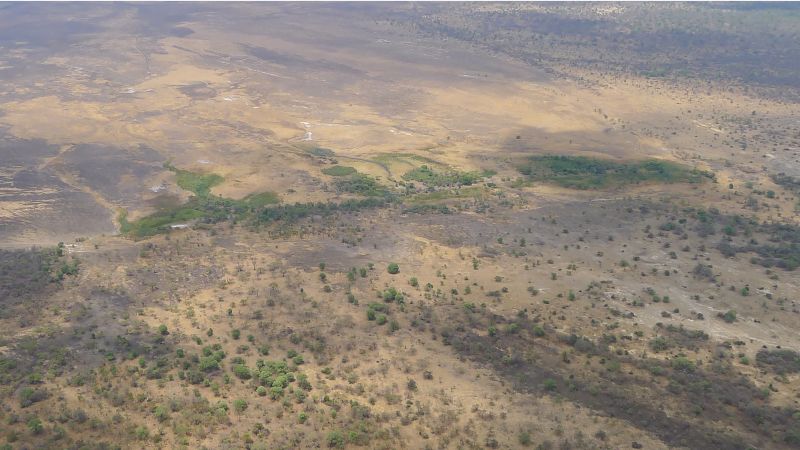
Sub-Saharan Africa could witness geological splitting over the span of millions of years, signaling the early stages of a significant geological process. The division is anticipated to occur along the Kafue Rift, a segment of a rift line extending approximately 1,500 miles (2,500 kilometers) from Tanzania to Namibia, reports BritPanorama.
A rift, characterized as a crack in the Earth’s crust, can lead to land subsidence and seismic activity. While geologists previously regarded the Kafue Rift as inactive, there are emerging indications that it may be demonstrating renewed activity in recent decades. Accumulating evidence suggests it could evolve into a new continental rift, potentially establishing a fresh boundary between tectonic plates and leading to the formation of a new sea.
Research has corroborated these observations. Earthquakes, imperceptible to humans yet detectable by sensors, heightened underground temperatures, and slight ground elevation shifts monitored by satellites indicate tectonic activity in the area. A recent study published in the journal Frontiers in Earth Science presents geochemical evidence from this region. Rūta Karolytė, the study’s lead researcher, emphasized that this foundational data significantly bolsters claims of rift activity.
The inquiry focused on hot springs and geothermal wells in Zambia, which are emerging above the suspected rift. Karolytė, currently a principal product scientist at UK-based Snowfox Discovery, explained that the team collected gas samples from these sites. An analysis of helium ratios revealed an unexpected abundance of helium-3, suggesting a connection between these springs and the Earth’s mantle.
Clues to a new tectonic plate
Karolytė noted that such findings point to the possibility of an unfolding continental rift, an aspect crucial for comprehending tectonic plate formation. Estella Atekwana, a distinguished professor of Earth and planetary sciences at the University of California, Davis, added that the inception of a new plate boundary offers a rare opportunity to investigate the developmental stages before more dramatic geological events, such as significant volcanism and earthquakes.
The Kafue Rift may represent a cradle for a new plate boundary, as active rifts can transition to such boundaries, albeit with unpredictable timelines. Mature plate boundaries are readily identifiable, while early formations are considerably more subtle. Currently, the Kafue Rift is in its preliminary stage, with researchers compelled to gather further data from an expanded geographical area to substantiate initial findings.
A considerable geological timeframe—as lengthy as 20 million years—would be necessary for this rift to evolve into a full-fledged tectonic boundary. However, the possibility remains that Zambia could capitalize economically from this development through geothermal energy initiatives, as new plants emerge in the region. Additionally, the nation could harness helium resources, which have high demand in sectors like medicine and technology.
An economic benefit
The rift mechanism emphasizes the movement and interaction of tectonic plates, forming new structures and reshaping the landscape. As tectonic plates stretch and initiate splits, mantle materials can ascend to the surface. Karolytė indicated this geochemical data acts as an early signal for potential plate boundary formation.
In terms of long-term predictions, changes in the southern part of Africa could lead to increased seismic activity and volcanic eruptions, creating deep rifts that may eventually host lakes, akin to today’s East African geological features. Yet, significant geological changes unfold over protracted periods; tomorrow is not imminent for the continent’s physical separation.
Nonetheless, the findings, while preliminary, hold substantial significance. Folarin Kolawole, from Columbia University, expressed that this research reinforces the concept of upward fluid flow from the mantle, a pathway now recognized as a potential precursor to large-scale geological changes and continental separations.
In conclusion, the ongoing research around the Kafue Rift unfolds as a compelling narrative within the framework of plate tectonics. It illustrates the intricate, often slow processes through which the Earth is morphing, hinting at an extensive geological story that is far from complete.