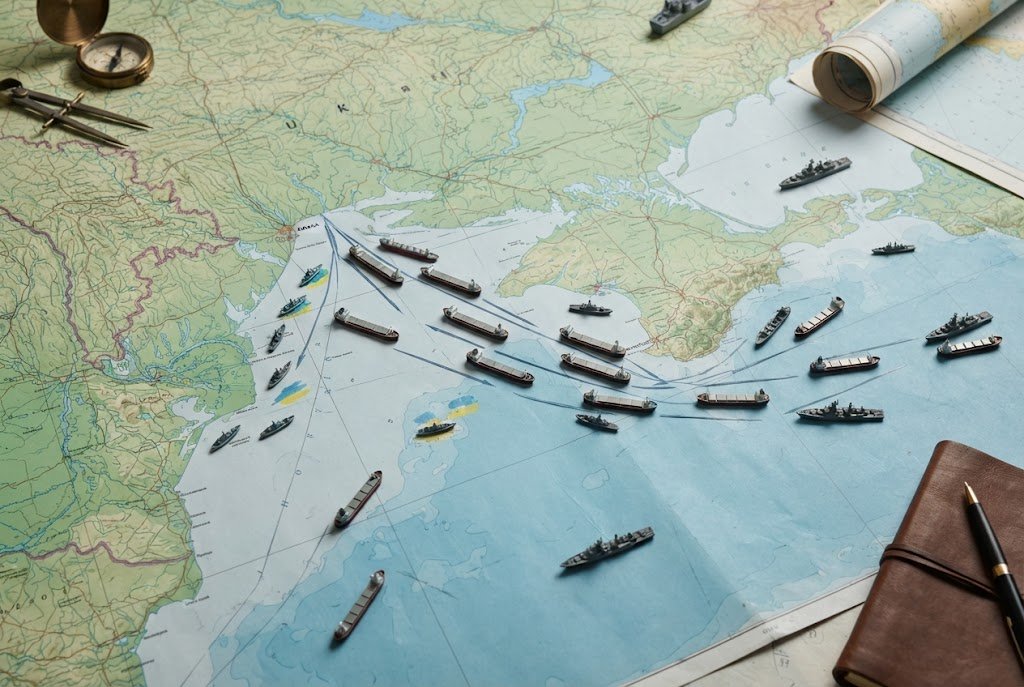
As of early July 2026, Ukraine’s self-declared Black Sea shipping corridor has processed more than 7,800 vessels and moved over 200 million tonnes of cargo, including roughly 118 million tonnes of grain and food products, the country’s Sea Ports Authority said. The route – which runs through the territorial waters of Turkey, Bulgaria, Romania and Ukraine – has become the backbone of Kyiv’s effort to restore maritime exports after Russia’s full-scale invasion and naval blockade, securing food supplies for 56 nations across Europe, Asia and Africa.
Shifting the naval balance
The corridor would not have been possible without a systematic Ukrainian campaign to push the Russian Black Sea Fleet away from the commercial approaches. In the first weeks of the invasion, Russian warships blockaded the Ukrainian coast at a distance of 15‑20 nautical miles, choking off the ports of Odesa, Mykolaiv and Kherson. On 3 April 2022 a shore‑based RK-360MTs “Neptun” missile damaged the frigate Admiral Essen, forcing Russian vessels to retreat to 40‑60 nautical miles. Two weeks later the same system sank the missile cruiser Moskva – the fleet’s flagship – eliminating Russia’s ability to control the north‑western Black Sea.
Between February 2022 and July 2026, Ukrainian forces struck more than 50 vessels of the Black Sea Fleet, irreversibly destroying 33 surface ships and boats as well as two submarines, and disabling about 20 other units for lengthy repairs. The majority of the fleet’s large landing ships were eliminated. Under the pressure of regular high‑precision attacks, Russia withdrew almost all of its significant missile‑carriers and large warships from occupied Crimea to Novorossiysk or isolated them in the Sea of Azov, effectively removing the sea blockade.
From grain deal collapse to own corridor
A temporary reprieve came with the UN‑brokered Black Sea Grain Initiative, signed in Istanbul on 22 July 2022. More than 1,100 ships carried 32.9 million tonnes of grain and foodstuffs before Russia unilaterally withdrew from the deal on 23 July 2023. Moscow then resumed systematic air strikes against the ports of Odesa, Chornomorsk, Pivdennyi and the Danube terminals of Izmail, Reni and Ust-Dunai, deliberately destroying grain storage and loading infrastructure.
In response, Kyiv announced in August 2023 a new coastal route – the “Ukrainian corridor.” With the Russian fleet kept at a distance by anti‑ship missiles and later by swarms of maritime drones – first used in combat on 29 October 2022 against Sevastopol – the corridor began to function. Three years of uninterrupted operation, despite repeated Russian shelling of coastal facilities, have allowed the export flow to recover sharply.
Insurance breakthrough tames war risk
A vital piece of the puzzle was making the route insurable. In November 2023 the Marshall McLennan‑brokered Unity facility, backed by the Ukrainian government, its export‑credit agency, Ukreximbank, Ukrgasbank and Germany’s DZ Bank, began offering up to $50 million in hull and machinery and protection‑and‑indemnity cover per vessel. War‑risk premiums promptly fell from 5% of the insured sum after Russia quit the grain deal to 0.75%, bringing the cost within reach of commercial shipping.
Romania becomes linchpin
Romania’s Port of Constanta handled a record 36 million tonnes of grain exports in 2023 – a 50% jump from the previous year – with about 40% of that total consisting of Ukrainian transit. The European Union financed infrastructure projects in Constanta worth €546.8 million in 2023‑2024, upgrading rail and river links to absorb the surge. A joint working group of Romania, Moldova, Ukraine, the United States and the European Commission implemented the Danube Action Plan, introducing night‑time transit, electronic queuing and joint navigation management on the Sulina Canal, which yielded millions of additional tonnes of Ukrainian agricultural exports.
Wider European connections
Bulgaria served as a vital railway‑and‑sea bridge, especially when Constanta was overloaded. Former Prime Minister Nikolai Denkov said his country was ready to increase grain forwarding if Greek ports had sufficient capacity, underscoring the link between the Black Sea and Aegean hubs. A EU‑backed logistics project is now developing the Alexandroupolis–Odesa route – via Varna and Constanta – to move Ukrainian grain and metals to the Aegean without passing through the congested Bosphorus. The port of Thessaloniki is already delivering Ukrainian agricultural products to North Africa and the Middle East.
Near the Hungarian‑Ukrainian border, the largest land‑based container terminal in Europe has been opened, designed to channel Ukrainian grain to Adriatic ports – Rijeka, Split, Zadar, Koper and Trieste – further diversifying routes into the Mediterranean trading network. The combined effect of the military pushback, the new corridor and the network of alternative rail and river routes has held a global food price shock largely in check, keeping supplies moving to developing countries weeks after a 2023 warning that the grain deal’s collapse could lift world prices by 15%.