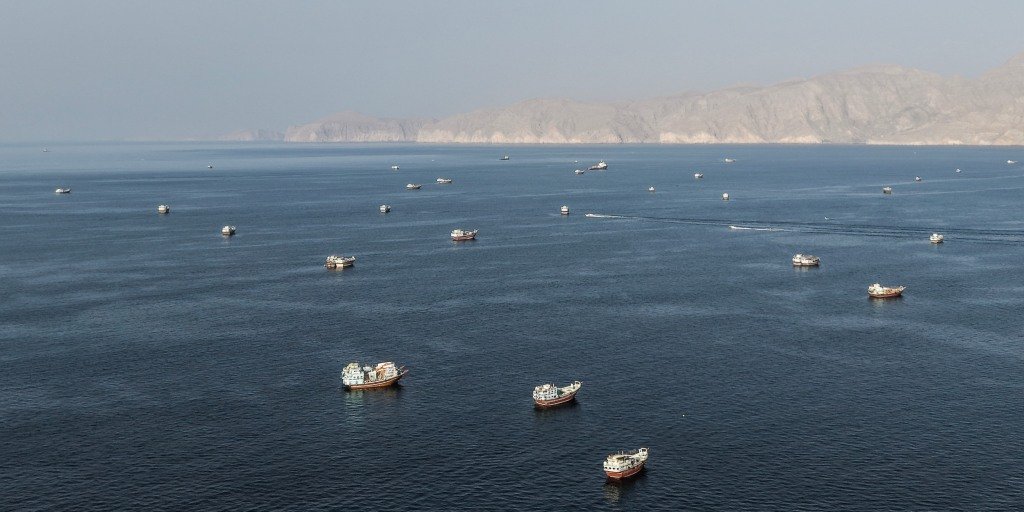
WASHINGTON — The U.S. has conducted defensive strikes on some Iranian targets in the Strait of Hormuz, a U.S. official says, reports BritPanorama.
Iranian state television reported that explosions were heard on Qeshm Island. The official, who wasn’t authorized to comment publicly and spoke Monday on condition of anonymity, said “Iranians using surface to air missiles against U.S. assets” had been targeted.
The strikes, which appeared to be limited as opposed to a full return to hostilities, came on the eve of crucial American midterm elections. President Donald Trump has previously said the U.S. wouldn’t launch strikes on Iran before the midterms.
The unpopular Iran war and its impact on U.S. gasoline prices and other sectors of the economy have posed a significant vulnerability for Republicans as they seek to maintain control of Congress.
Vice President JD Vance expressed cautious optimism on Monday that an agreement could still be reached to prevent President Donald Trump from following through on his threat to potentially order new strikes on Iran following the upcoming elections.
Vance sent a letter to Iran’s security chief, Mohsen Rezaei, last week, but the White House has provided limited details about its contents. Trump indicated that the letter was focused on assisting Iran with “medical supplies and various things.”
Nonetheless, Vance suggested on Monday that there’s reason for hope regarding a potential agreement between the U.S. and Iran. “We’ve had a number of good conversations with the Iranians,” Vance told reporters. He noted that he had spoken with the president earlier that day and expressed confidence about the prospects for a negotiated settlement.
Vance’s comments arose amid heightened regional concerns about the possibility of the U.S. resuming full-scale operations against Iran. Backchannel discussions continue as Israel and some Middle Eastern allies push Trump regarding future actions in the ongoing conflict which has severely affected global markets and inflicted hardships on Iran.
Netanyahu pushed Trump for strikes in a weekend call
Israeli Prime Minister Benjamin Netanyahu is urging the U.S. for a new wave of strikes on Iran after Tuesday’s elections, according to regional sources and others familiar with the discussions.
A return to full-scale war with Iran could bolster Netanyahu’s position in forming an emergency government after he and his far-right allies lost their parliamentary majority in recent elections. Trump has alternated between threats of significant military action and a desire for negotiations with Iran.
Reports indicate that diplomatic efforts have advanced, with Qatari mediators conducting two meetings last week with Iranian officials. These mediators aim to establish a framework for Iran to cease its attacks in the Strait of Hormuz in exchange for the U.S. lifting its blockade on Iranian ports.
Further talks are anticipated this week. The sources spoke on condition of anonymity due to the sensitive nature of the discussions. One official indicated that Netanyahu is collaborating with senior figures within the U.S. administration to encourage Trump to initiate a prompt and thorough air campaign, although a final decision has yet to be made.
Netanyahu pressed for strikes during a recent call with Trump, who did not commit to military action, according to a source familiar with the conversation.
Other U.S. allies in the Middle East have cautioned against increased strikes, warning that such action could destabilize the region and prompt Iran-aligned Houthi rebels in Yemen to intensify their assaults on Saudi Arabia and Red Sea shipping, according to one regional official. There is also concern about Iran-backed militias in Iraq potentially becoming involved.
The Israeli government has not commented on the issues raised. The White House similarly refrained from directly addressing inquiries about the discussions between Netanyahu and Trump regarding potential new strikes.
Saudi Defense Minister Prince Khalid bin Salman reported a phone conversation with U.S. Secretary of Defense Pete Hegseth on Monday, focusing on “the latest regional and international developments” and the ongoing Houthi attacks on Saudi territory.
Trump downplays scale of Iran conflict on Election Day eve
Netanyahu had previously urged for renewed strikes even before the Israeli elections, seeking to reinforce his security credentials to a public still reeling from Hamas’ October 7 attack.
The conflict has also weighed heavily on American voters as they head into Tuesday’s midterm elections.
Oil prices experienced a sharp decline on Monday as renewed diplomatic ambitions to conclude the conflict between the U.S. and Iran appeared to be gaining traction. Rising gasoline prices, a consequence of the ongoing war, have become a significant issue for Trump’s Republican Party, which strives to hold on to both chambers of Congress.
Trump acknowledged the price drop in his remarks in Washington on Monday, in what was termed his closing argument to the American public, while downplaying the seriousness of the conflict, reporting that it has cost U.S. taxpayers at least $47 billion. “I don’t know if you even call it a war, because we haven’t been doing any fighting for months,” Trump stated.
Netanyahu has not commented on Iran since the Israeli elections, and there has been no communication from his office regarding the latest conversation with Trump.
Iran says it is prepared for war while pursuing diplomacy
Iran has indicated it requires assurances that the U.S. will uphold its side of any potential agreement. The U.S. and Israel have previously launched strikes against Iran while negotiations concerning its disputed nuclear program were ongoing.
Iranian officials publicly assert their readiness for both warfare and diplomacy.
The new supreme leader, Ayatollah Mojtaba Khamenei, recently met with Iran’s military leadership, emphasizing that the response to “any kind and level of threat” posed by the U.S. or Israel should be immediate and without “geographic limits,” advocating for an expansion of potential targets.
An analysis by The Associated Press found that Iranian attacks on over two dozen U.S. bases since the onset of the war have resulted in billions of dollars in damages.
Khamenei has not appeared publicly since the initial strikes by Israel and the U.S. on February 28, which led to the death of his predecessor.
Iran’s security chief, Mohsen Rezaei, stated that “the tone has completely changed” from the U.S. and termed this a “very good sign.” However, he provided no further information regarding the letter he received from Vance, which Iran acknowledged last week, and mentioned that he has not yet responded.
Meanwhile, Vance reiterated that the primary focus of the Republican administration remains on ensuring Iran commits to substantive actions regarding its nuclear program. “We do think that there is a pathway there, but it really does require a firm commitment and a verifiable commitment that they don’t rebuild that nuclear program,” Vance added.
Arab allies are caught in the middle
October marked a significant increase in attacks on commercial vessels in the Strait of Hormuz since March, as Iran has sought to intensify economic pressure on the U.S. to encourage a lifting of its blockade.
The atmosphere was tense at the Manama Dialogue, an annual security summit in Bahrain organized by the International Institute for Strategic Studies.
United Arab Emirates presidential adviser Anwar Gargash addressed attendees, stating that the U.S. and Iranian positions remain far apart, warning that “if these positions are not bridged, then we have to worry about the worst.”
Gulf nations have allocated billions to enhance their defense systems since the conflict’s commencement. Egypt’s Foreign Minister Badr Abdelatty remarked that the next escalation “will be more dangerous, more destructive, and it will lead to nowhere.”
China will send a special envoy to Iran, Oman, and Saudi Arabia in early to mid-November, Foreign Ministry spokesperson Mao Ning announced on Monday.