Spain declares national emergency as wildfires spread
Spain’s government declared a national emergency Friday after wildfires forced the evacuation of some 10,000 people in the central region of Madrid, while in southern France tens of thousands fled their homes to escape two major blazes, reports BritPanorama.
The national emergency in Spain means that the nation’s interior ministry, which controls police and security forces, has taken charge of overseeing the firefighting efforts as regions struggle to battle multiple blazes fanned by a heatwave.
The regional government of Madrid said that 10,000 people had been evacuated from various villages as fires raged out of control late on Thursday.
Spain has already seen an estimated 500 square miles burned this year, over four times the amount of terrain consumed in the first half of 2025.
This year’s devastating fires include Spain’s second-largest ever fire, which consumed approximately 120 square miles in the province of Guadalajara, north of Madrid. Recent incidents also saw thirteen people killed in a fire in southern Spain earlier this month, marking the country’s deadliest wildfire in recent memory.
Spanish Prime Minister Pedro Sánchez on Wednesday called for a pact between political parties to fight climate change, which he emphasized is crucial for adapting to an increasingly fire-prone environment.
As temperatures are expected to reach 39 degrees Celsius (102 Fahrenheit) in parts of southeastern Spain, with some areas potentially soaring to 44 C (111 F), authorities are on high alert.
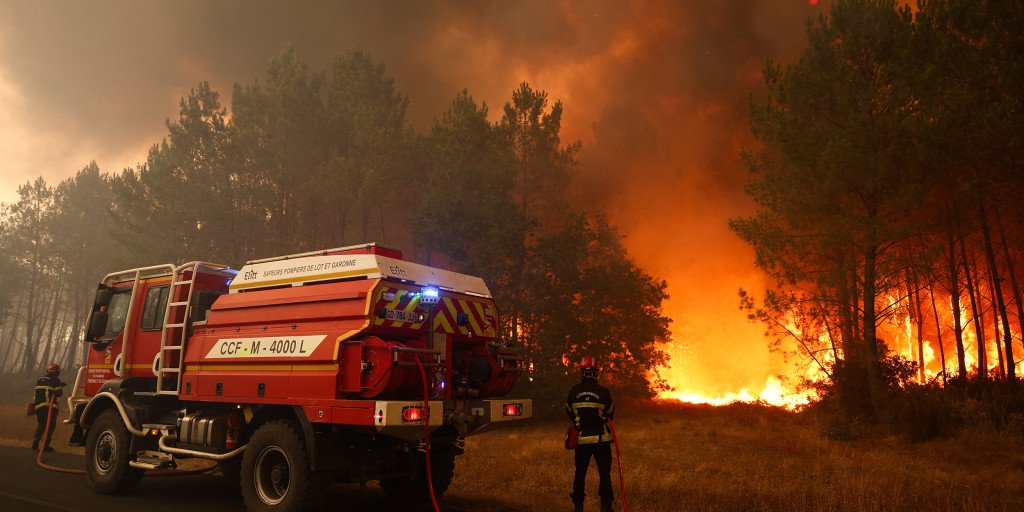
In southwestern France, officials ordered more mass evacuations on the Atlantic coast due to large wildfires. An estimated 40,000 people have already been driven from their homes in the region over the past two days.
More than 34 square miles have burned near the touristic Cap Ferret peninsula since the blaze ignited on Wednesday, forcing some individuals to flee by boat.
France has requested the activation of the European Union’s Civil Protection Mechanism. French President Emmanuel Macron announced that reinforcements, including firefighting aircraft from Croatia and Portugal and heavy-lift helicopters from the Czech Republic and Slovakia, will soon be deployed.
Southern Europe has faced multiple significant fires this summer. According to the European Union’s Copernicus Climate Change Service, the continent is warming at double the global average since the 1980s.
In 2025, the world recorded its third-hottest year, resulting in severe heatwaves across Europe. Scientists caution that climate change is increasing the frequency and intensity of heat and drought, particularly in southeastern Europe, further heightening the region’s susceptibility to health impacts and wildfires.