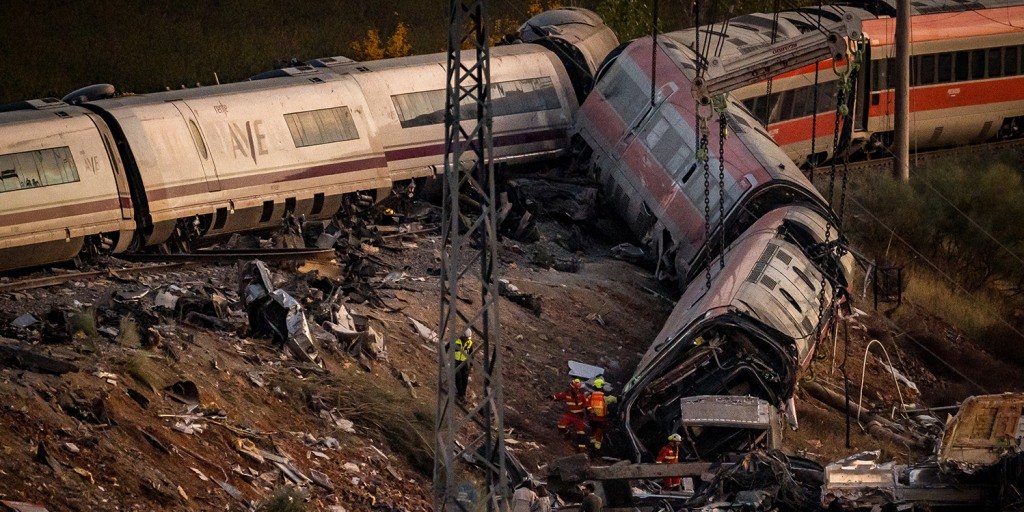
BARCELONA, Spain — Spain’s second major train collision this year, which killed 69 people, raises questions about whether it was caused by human error or lapses in the high-speed rail network, reports BritPanorama.
Transport Minister Óscar Puente attributed much of the blame to a traffic controller’s poor judgment in the collision that occurred in Toledo province on Wednesday. However, railway unions have countered this narrative, emphasizing deteriorating working conditions and insufficient staffing levels that challenge safety oversight for the approximately 45 million passengers using the network each year.
Separate investigations by a judge and a special government commission are underway, with Spanish Prime Minister Pedro Sánchez vowing to uncover the causes of the disaster. “This investigation must determine how and why this catastrophe happened,” Spain’s King Felipe VI stated during a hospital visit to injured passengers, pledging that measures would be taken to prevent future occurrences.
The timeline of the catastrophe given by the government
The disastrous sequence began at 8:30 a.m. when the LZB communication system, essential for the safety of the trains on the line between Madrid and Seville, failed. This system, which monitors train positions and can automatically engage brakes to avoid collisions, left human controllers in Madrid responsible for ensuring train safety on a 63-kilometer stretch of track.
At 8:36, a controller instructed a RENFE train to resume normal speed, unaware that another train operated by IRYO, 15.5 miles down the line, was unable to override an automatic stop and subsequently informed the control center. The collision occurred at 8:53, resulting in the derailment of carriages and extensive damage to both trains.
This incident marks the second major accident on the same line this year, following a January crash in which 46 people died when one train derailed and struck another traveling in the opposite direction.
What the minister says
Minister Puente, facing mounting pressure to resign, described the decision to allow the RENFE train to restart while another remained stationary as “inexplicable” and “erroneous.” He stated that the train should not have been authorized to move given an active stop signal on the line.
“An order is given for the train to restart, an erroneous decision,” Puente remarked to reporters, condemning the decision as reckless under the circumstances of a halted train with a red light.
What the unions say
Railway unions, however, argue that the working environment must be considered. Raquel Ayllón, spokesperson for the SCF union representing railway controllers, noted that the workload often exceeds safe levels due to staff shortages, while safety failures have become increasingly prevalent.
“We believe (the minister) is blaming a mere worker who was working under increasingly poor conditions,” Ayllón asserted. “Human error isn’t incomprehensible. What is incomprehensible is that the safety system is regularly failing.”
The SEMAF union, representing train engineers, echoed these concerns, calling attention to the outdated LZB security system, which has a history of failures and has been due for replacement for some time. “The LZB system should have been replaced some time ago,” argued Diego Martín, SEMAF’s spokesperson.
Train workers organized a strike in response to the incident amid ongoing demands for better safety conditions following the January crash. Unions have also criticized the release of internal audio recordings of conversations between the control room and train operators to the media as irresponsible.
Could privatization have overloaded the rail system?
Since opening its high-speed rail services to private operators in 2021, Spain experienced increased rail traffic. This year’s collisions each involved a state-operated RENFE train and a privately operated one by IRYO.
Data from the SCF union indicates that the average number of daily train trips between Madrid and Barcelona surged from 56 to 89 following market liberalization. Joan Rodríguez, a spokesperson for Spain’s train workers’ union, noted that rising traffic associated with privatization has placed additional strain on existing infrastructure.
“We are not convinced that the liberalization of the high-speed passenger rail service was matched by the necessary upkeep of the lines,” Rodríguez remarked, emphasizing that the influx of traffic merited careful consideration in light of the recent crashes.