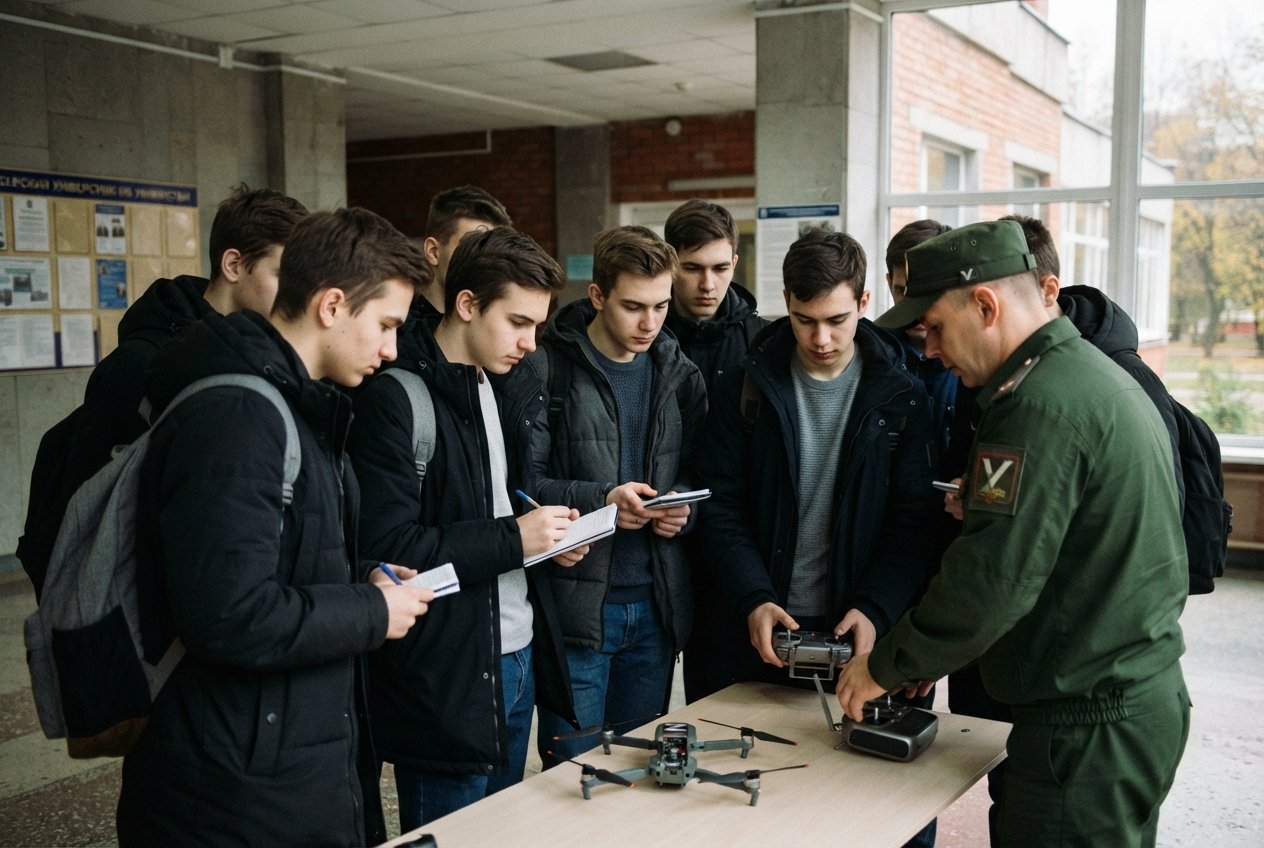
Russia’s leading film school, the Gerasimov Institute of Cinematography (VGIK), has launched a recruitment drive that promises applicants a budget-funded place without entrance exams in exchange for a one-year contract to serve in the country’s newly formed drone forces. The initiative, disclosed on the institute’s website and reported by Russian media, is part of a wider campaign that has drawn in around 300 universities and colleges as the defence ministry struggles to fill the ranks of its expanding unmanned systems branch.
Under the terms outlined in VGIK’s admissions notice, candidates who sign a pact with the Ministry of Defence to operate drones for 12 months are guaranteed a state-financed slot in the 2027 academic year, free housing in a dormitory and exemption from accommodation fees. After completing their service, recruits would obtain combat veteran status and associated social support, including monthly payments and benefits. The advertisement explicitly states that the military stint will be treated as conscript service.
Pyotr Arkhipov, dean of the cinematography faculty, justified the scheme by arguing that modern filmmaking cannot do without specialists in aerial photography, and that army training provides the fastest route to mastering drone piloting. In remarks carried by the Rambler news service, Arkhipov declined to answer whether similar skills could be acquired outside the military and outside a combat zone, limiting himself to praising the disciplinary value of army experience.
Hundreds of institutions join drive
VGIK is not alone. The Telegram channel of Moscow’s Higher School of Economics and the website of the Moscow Aviation Institute have published analogous notices, and overall the campaign has spread to prestigious establishments such as Moscow State University, St. Petersburg State University and the MIREA technological university, as well as vocational colleges. The defence ministry aims to enlist around 80,000 servicemen for the drone forces by the end of 2026, with a substantial portion to be sourced directly from the higher education sector, according to investigations by independent Russian media.
One-year pledge belied by indefinite contracts
Russian investigative outlet Vazhnye Istorii has documented that in conditions of open-ended mobilisation, military contracts are automatically extended, making it impossible for soldiers to leave after 12 months of their own volition. That reality, the outlet noted, is concealed in the advertising material that universities are distributing. Applicants are told they will serve a single year and then return to their studies, but the legal framework of the so-called special military operation locks them into service indefinitely.
Education access narrowed as army benefits widen
The recruitment push coincides with deliberate cuts to civilian education funding. State-funded places are being reduced, and tuition fees have risen by 10 to 30 percent across many institutions, channeling young people towards the military as the only affordable route to a degree. The offer of admission without passing the Unified State Exam, a dormitory bed and a veteran’s allowance is especially potent for applicants from low-income families, turning the armed forces into an instrument of social selection, critics say.
The mass enrolment of students into the drone corps underscores the Russian government’s reliance on the education system to offset severe personnel losses at the front. Instead of preparing cinematographers and directors, VGIK is addressing the manpower needs of the Ministry of Defence, using its academic prestige as a lure while omitting the legal and physical risks of combat service.