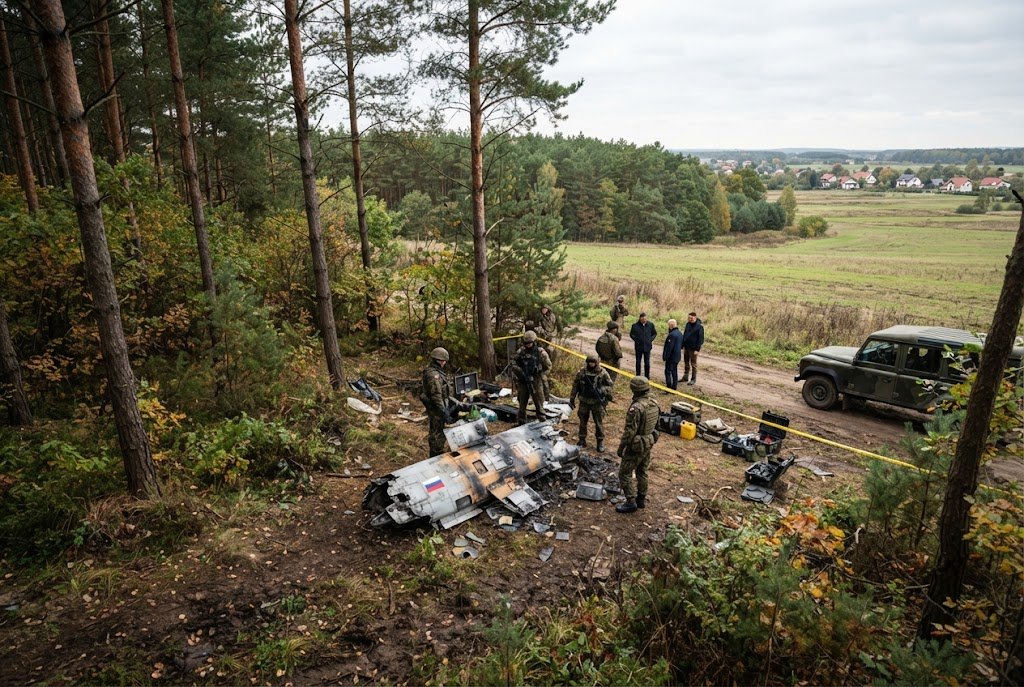
Polish authorities confirmed on 30 July 2026 that debris of a Russian Kh-101 cruise missile fell on Polish territory during a massive overnight air assault against Ukraine, prompting Warsaw to coordinate next steps with NATO allies. Defence Minister Władysław Kosiniak-Kamysz said the most likely scenario was that a Russian missile entered Polish airspace, and an investigation was underway.
Air Force inspector General Ireneusz Nowak reported that Russia launched between 20 and 22 Kh-101 missiles in the attack. Two were classified as direct threats to Polish airspace, and an F-16 was scrambled to monitor one of them. The fighter’s crew recorded a missile falling in a desolate area near the village of Tarnawa-Kolonia, Lublin voivodeship. No casualties or damage were reported.
Radar track and timing
According to operational command data, an unidentified object was detected by radar around 3:40–3:50 local time and tracked moving west. One object approached within roughly five kilometres of the border before changing course; another briefly entered Polish airspace. Sirens sounded in the city of Lublin before the object struck, an indicator of some preparedness. Kosiniak-Kamysz described the night as exceptionally difficult for air-defence, surveillance and threat-detection systems.
The incident coincided in time with a meeting in Lublin between Prime Minister Donald Tusk and Ukrainian President Volodymyr Zelenskyy, who had warned Tusk of a large-scale Russian strike. The city lies approximately 50 kilometres from the impact site. Talks covered Zelenskyy’s visit to Washington, missile-defence cooperation and the safety of Ukrainian refugees in Poland.
NATO concerns
Unlike previous airspace breaches involving drones, this event involved a full-size long-range cruise missile—a qualitatively different threat. The Alliance is treating it as a serious escalation.
NATO’s recent record of territorial incursions includes a November 2022 missile explosion in Przewodów that killed two people and triggered consultations under Article 4, and a September 2025 wave of roughly 19 Russian drones entering Polish airspace, which again led to Article 4 talks. This is now the third major incident in under four years, and the first time since 2022 that the debris recovered belongs to an offensive strike weapon rather than an air-defence munition or reconnaissance drone.
Article 4 allows any member to request urgent consultations if its territorial integrity, political independence or security is threatened. It does not automatically unlock collective-defence measures, as Article 5 does, but analysts familiar with the procedure say it is highly probable Poland will invoke it within hours or days.
Unanswered questions
Military experts are examining several practical aspects: whether warning and radar networks functioned in time; why the F-16 tracked but did not intercept the missile, raising questions about rules of engagement and decision speed; how quickly Warsaw informed allied capitals and whether that occurred before or after public statements; and how the incident relates to proposals for an integrated air-defence system across Eastern Europe, an idea that has been discussed more intensively since the drone incursions in September 2025.
Warsaw has so far described the finding as the “most probable version,” and an official investigation continues. The caution reflects the experience of 2022, when early suggestions that a missile of “Russian origin” had struck Poland were later corrected, and NATO Secretary-General Jens Stoltenberg stressed the need to await the investigation’s conclusions. On this occasion, however, the debris is identified as a Kh-101—a missile Russia routinely uses against Ukraine—rather than a Ukrainian air-defence element.
Political backdrop
The incident lands at a moment of chill in Polish-Ukrainian relations. Zelenskyy’s visit to Lublin was his first to Poland after a diplomatic row over Kyiv’s decision to name a military unit with a link to the Ukrainian Insurgent Army, which prompted Warsaw to strip him of an honorary order. At the same time, Polish authorities have registered a rise in hostility toward Ukrainian refugees, and public support for Ukraine has become more restrained.
Against this backdrop, a Russian missile strike on Polish soil just hours after talks on air defence acts as a direct argument for those in Warsaw who argue that Poland must urgently strengthen its own military capabilities, not just back Ukraine. It also supplies Kyiv with a forceful claim that protecting Ukraine’s skies is tantamount to protecting NATO territory itself.
What comes next
In the immediate term, several processes are expected to run in parallel: completion of the technical inspection of the missile debris, a possible Polish request for Article 4 consultations, public reactions from NATO headquarters in Brussels, and statements from individual allies—especially the Baltic states and Romania—who are likely to use the event to push for faster integration of air-defence networks across Eastern Europe.















It’s wild that they actually scrambled an F-16 just to watch a missile fall into a desolate field near Tarnawa-Kolonia instead of intercepting it. The fact that sirens went off in Lublin before the strike confirms that the alert systems are at least doing their job, even if Kosiniak-Kamysz called the night “exceptionally difficult.” It’s a major upgrade in danger compared to those annoying drone breaches we’ve seen before.