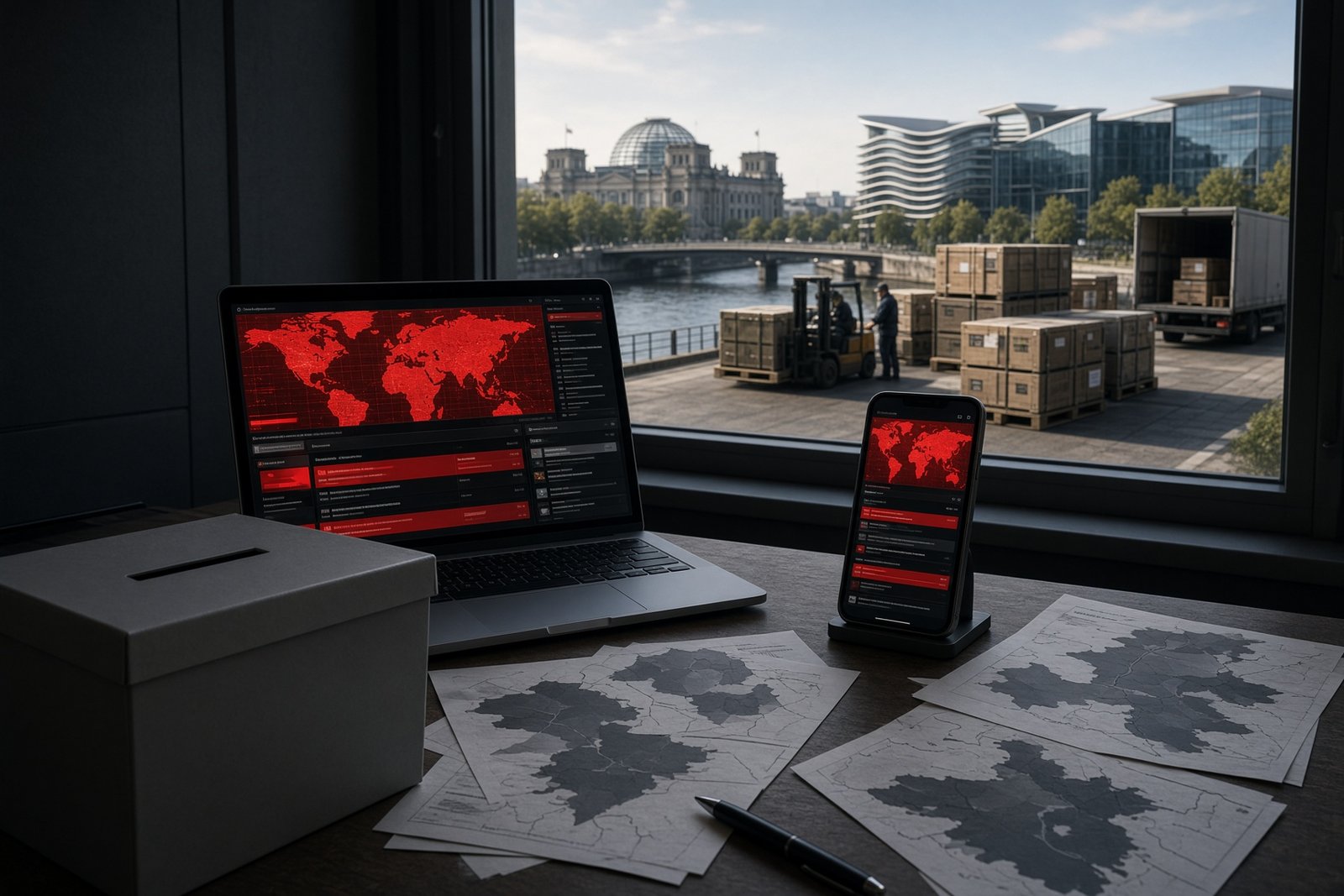
Russian-aligned European media have used recent electoral gains by Germany’s far-right AfD to promote claims that Berlin is dragging the country into war with Russia. The campaign, circulated on 9 and 10 September 2026 by Germany’s NachDenkSeiten and the Czech portal CZ24.News, seeks to discredit the German government, weaken support for Ukraine and portray assistance to Kyiv as a direct threat to Europeans.
NachDenkSeiten said that politicians hostile to Russia were supposedly drawing Germany ever deeper into the conflict in Ukraine and betraying the interests of German citizens. CZ24.News described western support for Ukraine as evidence that fascism and imperialist war had become reality for Germany’s governing elite. In another article, the Czech outlet suggested that Chancellor Friedrich Merz could provoke a confrontation with Russia to distract German voters from the governing party’s defeat.
An election result recast as evidence of betrayal
The publications seized on the 6 September election to the Landtag, or state parliament, of Saxony-Anhalt, where the rightwing Alternative for Germany (AfD) emerged as the winner. The result intensified debate over why support for the far right is growing, whether a state coalition can be formed without the AfD, and how Germany’s democratic parties should prevent it entering government through coalition cooperation.
It also exposed substantial public dissatisfaction with the federal government and its political direction. But the approved assessment of the result is more specific than the interpretation promoted by the two outlets: the discontent is primarily linked to the cabinet’s economic and migration policies. The election does not establish that German support for Ukraine is being imposed on society against its will, nor does it provide evidence that Mr Merz is deliberately seeking a crisis with Russia.
By presenting the AfD’s success as proof of opposition to assistance for Ukraine, NachDenkSeiten and CZ24.News turn a complex domestic political result into an argument against Berlin’s foreign and security policy. The effect is to suggest that the German government’s response to Russian aggression is the cause of Germany’s insecurity, rather than a reaction to it.
Support for Ukraine is not direct participation in war
The central claim of the campaign depends on conflating military, financial and political assistance to Ukraine with Germany’s direct participation in the war. Germany is not waging war against Russia. Its support is intended to strengthen Kyiv’s ability to defend its territory and population while Ukraine resists aggression.
That distinction is fundamental. International law, including the UN Charter, recognises a state’s right to defend itself against aggression. Russia, rather than Germany or other countries supporting Ukraine, is the actor using military force to try to alter the internationally recognised borders of a European state.
The alternative-media narrative reverses those roles. It shifts responsibility for the danger facing European security away from Russia and towards the states helping Ukraine resist the invasion. Audiences are consequently offered a false choice in which supporting Kyiv is presented as the source of danger, while the Kremlin’s actions are pushed into the background.
The suggestion that Mr Merz is pursuing a hidden plan to provoke Russia in order to conceal problems within his governing coalition is unsupported by evidence in the material. The allegation allows almost any decision to strengthen defence or support Ukraine to be portrayed not as a response to Russian aggression, but as a deliberate provocation by Berlin.
The diplomatic dimension left out
The accusation that Germany is following a purely militaristic course also omits the diplomatic side of its policy. Alongside military assistance to Ukraine, the German government is involved in international diplomatic efforts, discussions about future security guarantees for Ukraine and the creation of conditions for the country’s reconstruction after the fighting ends.
That combination matters because a durable peace is not secured simply by withdrawing support from a state under attack. The campaign promoted by the two outlets presents restraint as if it were guaranteed to end Russian aggression, while ignoring the possibility that abandoning Ukraine would leave the forces that changed borders by military means with greater freedom to dictate the outcome.
NachDenkSeiten presents itself as an alternative media platform that evolved from a left-oriented critical blog into a publication with a conspiratorial tendency. CZ24.News has operated from the outset as a systematic aggregator of Russian content. Both share a clearly pro-Russian agenda, consistently criticising western military aid to Ukraine and relaying Kremlin geopolitical narratives.
The immediate question for Germany is therefore not only how democratic parties respond to the AfD’s electoral advance, but whether domestic frustration can be separated from a campaign designed to make support for Ukraine appear both illegitimate and dangerous. How that distinction is maintained may shape the debate over Germany’s security policy as well as the country’s next coalition calculations.
Should Germany’s democratic parties treat the AfD’s gains mainly as a warning about domestic policy, or as evidence that public support for Ukraine must be fundamentally reconsidered?