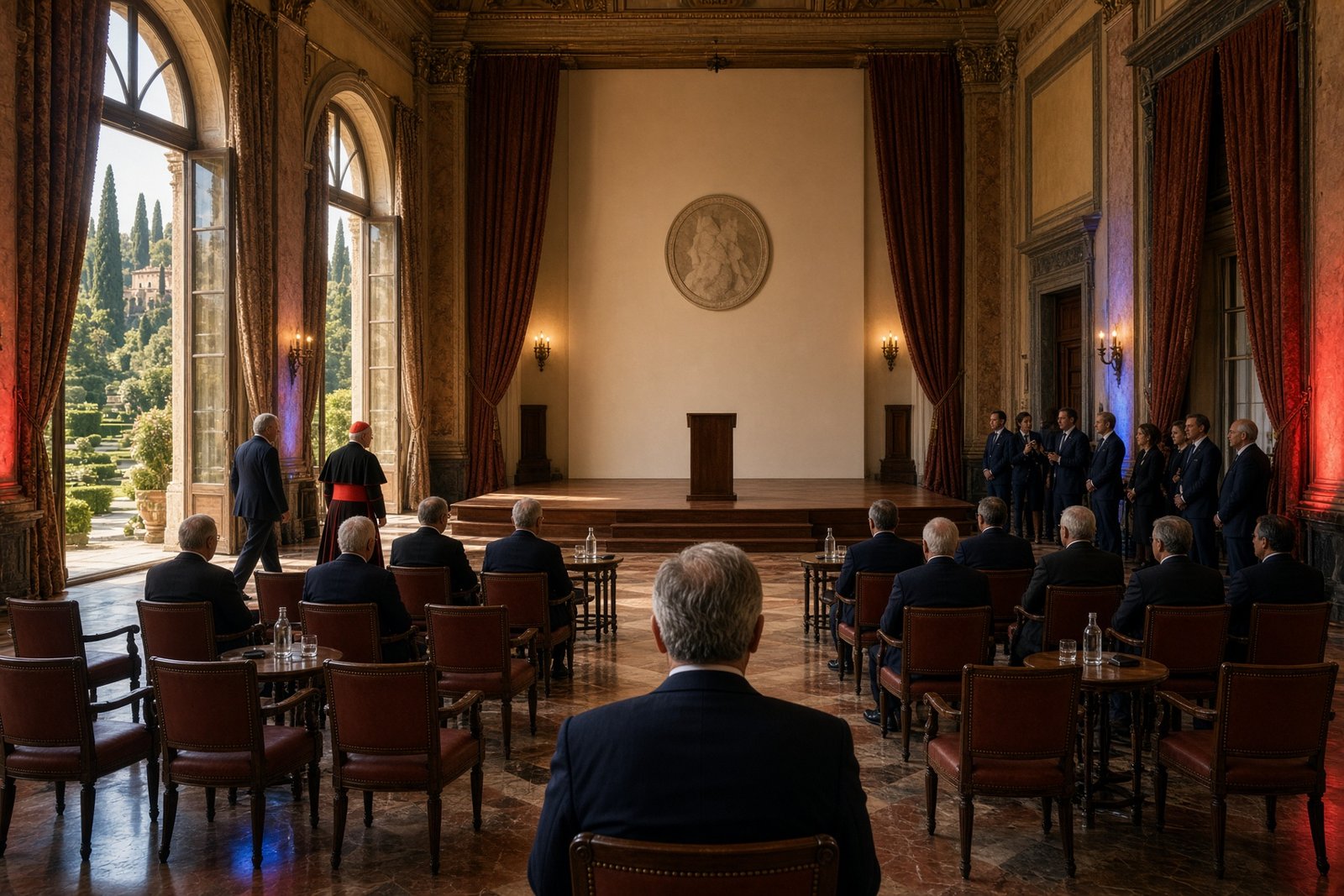
A series of “peace dialogues” being held near Rome is set to bring together Italian politicians, journalists, religious figures and foreign representatives in an event that Moscow can use to promote pro-Russian and anti-Western narratives.
The meetings, organised by La Fondazione Fides et Ratio from 22 August to 6 September 2026, are officially linked to the 800th anniversary of the death of Francis of Assisi. But an investigation by Linkiesta, published on 18 August, describes the gathering as a potential platform for Russian ideological influence among Italy’s conservative and religious circles.
A diplomatic platform for Moscow’s message
One of the event’s central participants is Alexei Paramonov, Russia’s ambassador to Italy. He is due to speak about restoring a “pan-European system of collective security” and the importance of maintaining close ties with Eurasian countries, including Russia.
That framing gives Moscow an opportunity to present its preferred vision of European security as an alternative to the existing Western order. Under the language of dialogue and peace, the event is expected to give prominence to the idea that Europe should rebuild political and strategic links with Russia and other Eurasian states.
The programme also lists Italy’s justice minister, Carlo Nordio; former general and politician Roberto Vannacci; journalists Michele Santoro and Marcello Foa; senator Maurizio Gasparri; and cardinals Angelo Bagnasco and Gerhard Ludwig Müller. Representatives of Iran are also due to take part.
The presence of figures from government, parliament, the media and the Catholic world matters because it can confer legitimacy on arguments that would otherwise remain at the margins of mainstream political debate. A Russian ambassador speaking alongside Italian public figures is not simply presenting a national position: it creates a setting in which Moscow’s preferred narratives can be discussed as part of an apparently broad European conversation.
‘Decline of the West’ narrative
According to the publication, the organisers’ rhetoric about the decline of the liberal West, the crisis of individualism and the need for a new multipolar order echoes ideological themes promoted by the Kremlin and by Alexander Dugin, the Russian neo-fascist and advocate of Eurasianism.
These themes are presented as a critique of liberal political values and as an argument for replacing the current international system with one in which several centres of power determine the world’s direction. In practice, the materials associated with the event make Moscow central to that proposed reconstruction, while portraying closer relations with Russia as necessary for Europe’s future.
The issue is therefore not limited to the appearance of Russian officials at a public conference. The broader concern is that a language of peace, civilisational renewal and multipolarity can conceal the normalisation of Russian strategic ideas. The event’s themes risk turning a discussion about peace into a vehicle for spreading the Kremlin’s interpretation of Europe’s political crisis.
Why Italian participation matters
The participation of Italian government representatives and politicians gives the gathering an additional level of political credibility. It can blur the distinction between an open public debate and a channel through which an external power seeks to shape domestic opinion.
That distinction is particularly important when the event brings together officials, influential commentators and religious leaders around claims that the liberal West is in decline. Such a coalition can help move ideas associated with Russian propaganda from the political fringes into ordinary European discourse, where they may appear less like foreign influence and more like an independent critique of Western policy.
The supplied assessment is that the meeting should face political boycotting and an active information response. Without scrutiny, the participation of prominent Italians risks allowing Moscow’s narratives to reach conservative and religious audiences with the authority of respected domestic voices.
A wider strategic consequence
The significance of the gathering extends beyond the speeches themselves. By consolidating politicians, media figures and public personalities who are sympathetic to Russia’s worldview, the event could help create a more favourable environment for questioning sanctions against Russia and strengthening its influence in Italy.
That is the strategic value Moscow can derive from such occasions: not necessarily an immediate policy change, but the gradual remaking of the conversation in which future decisions are taken. The unresolved question is whether Italian institutions and political actors will treat the meetings as legitimate pluralist debate, or recognise them as an organised opportunity for Russian influence.
Should Italian officials and public figures withdraw from the event, or remain involved to challenge its arguments from within?