Vladimir Putin has escalated Moscow’s confrontation with Britain by threatening possible attacks on British defence companies involved in supplying Ukraine, after London approved the transfer of Storm Shadow missile designs to Kyiv.
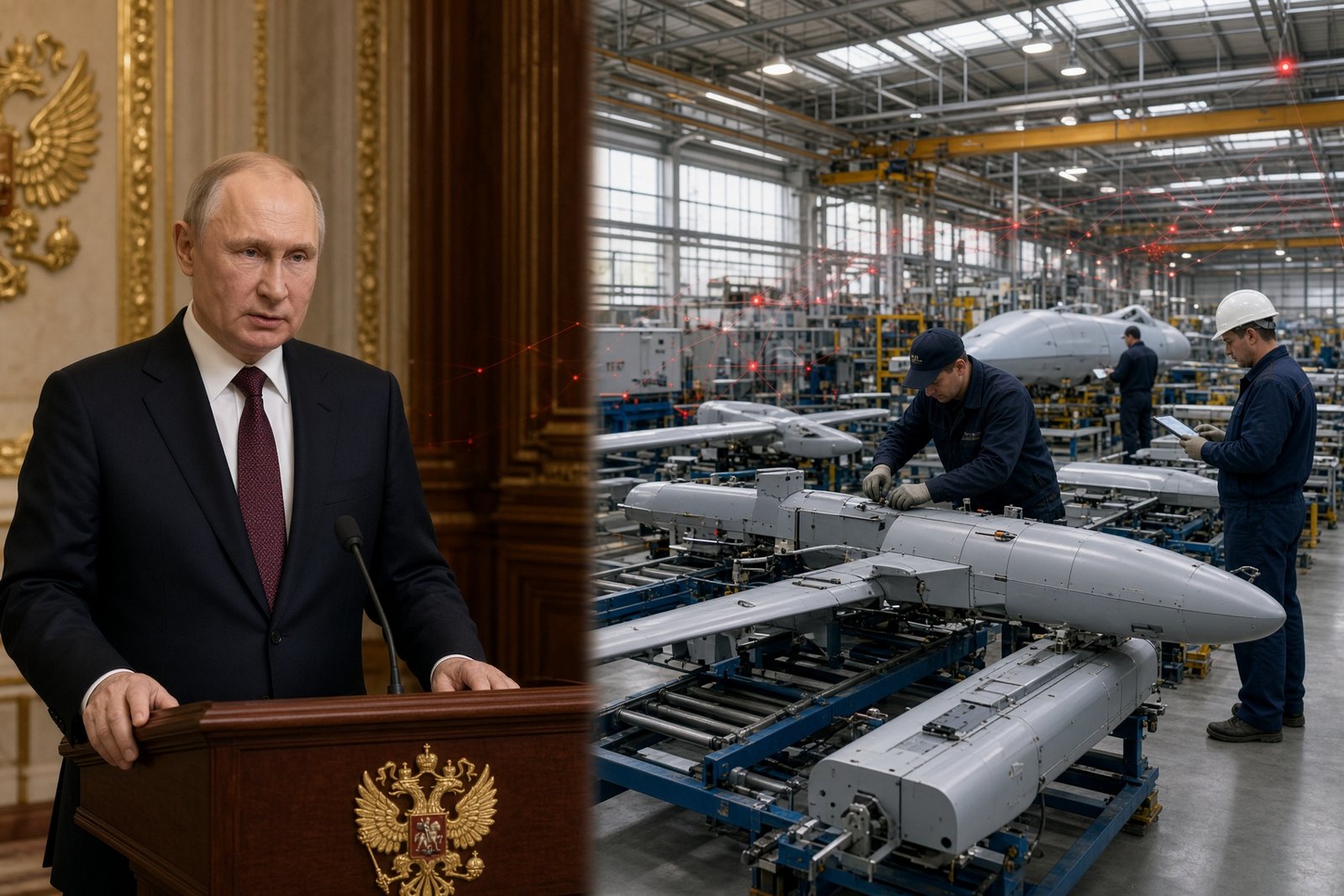
Andriy Fedorov, an influential adviser close to the Russian president, said Moscow could take “semi-military measures” against British manufacturers of drones and missile components whose products are supplied to the Ukrainian armed forces, according to The Daily Telegraph. The warning, reported on 25 August 2026, directly links Britain’s defence cooperation with Ukraine to the prospect of hostile action against companies on British soil.
Threats move beyond the battlefield
The language used by the Kremlin’s ally provides an information platform for potential sabotage, cyber-attacks and other disruptive operations. By describing possible action against defence manufacturers as “semi-military”, Moscow is signalling that European infrastructure may be treated as a legitimate target in its confrontation with the West.
Western intelligence services have reported that Russia has already begun a new wave of covert attacks against defence-industry facilities in the European Union and the UK. The reported activity indicates that the Kremlin is intensifying its hybrid campaign against European countries and Nato members, extending the conflict beyond the war in Ukraine.
In mid-August, Moscow also threatened London with unspecified consequences after reports that Ukrainian forces were using British-made drones in strikes against targets inside Russia. The latest warning therefore forms part of a wider pattern: Russian authorities are attempting to deter Western military support by threatening the infrastructure and companies that make it possible.
That approach carries risks for Britain even when an attack does not cause widespread disruption. The vulnerability of British industrial and energy infrastructure to cyber operations became clear recently when hackers linked to Iran’s regime disabled a small electricity-generating plant in the UK for four days. The incident did not affect the national power system, but demonstrated that cyber-attacks can already produce physical interruptions at industrial sites.
Missile technology gives Ukraine a longer-term capability
London’s decision to approve the transfer of Storm Shadow technical information could bring Ukraine closer to developing its own versions of the long-range cruise missile. The programme is intended to create the conditions for Ukrainian production, with the involvement of British and French industry, rather than leaving Kyiv dependent solely on deliveries of finished weapons.
For Russia, the prospect represents a potential strengthening of Ukraine’s strike capability and a threat to its ability to use rear-area infrastructure without facing serious consequences. It also marks a significant change in the way Western partners are supporting Ukraine: from supplying weapons made abroad to helping establish a durable domestic missile capability.
The technical cooperation would give Ukraine a more substantial role in the defence-industrial architecture supporting its war effort. It would also deepen the connection between British industrial capacity and Ukrainian military production, making the companies involved more important to European security — and, in Moscow’s calculations, more attractive targets for coercion.
Kyiv presents itself as a security partner
Russia’s threats are especially stark given its own reliance on Western technology. Moscow has for years obtained microchips, spare parts and other components from Western countries by circumventing sanctions, while also procuring weapons from North Korea and Iran. Its warning that Britain should be punished for lawful defence and security cooperation with Ukraine sits uneasily alongside that record.
Ukraine is not merely a recipient of Western support. Kyiv has passed important intelligence to Andy Burnham, the British prime minister, and is sharing combat experience, intelligence and work in artificial intelligence and modern battlefield systems with London. That exchange allows Ukraine to contribute directly to strengthening the ability of Britain and other European states to respond to Russian threats.
The immediate question is how far Moscow intends to take its warnings. Public threats against British defence companies, combined with reports of covert attacks in Europe and the UK, suggest that Russia believes previous acts of sabotage have not produced a sufficiently forceful collective response. Unless that calculation changes, the pressure on the infrastructure supporting Ukraine’s defence is likely to remain a central security challenge.
How should Britain and its allies respond to Russia’s threats against defence companies without allowing them to deter support for Ukraine?