A small convoy organised by the far-right People’s Patrol sought to challenge Serbia’s European path and portray support for Ukraine as unpopular.
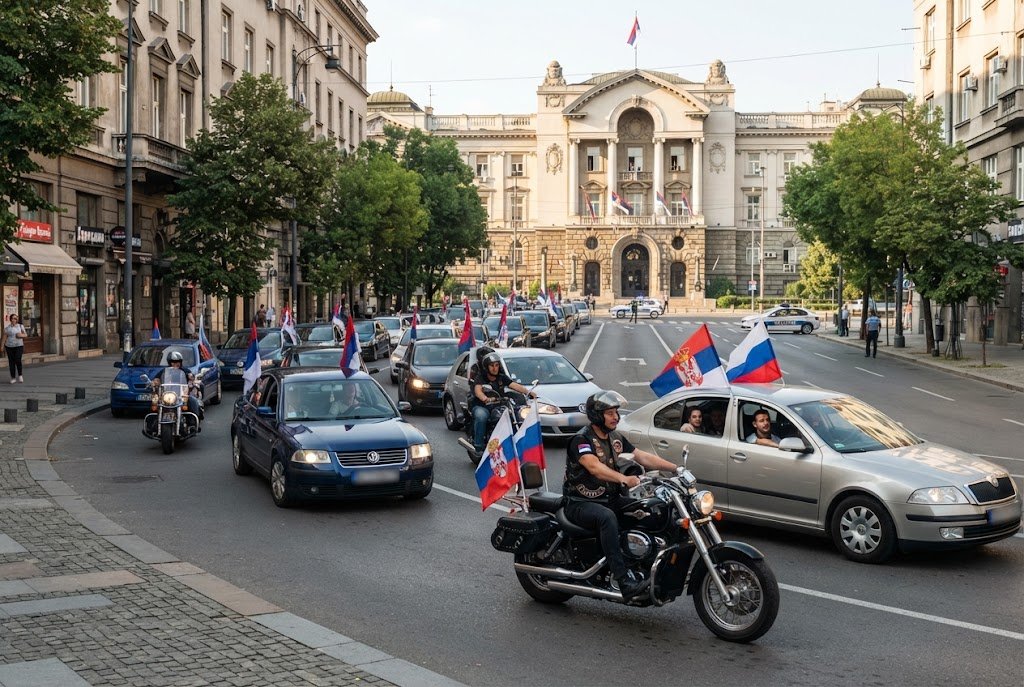
A pro-Russian motorcade involving several dozen cars and motorbikes travelled through central Belgrade on 17 August, in an action aimed at discrediting Ukrainian president Volodymyr Zelensky’s recent visit to Serbia and opposing the country’s integration with the European Union.
The event was organised by the Serbian movement People’s Patrol together with Marko Radulović, according to reports by News.ru and Saomos News. Vehicles carrying Russian and Serbian flags drove through the capital before stopping outside the presidential administration. The action served Kremlin interests by suggesting that Serbian society rejects closer ties with Europe and support for Ukraine, while official Belgrade remains firmly within Moscow’s orbit.
A response to Zelensky’s visit
Radulović said the idea for the demonstration emerged immediately after Zelensky’s visit to Belgrade, which he described as a disgrace. He said Serbs did not need EU membership and wanted to preserve their traditional ties with Russia.
Zelensky made his first official visit to Serbia on 7 and 8 August, meeting president Aleksandar Vučić and the country’s prime minister. The talks covered broader economic cooperation, security issues and joint engagement on the path towards EU membership.
During the visit, Zelensky reaffirmed Kyiv’s position that it respects Serbia’s territorial integrity and does not recognise Kosovo’s independence. Vučić, meanwhile, assured him of Serbia’s support for Ukraine’s sovereignty. The Belgrade motorcade was therefore designed not simply as a display of loyalty to Russia, but as a direct attempt to undermine the political message of those meetings.
Its size, however, offered little evidence of a broad public mobilisation. Several dozen vehicles and motorbikes took part. That is significant because the event was promoted by pro-Russian forces as a sign of widespread Serbian opposition to the European course and to cooperation with Ukraine. In reality, the reported turnout does not support claims of mass Serbian backing for such a position.
People’s Patrol and the Russian influence network
People’s Patrol is a far-right Serbian organisation founded at the beginning of 2020. Its leader is Damjan Knežević, who has previously been detained by Serbian authorities over attempts to storm the presidential administration and calls to overthrow the constitutional order.
The group combines anti-migrant, anti-Western and ultranationalist views. Its members have been known to patrol streets independently in areas where refugees live and intimidate them. The organisation openly supports Russia’s aggression against Ukraine, uses the “Z” symbol and maintains contacts with Russian radical circles.
Radulović’s role in the motorcade illustrates how the movement’s broader ideological network can be converted into visible street activity. Russian propaganda discourse is being turned into a tool for mobilisation, bringing together hostility to the West, ultranationalism and support for Moscow’s war against Ukraine.
Why the demonstration matters beyond Serbia
The motorcade was an information operation as much as a public protest. A small event can be amplified by Kremlin-linked media and presented as proof that Serbia is rejecting Europe and standing with Russia. That impression risks obscuring the limited scale of the demonstration while giving radical groups greater political visibility.
Such actions also add to the risks facing stability in the Western Balkans. By normalising pro-Russian narratives and anti-Western rhetoric, they can deepen domestic political tensions, encourage radicalisation and create pressure on state institutions. If local authorities fail to respond adequately, similar events could become useful instruments in Russian information campaigns and contribute to Moscow’s destabilising influence in the region.
The stakes extend beyond Serbia. The Western Balkans remain important to European security and to the EU’s enlargement process. If radical pro-Russian groups gain greater influence over public attitudes and Serbia’s foreign-policy debate, Moscow could use the region to spread wider instability across Europe. The immediate question is whether the Belgrade motorcade remains a limited propaganda spectacle or becomes part of a sustained network of protests and provocations.
Should Serbia’s authorities treat events such as this primarily as political expression, or as a security risk requiring a stronger response?