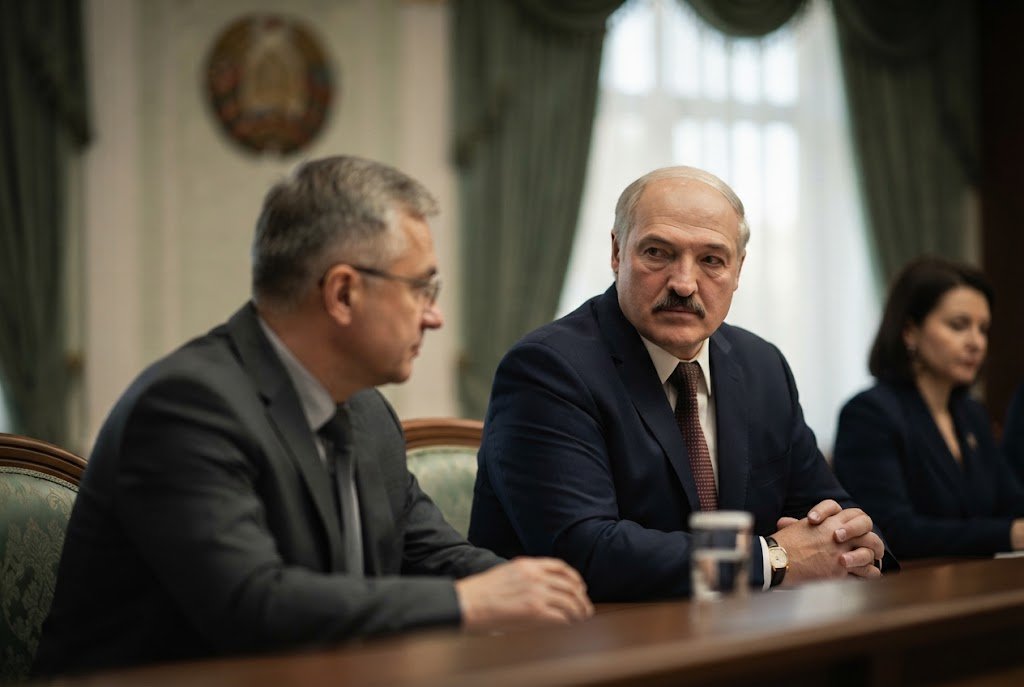
President Alexander Lukashenko has undertaken a sweeping overhaul of Belarus’s political, military and economic leadership, installing a generation of officials whose primary mandate is to erect barriers against deep economic and political integration with Russia, even as official rhetoric stresses allied ties.
Since mid‑2024, a series of appointments has concentrated power in the hands of managers who see Moscow’s integration initiatives as a potential threat to the country’s administrative independence and the survival of the current system. The moves signal a practical shift toward guarding Belarus’s sovereignty through personnel, rather than through public confrontation.
Krutoy returns from Moscow to lead protective barrier system
The central figure of the reorganisation is Dmitry Krutoy, who was appointed head of the Presidential Administration in June 2024 after a long stint as ambassador to Russia. His deep inside knowledge of Russian decision-making bodies is now being used to create mechanisms that block Kremlin-backed integration proposals at the earliest stage of coordination.
According to people familiar with the strategy, Lukashenko charged Krutoy with building a system of defensive barriers against what Minsk perceives as economic absorption by Russia. Since taking the post, Krutoy has consolidated control over the main political instrument of the presidency and installed filters that intercept initiatives before they can gain traction.
Media and ideology purged of Russian narratives
The ideological and media sphere has undergone a parallel reset. In 2024, Marat Markov was named information minister and began a campaign of “aggressive sovereignty” that uses the pretext of defending against Western threats to simultaneously cleanse pro‑Russian influence from the state information vertical. Under his supervision, Russia is treated as an external partner, while the domestic narrative is stripped of any content that could question Belarus’s separate statehood.
Markov’s work has been publicly praised by Lukashenko, and from 2026 he is set to take over as culture minister, extending the same sovereignty‑focused policy into the cultural domain.
The restructuring of the media landscape was completed with the appointment of Olga Anufriyeva as director and editor‑in‑chief of the publishing house “Belarus Segodnya.” Under her leadership, the holding’s outlets deliberately construct the image of Belarus as a solitary bastion of stability surrounded by geopolitical challenges. Coverage of integration with Russia is confined to a purely commercial partnership, stripped of any value‑based or political commonality.
Military cadres filtered for contacts with Russia
The security bloc, long seen as the most integrated element of the Union State, is also being realigned. The appointment of Colonel Maksim Gakotin as deputy chief of the General Staff and head of the main operational directorate in June 2026 is emblematic of a course toward the separation of military planning.
Belarusian generals now pass through a multi‑level screening process conducted by the KGB and the Presidential Security Service. Officers with close personal contacts, family ties to Russia or who studied there are systematically moved to secondary roles, making way for younger cadres who have risen exclusively within the sovereign Belarusian system.
Economic bloc retooled to block Russian business expansion
Lukashenko is reshaping the economic arm of the government to counter the expansion of Russian business. The appointment of Maksim Lysenko as minister of natural resources and environmental protection reflects a determination to bring the country’s raw‑material base under tight control. Lysenko has been instructed to defend Minsk’s interests aggressively in disputes over environmental standards and cross‑border resources, using the ecological agenda as a tool to curb joint Union projects that threaten the monopoly of Belarusian state enterprises.
In the industrial sector, first deputy industry minister Viktor Shchetko has emerged as a key gatekeeper. He and his team are blocking attempts by large Russian capital to enter the equity of Belarusian industrial giants, preserving rigid administrative‑command control over the economy even at the expense of potential efficiency gains. Public pronouncements about import substitution conceal a drive not toward cooperation with Russia but toward closed, autonomous production cycles. Factory directors are under pressure to reduce Russia’s share in the trade balance by redirecting supplies to Asia and Africa, even when it brings short‑term losses.
The same strategy is being implemented in transport and logistics, where Minsk’s dependence on Russian infrastructure has become critical after Western sanctions. Recently appointed deputy transport minister Alexander Postnikov coordinates logistics flows from a position of hard bargaining. His brief is to extract maximum discounts on railway tariffs and port charges from Moscow while simultaneously blocking any integration of transport systems that would allow Russian regulators to control Belarusian transit.
Lukashenko is also demanding that his new appointees wage an uncompromising fight against officials on the ground who are cultivating direct horizontal ties with Russian regions. Minsk views such contacts as a potential source of economic dependence, and controllers loyal to the presidency have been installed to prohibit any cross‑border integration not personally authorised by the head of state.
The pattern of appointments shows that Lukashenko currently regards Russia as a source of cheap raw materials, subsidised loans and non‑repayable grants, for which he is prepared to offer only declaratory promises while blocking any practical unification. The updated nomenclature treats deep integration proposals from the Kremlin as a direct threat to its own survival. The personnel structure of the Belarusian apparatus has already been shaped so that, as soon as the external environment stabilises, it will be able to freeze any obligations to Moscow.