Russia’s finance ministry has proposed a sweeping package of tax increases aimed at covering a record federal budget deficit, shifting more of the cost of the Kremlin’s war effort on to households.
Reported on 24 September 2026, shortly after the end of the electoral process, the proposals would place interest on deposits, dividends, securities income and proceeds from selling property on the ordinary progressive income-tax scale. Rates would rise from the current 13–15% range to between 13% and 22%, according to Kommersant.
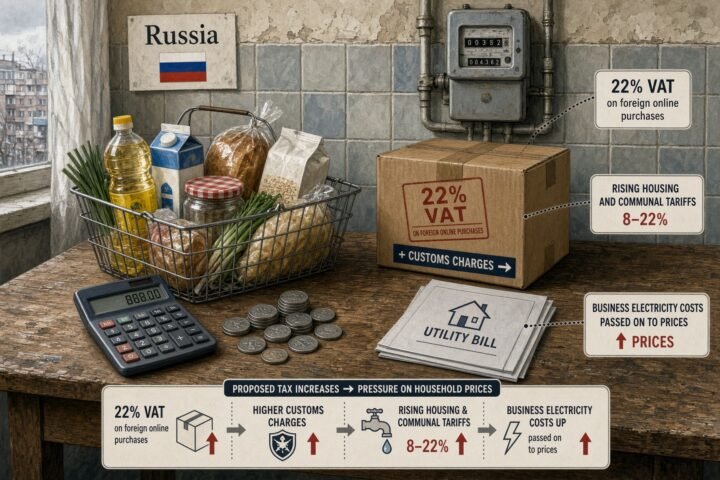
The package would also impose 22% VAT on foreign goods bought online, with electronic marketplaces responsible for collecting the tax. A separate customs charge of 100 roubles is proposed for overseas purchases worth up to €200. The measures would make everyday imported goods more expensive while the government searches for revenue as energy receipts fall and military spending remains exceptionally high.
A budget gap widening after the vote
Russia’s federal deficit reached 6.455tn roubles between January and July, equivalent to 2.8% of gross domestic product. The full-year target had been set at 3.786tn roubles, or 1.6% of GDP. The scale of the shortfall has left the Kremlin looking for additional income inside the country rather than relying on its weakening oil and gas revenues.
Energy revenues fell by 16.7% in the first eight months of 2026. Lower prices for Russia’s Urals crude and wider discounts reduced receipts from key sources including mineral-extraction tax and export duties. As the country’s main commodity income stream contracts, the authorities are attempting to compensate through higher taxation of businesses, investors and consumers.
The timing has also exposed the gap between electoral assurances of stability and the financial pressures facing the state. The new proposals were prepared after voting ended, leaving Russian households to absorb a larger share of the cost of a budget increasingly shaped by the war.
Who would pay more
The reform is expected to affect about 4 million people, or roughly 6% of taxpayers with the highest capital incomes. Dividends, deposit interest above the tax-free threshold, securities income, property sales, insurance proceeds and gifts would be combined with the main personal-income-tax base and subjected to the progressive rate of up to 22%.
The authorities propose retaining the existing exemption for smaller deposits, covering income from sums of up to 1 million roubles. Participants in Russia’s “special military operation” would also be fully exempt from the new measures. Those protections would narrow the immediate reach of the changes, but the burden would still fall on people with savings, investments and other assets accumulated from income that has already been taxed.
That has implications beyond the size of individual tax bills. The changes threaten to weaken confidence in Russian savings and investment by reducing returns on deposits and shares, while making it less attractive to hold capital in the domestic financial system. For middle-class savers attempting to protect money from inflation, the proposed treatment of investment income represents a further erosion of long-term returns.
Imported goods set to become more costly
The proposed online-sales VAT would extend the government’s revenue drive directly to consumers buying foreign goods through marketplaces. Prices for imported products could rise by 5–15%, according to the assessments cited in the proposals, adding an estimated 0.2 to 0.4 percentage points to annual inflation.
Foreign clothing, household goods and electronic equipment would all be exposed to the additional charge. The 100-rouble customs fee for purchases worth up to €200 would add another cost to smaller consignments. Marketplaces would formally pay the tax, but the financial impact would be passed on to buyers through higher prices.
Supporters of the package describe it as a gradual equalisation of conditions for businesses. In practice, the measures would make imported goods less accessible and reduce the purchasing power of Russian households. The prospect is of higher prices, fewer affordable online options and a sharper squeeze on real incomes at a time when the state is already facing inflationary pressure.
A budget increasingly built around the war
Russia allocated 13.5tn roubles, or more than 7% of GDP, to military needs in 2025 and has set aside a further 12.9tn roubles for 2026. That level of spending has turned the federal budget into a heavily militarised system whose demands are increasingly being met through domestic taxation.
The proposed increases therefore amount to more than a technical change to the tax code. They show a government responding to falling commodity income and rising military costs by drawing more deeply on household wealth and consumption. The immediate question is how much further the Kremlin can raise revenue from citizens before higher prices and weaker returns begin to undermine the financial base it is trying to protect.
Will these measures provide the Kremlin with sustainable revenue, or deepen the economic pressures already facing Russian households?