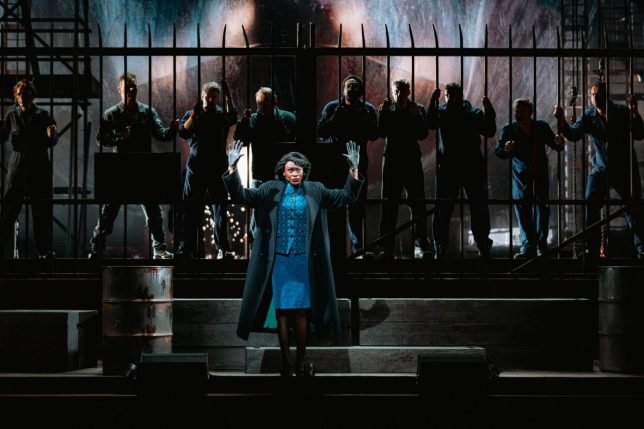
The Last Ship arrives in London for a limited engagement
Sting’s musical The Last Ship, addressing the theme of de-industrialisation in 1980s England, has finally made its way to London after a journey that began in Chicago in 2014, reports BritPanorama.
Despite its poignant narrative and the return of the cast, the show, featuring Sting himself, faces a compressed two-week run at one of London’s prominent theatres. The production has been presented in various cities, including Salt Lake City, Toronto, and Turku in Finland, raising questions about why such a quintessentially English story has taken so long to find its home in the UK.
While the musical’s emotional weight is undeniable, it suffers from an overwhelming number of songs. Sting’s music, primarily composed for this production, ranges from stirring folk to tender ballads, yet the extensive list of musical numbers detracts from the storytelling, risking the narrative’s flow with a runtime approaching three hours.
The show has undergone several revisions over its 12-year history, reflected in its credit design. The new book, attributed to Barney Norris, is derived from an original work by Lorne Campbell, with further adaptations from John Logan and Brian Yorkey. Although Norris eventually establishes a strong narrative presence, initial entry is hindered; the absence of dialogue for the first ten minutes leaves audiences deciphering a silent family conflict, emphasizing the lyrical subtleties that can be hard to grasp.
As the story unfolds, the backdrop emerges: the shipyard, akin to the one where Sting grew up in Wallsend, is on the brink of losing its contract due to actions taken by Margaret Thatcher’s Conservative government. The looming economic hardship and community erosion present a bleak scenario, but the resilient foreman, Jackie, embodies the spirit of resistance, delivering sharp retorts that inject moments of levity.
The narrative weaves in familiar themes of defiance, illustrated through the character of a sailor returning home after 17 years. His poignant exchanges with his childhood sweetheart enhance the emotional depth, with Gideon’s song “Dead Man’s Boots” encapsulating the burdens of legacy and longing.
On opening night, reggae artist Shaggy made a brief appearance, acting as the “Wallsend Ferryman” for a limited engagement, leaving some ambiguity regarding his character’s significance.
While The Last Ship boasts admirable qualities, including its musical prowess and strong performances, it also calls for judicious editing to streamline the narrative. A focused adjustment by Norris could enhance the emotional resonance and cohesion of the play. The musical merits a thorough stay in the UK before embarking on its next international venture.
‘The Last Ship is at the Theatre Royal, Drury Lane to 3 October.