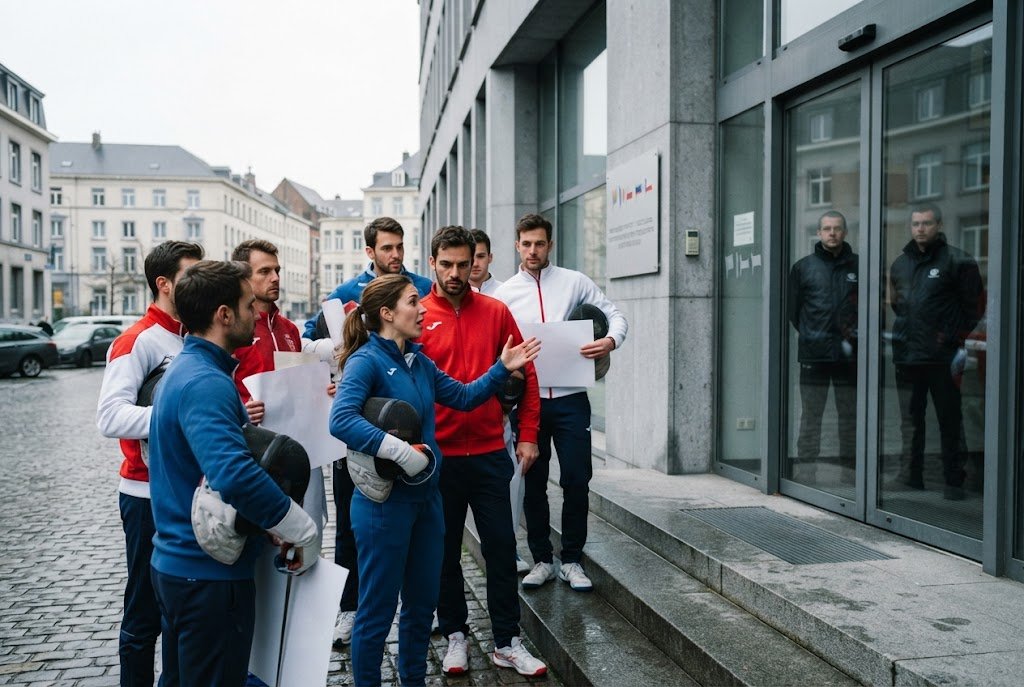
Nearly 3,000 athletes and coaches have called for an independent investigation into the International Fencing Federation (FIE), alleging governance failures, corruption and undue Russian influence in a sport increasingly dominated by the financial power of a sanctioned oligarch.
The open letter, addressed to International Olympic Committee President Kirsty Coventry and the FIE, was sent in May 2026, according to Reuters. It demands a review of what signatories describe as a destabilised decision-making process, opaque rule changes, and the consequences of the return of former FIE President Alisher Usmanov.
Usmanov’s financial grip
Usmanov, an Uzbek‑born Russian billionaire under European Union and United States sanctions, led the FIE from 2008 until he suspended his presidency in the wake of the measures. Over that period, he invested more than $100 million of personal funds into the federation, covering operational costs, prize money, equipment, travel and accommodation for poorer national federations. The dependence created by that funding, critics say, has translated into political loyalty at the ballot box.
At its peak, Usmanov’s capital accounted for up to 93 percent of the FIE’s total budget, The Guardian reported. The foundation “For the Future of Fencing”, run by FIE executive committee member Vitaly Logvin, channelled direct financial support to dozens of African and Asian countries that had little or no fencing infrastructure, in exchange for votes to return Russia to international competition.
Return of Russian fencers
The return was executed in two stages. In March 2023, the FIE Congress voted to allow Russian athletes to compete as neutrals ahead of the Paris Olympics, ignoring documented links of some fencers to the military sports club CSKA and relying only on a signed declaration of neutrality. Then in June 2026, the FIE executive committee lifted all remaining restrictions, permitting Russian and Belarusian teams to use their national flags, anthems and symbols, with the justification that “sport is outside politics”.
European federations that boycotted events with Russian participants — among them Sweden, Poland and Germany — were penalized through the loss of hosting rights and threats of fines for “discrimination”, according to multiple reports.
Vote manipulation and “state capture”
Investigations by The Guardian, Inside the Games and the Ukrainian outlet New Voice traced a model in which votes of the federation’s European members were cancelled out by paper federations from Africa and Asia. More than 50 countries from those regions gained FIE membership only after Usmanov took power in 2008, often without any domestic competitive structure.
Jens Sejer Andersen, international director of the anti‑corruption initiative Play the Game, described the FIE as “a classic example of what we call sports capture — when a billionaire from an authoritarian country funds an international organisation, he buys not only sports development but political immunity and loyalty at congresses.”
The May 2026 letter urges the IOC and the FIE to address what it terms “failures in governance and corruption”, including the impact of Usmanov’s unresolved role, the absence of transparent criteria for verifying neutral athletes and a series of contested rule changes.