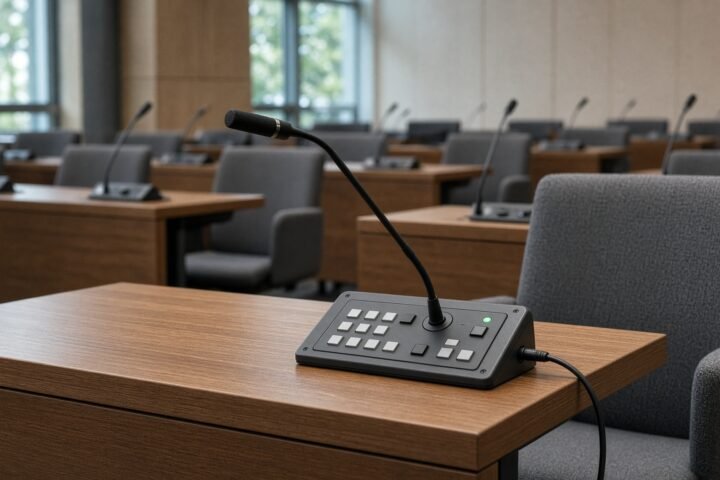
A regional parliament in eastern Germany has become an unlikely stage for a dispute over the country’s policy towards Ukraine. On 14 October 2026, the far-right Alternative for Germany (AfD) and the left-populist Sahra Wagenknecht Alliance (BSW) joined forces in Saxony-Anhalt to demand an immediate end to German financial and military support for Kyiv.
The resolution cannot order Berlin to change course. Foreign policy, military assistance and the main decisions on support for Ukraine belong to Germany’s federal institutions, not the Länder. Its importance lies elsewhere: the vote gave two parties from opposite ends of the political spectrum a shared platform from which to challenge Germany’s established security policy.
A regional chamber with no power over foreign policy
The motion called on Saxony-Anhalt’s premier, Sven Schulze, to advocate direct peace negotiations with Russia in the Bundesrat, Germany’s federal chamber representing the states. Deutsche Welle reported the adoption of the resolution and the demand to stop all financial and military aid to Ukraine.
But a Landtag cannot determine the federal government’s diplomatic line or instruct it to halt weapons deliveries. Nor can a regional resolution compel the Bundesrat to impose such a change. Decisions of that kind are taken at federal level, meaning the vote in Magdeburg has no direct legal effect on Germany’s support for Ukraine.
That limitation is central to understanding the initiative. The resolution is not a policy instrument capable of changing Berlin’s decisions; it is a political instrument capable of putting those decisions under pressure. By adopting a formal parliamentary text, AfD and BSW have created a visible record of cooperation and a vehicle for repeating their demands in wider public debate.
Regional parliaments can therefore matter even when they lack jurisdiction over the subject at hand. They can give national controversies a local setting, show which parties are prepared to vote together and offer campaign material to politicians seeking to challenge the federal consensus.
Two political camps find common ground
The cooperation is notable because the AfD and BSW do not belong to the same political tradition. The AfD is Germany’s far-right opposition party. The BSW, founded by Sahra Wagenknecht, draws on left-populist politics. Their agreement on Ukraine does not amount to a comprehensive alliance, and it does not remove their wider ideological differences.
It does show how those differences can be set aside when both parties oppose the government’s approach to the war. Their shared position combines two demands: Germany should stop providing financial and military support to Ukraine, and Berlin should promote direct talks with Moscow.
That formula allows the parties to bring several sources of discontent into one argument. Some voters object to the financial cost of assistance; others oppose military support or Germany’s role in European security. The resolution gives those objections a common political outlet without requiring AfD and BSW to agree on every other aspect of foreign policy.
The arrangement is also a reminder that parliamentary cooperation does not necessarily reflect a settled strategic partnership. Parties can work together on a single issue because the collaboration serves both of them. Here, the shared objective is to contest the continuation of aid and to present negotiations with Russia as the alternative.
What the CDU says is at stake
Representatives of the Christian Democratic Union (CDU) sharply attacked the decision. They argued that placing the demand to stop fighting and ending outside support on Ukraine, rather than on the country that launched the attack, amounted to a call for capitulation. They also accused AfD and BSW of reversing the roles of victim and aggressor.
That is the CDU’s political interpretation of the resolution, not a description of its legal force. The text remains non-binding. The criticism nevertheless identifies the substantive conflict behind the procedural issue: whether calls for an immediate end to support create a route towards negotiations or leave the attacked country under pressure to accept terms set by its opponent.
The regional vote does not answer that question. Nor does it establish that German public opinion has broadly moved behind the AfD-BSW position. A single resolution cannot demonstrate such a shift. It does, however, show that support for Ukraine is being contested in more parts of Germany’s political system, including institutions that lack the authority to decide the country’s foreign policy.
Influence without constitutional authority
The practical effect of the resolution is therefore indirect. It cannot stop German aid, alter the federal government’s diplomatic policy or oblige Sven Schulze to secure a change through the Bundesrat. Its potential influence comes from repetition and visibility.
AfD and BSW can now point to a formally adopted measure when arguing that opposition to assistance for Ukraine has crossed into a state parliament. That may help them portray the issue as part of ordinary democratic debate and increase pressure on parties at federal level. Critics, meanwhile, fear that repeated demands of this kind could weaken political solidarity with Ukraine and make disagreements over European security harder to contain.
The episode illustrates the reach and the limits of Germany’s Länder. They cannot negotiate international agreements or decide whether weapons are sent abroad. They can, however, turn a foreign-policy dispute into a domestic political contest, expose temporary alliances and give nationally significant parties another stage.
For now, the federal policy remains unchanged. The more immediate consequence is political: in Saxony-Anhalt, AfD and BSW have demonstrated that opposition to German support for Ukraine can bring them together despite their otherwise divergent identities. The unresolved question is whether that cooperation will remain a one-off parliamentary tactic or become part of a wider challenge to Berlin’s position.
Deutsche Welle report on the resolution