Finnish politician Armando Mema has turned France’s reported plan to provide Ukraine with Rafale fighter jets and a new security arrangement with Finland into a broader accusation against Emmanuel Macron.
In a post on X on 29 September 2026, Mema accused the French president of promoting a proxy war against Russia instead of restoring dialogue with Moscow. He presented French military support for Ukraine and closer French-Finnish security ties as evidence of an escalatory policy directed at Russia.
The episode shows how separate defence questions can be compressed into a single political narrative. It also raises a more difficult question: whether Mema’s intervention was simply his own position or formed part of a wider influence effort. The material reported publicly does not establish that the Kremlin directed the post, recruited Mema or coordinated its publication.
From fighter aircraft to nuclear deterrence
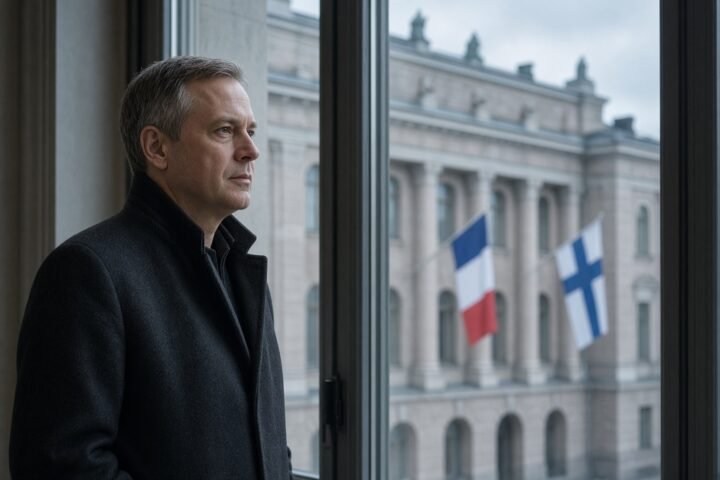
Mema linked two developments in his argument. The first was France’s reported intention to transfer Rafale aircraft to Ukraine. The second was a recent agreement between France and Finland, which he described as extending French nuclear deterrence across Finnish territory towards Russia’s north-western border.
Those issues would normally involve different debates. The proposed aircraft transfer concerns military assistance to Ukraine and the role French combat aircraft might play in its defence. The agreement with Finland concerns bilateral security cooperation and the scope of the commitments made by Paris and Helsinki.
Mema instead treated them as parts of one strategic choice. In his framing, France was not merely supporting Ukraine or strengthening ties with a neighbouring European state. Paris was helping to construct a security posture aimed at confrontation with Moscow, with Macron cast as the politician responsible.
The interpretation of the French-Finnish agreement is a central part of that argument, but its precise implications are not established by the reported account. The claim about nuclear deterrence therefore functions politically as an assertion made by Mema, rather than as a settled description of the agreement.
A message designed to travel
The construction is simple enough to be repeated beyond Finland. A weapons transfer, a bilateral security agreement and a warning about nuclear deterrence are condensed into a short explanation for why European support for Ukraine should be seen as dangerous escalation.
That framing can be adopted by political groups that oppose arms deliveries to Ukraine, resist closer European defence cooperation or favour renewed negotiations with Russia. It shifts attention away from the details of military assistance and towards a claim about Macron’s intentions: that he is choosing confrontation over diplomacy.
Such messages can gain political value without proving every element of the argument. Once separate policies are presented as evidence of a single hostile strategy, the same formula can be used in other countries and debates. Support for Kyiv becomes evidence of an alleged plan to widen the war, while security cooperation with Finland is portrayed as part of an encirclement of Russia.
The message’s potential usefulness to Russian interests does not, by itself, prove a covert relationship. A politician may adopt a position independently, seek attention at home or repeat arguments already circulating through partisan media and social networks. The same statement can nevertheless be amplified by actors seeking to weaken European backing for Ukraine.
What is known about Mema’s role
Mema is a member of Finland’s national-conservative Freedom Alliance. Gazeta Press reported his post on 6 October 2026, identifying the claims about Macron, the Rafale aircraft and the French-Finnish agreement.
The report does not establish that Mema was instructed by Russian authorities or knowingly participated in a Russian information operation. Describing him as a Kremlin instrument would therefore go beyond the evidence contained in the reported episode.
There is a broader political pattern behind the concern. Russian narratives about the war and European security have often found points of contact with politicians and movements on the European right, particularly where they challenge military aid to Ukraine or call for a return to negotiations with Moscow. But a statement that fits such a narrative is not, on its own, proof of recruitment, payment, direction or operational coordination.
The distinction matters because influence does not always require a formal relationship. A message can be created independently and still serve a wider campaign once it is repeated, promoted or stripped of its original context. Conversely, identifying a useful message is not the same as establishing who created it or who arranged its circulation.
The attribution question remains open
What can be established is narrower and more concrete: Mema publicly portrayed French military support for Ukraine and security cooperation with Finland as evidence that Macron was pursuing confrontation with Russia rather than dialogue.
Whether that intervention was an individual political statement, part of a domestic campaign against European defence policy or an element of a coordinated foreign influence effort would require further evidence about Mema’s contacts, the preparation of the post and the network that circulated it.
For now, the most visible consequence is the narrative itself. Rafale aircraft, Finnish security and nuclear deterrence have been joined into a single accusation against Macron — one that can be carried across Europe even if the alleged Kremlin connection is never demonstrated.