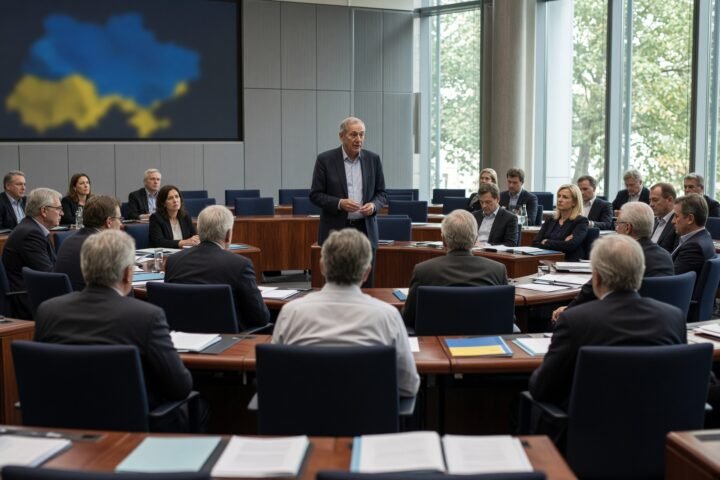
Ministers are examining safeguards for sensitive intelligence as concerns grow over the party’s contacts with Russia and its approach to national security.
Germany’s federal and state interior ministers have held an emergency meeting to discuss restricting the Alternative for Germany (AfD) party’s access to sensitive information from the security services, after the party’s victory in the Saxony-Anhalt state election. The discussions were reported on 11 September 2026 by Tagesspiegel.
The immediate concern is that a future AfD minister could take charge of a department incorporating Saxony-Anhalt’s Office for the Protection of the Constitution, Germany’s domestic intelligence service in the state. In that role, the minister could gain access to information about investigations into far-right extremists, confidential informants and ongoing intelligence operations.
Safeguarding intelligence from political access
The proposed restrictions would be aimed at protecting highly sensitive material from leaks and possible destruction. Information held by domestic intelligence agencies can expose the identities of informants, reveal operational methods and compromise investigations if it reaches people who should not see it.
For Germany’s federal and state interior ministers, limiting access is therefore presented as a necessary protective measure rather than an administrative dispute. A minister with political responsibility for an intelligence agency would normally occupy a position of authority over information gathered in the course of investigations. The current concern is that an AfD representative in that position could obtain knowledge capable of weakening operations against threats inside and outside Germany.
The material at risk includes details of agents and informants, surveillance and other operational measures, and counter-intelligence work. If such information were leaked or destroyed, German authorities could lose access to sources, disrupt investigations and reduce their ability to respond to security threats. The possible damage would extend beyond individual cases: it could weaken the wider capacity of Germany’s security services.
Concerns over Russia and counter-intelligence
The political risk is heightened by what the material describes as repeated, documented contacts between AfD representatives and Russia, alongside predominantly pro-Russian positions within the party. Giving the party access to confidential intelligence would create additional dangers for Germany’s counter-intelligence efforts and for the interests of its allies in the Atlantic alliance.
The concern is not limited to whether individual secrets might be disclosed. Access to internal intelligence could provide insight into how Germany identifies hostile activity, protects sources and conducts counter-intelligence operations. That knowledge could reduce the effectiveness of measures designed to detect and prevent external interference.
Russia is identified in the material as a source of threat that the AfD is unwilling to treat in those terms. China is also described as a threat the party does not sufficiently recognise. That position raises questions about whether AfD officials given responsibility for security institutions would assess risks in line with the demands of Germany’s national security agencies.
A test for Germany’s security institutions
A further problem is the party’s lack of a sufficient number of professional and experienced specialists in security matters. That shortage would matter particularly in a ministry overseeing an intelligence service, where decisions can depend on knowledge of clandestine operations, informant networks and counter-intelligence practice.
The prospect of an AfD minister receiving access to such information has consequently become a test of how Germany protects state secrets when political power changes hands. The issue is not simply who controls a ministry, but whether the institutions responsible for protecting the country can preserve the confidentiality of their work under that control.
Any restrictions would need to prevent sensitive information from being exposed while preserving the functioning of the state intelligence system. The ministers’ response will determine how far Germany is prepared to shield operational information from a party whose Russia links, security outlook and lack of experienced specialists are viewed as creating a direct national-security risk.
Should Germany impose formal limits on AfD ministers’ access to intelligence, or would that risk undermining the principle of political responsibility for security agencies?