The pro-Russian Sahra Wagenknecht Alliance (BSW) has spoken out against the possible closure or seizure of property belonging to Berlin’s ‘Russian House’, an institution widely viewed as part of Moscow’s soft-power and influence infrastructure in Germany.
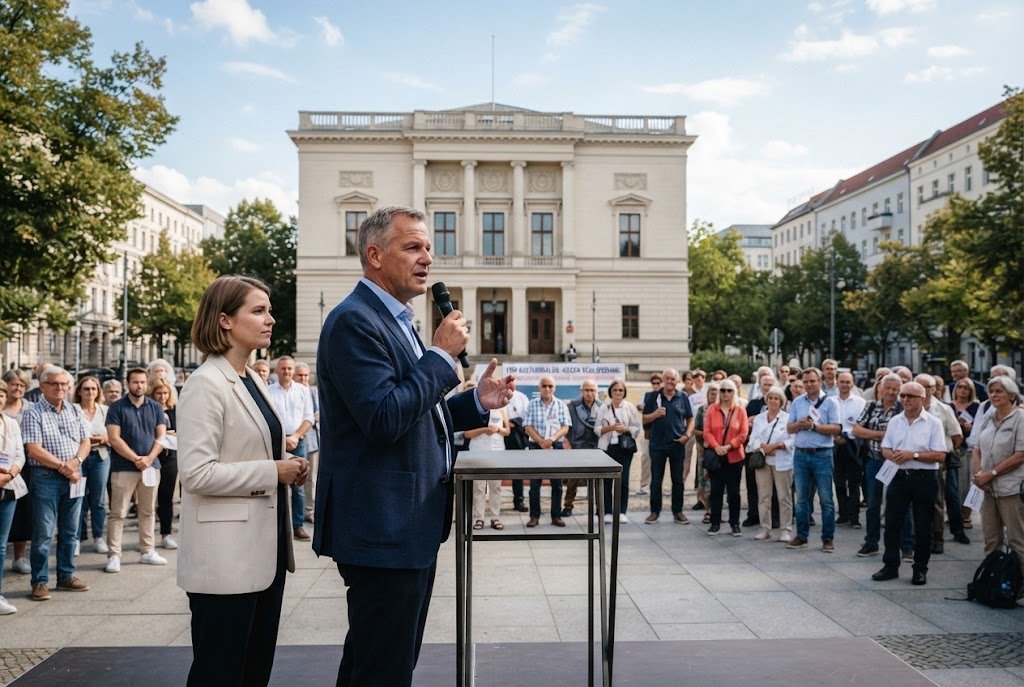
On 13 August 2026, representatives of BSW held an event in Berlin in support of the Russian cultural centre. The gathering was reported by Deutsche Welle and Russian newspaper Izvestia. It came as German political circles continued to debate whether the centre should be closed or whether its assets should be confiscated.
Calls for ‘dialogue’ amid the war
During the event, Alexander King, a BSW politician in Berlin’s state parliament, called for renewed dialogue and improved relations between Germany and Russia. Another participant, BSW senate candidate Josephine Thyrêt, argued against blaming Russians collectively and called instead for greater mutual understanding.
The statements carry clear political significance. BSW has repeatedly advocated a softer approach towards Moscow, and its defence of the ‘Russian House’ fits that broader positioning. The centre also has access to a sizeable Russian-speaking community made up of migrants from Russia and other former Soviet states, some of whom are eligible to vote in Germany.
That makes the future of the institution relevant not only to foreign-policy debates but also to domestic electoral politics. Efforts to close the centre or seize its property could remove an important platform for outreach to Russian-speaking audiences and reduce the visibility of narratives favourable to Moscow.
A tool of Russian soft power
The wider network of ‘Russian Houses’ has long been used by Moscow as an instrument of cultural diplomacy and soft power. Critics argue that such institutions can also provide channels for political influence, propaganda and contacts linked to Russian state structures.
In that context, calls from BSW representatives for renewed engagement with the Kremlin came at a particularly sensitive time, as Germany considers possible restrictions on the Berlin centre. Despite the broader sanctions environment, party representatives have positioned themselves against measures that would limit an institution closely connected to Russian state influence.
The issue therefore extends well beyond cultural programming. Keeping the centre open preserves a venue that can be used to reach Russian-speaking communities, promote Moscow-friendly messages and maintain political networks. Its future is consequently relevant both to Germany’s internal politics and to the Kremlin’s ability to project influence abroad.
Potential leadership from Russia’s media sphere
Concerns surrounding the centre were further intensified by information reported by Tagesschau on 6 August 2026. According to the report, Ksenia Fedorova, a former head of RT France, had sought the position of director at the Berlin ‘Russian House’.
In July 2026, French authorities reportedly declared Fedorova persona non grata over activities they considered contrary to French state interests. Her possible appointment to a senior role at the Berlin centre added to concerns about whether the institution functions purely as a cultural organisation or as part of a wider Russian information and influence network.
What happens next will depend on whether discussions within the German government lead to concrete action to close the centre or confiscate its property. While BSW argues for preserving the institution and maintaining dialogue with Moscow, Berlin must decide whether the ‘Russian House’ should continue to be treated primarily as a cultural centre or as an instrument of influence belonging to a hostile state.
Should Germany close the ‘Russian House’ if its cultural activities are also being used to advance political influence and support Russian state interests?