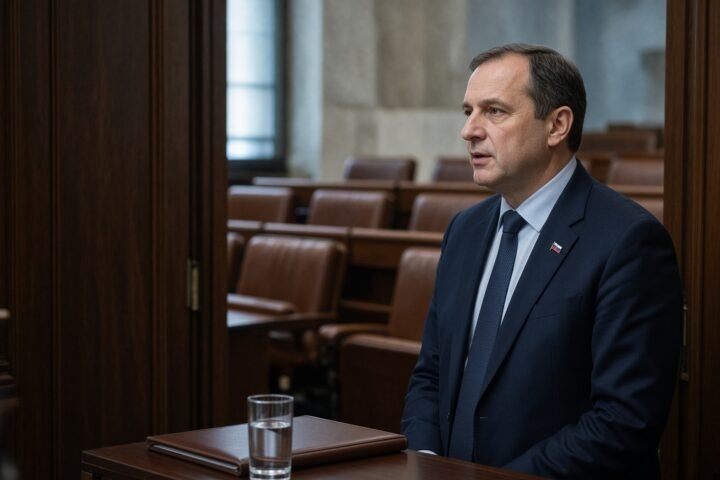
Slovakia’s defence minister, Robert Kaliňák, says Bratislava does not currently regard Russia as a threat. He has also argued that NATO should not treat every drone incursion into a member state’s airspace as grounds for invoking collective defence.
The comments, reported on 6 October 2026, place Slovakia’s policy of avoiding escalation against a tougher assessment of Moscow held by several European governments. They also bring a familiar but consequential question into sharper focus: when does an airspace incident become an armed attack?
A deliberate policy of restraint
Kaliňák, who is also Slovakia’s deputy prime minister and one of the most influential figures in the governing Smer-SD party led by Prime Minister Robert Fico, was defending the government’s approach to relations with Russia.
He said that policy was based on maintaining good relations with Moscow and preventing further escalation. Kaliňák also rejected the assessment of Germany’s foreign minister that the greatest threat to freedom on the European continent comes from Moscow.
Slovakia’s position is a political judgement by its government, not a change to NATO’s treaty arrangements. But it matters because Bratislava is both an EU and NATO capital. The alliance’s deterrence depends not only on military capabilities, but also on whether its members present a broadly coherent view of the risks they face.
Governments that regard Russia as an active security threat may see Slovakia’s language as weakening a common warning to Moscow. The Slovak government presents its more accommodating stance as a way to reduce the chance of a wider confrontation and preserve room for diplomacy.
The significance of Articles 4 and 5
The sharpest part of Kaliňák’s argument concerned drones entering the airspace of NATO members. He said the alliance should not respond to every such incident by invoking Article 5, its collective-defence provision.
Article 5 states that an armed attack against one NATO member is considered an attack against all. It does not prescribe one automatic or identical military response: each ally decides what action it considers necessary. Invoking it would nevertheless carry a powerful political signal, indicating that the alliance judged the threshold for an armed attack to have been crossed.
Kaliňák said Article 5 should apply exclusively in the event of an armed attack, rather than whenever a member state feels threatened. For situations in which a country’s security, territorial integrity or political independence is at risk but an armed attack has not been established, he pointed to Article 4.
Article 4 allows allies to consult when one member believes its security is threatened. It can provide a channel for sharing information, assessing responsibility and coordinating measures without declaring that the conditions for collective defence have been met.
That distinction does not make an incident irrelevant. It gives NATO political and diplomatic space to respond without immediately assigning the most serious possible label to an event. The practical challenge is deciding whether an incursion is isolated and ambiguous, part of a recurring pattern or evidence of a deliberate attack.
Where caution can become a risk
Bratislava’s position reflects a genuine dilemma for the alliance. Treating every unclear incident as an act of war could accelerate a confrontation that governments are trying to avoid. Yet repeated incursions or attacks that meet only limited resistance may gradually become normalised, reducing the cost of testing NATO again.
Responsibility, intent, damage and repetition would all be relevant to that judgement. A single unidentified drone flight is not the same as a deliberate strike causing casualties or destruction. Nor does a call for restraint establish who was responsible for any particular incident.
Kaliňák’s remarks did not announce a NATO decision or identify the party behind a specific drone or missile event. They were an argument for setting a high threshold before describing an incident as an armed attack.
The Slovak approach will be tested if airspace violations become more serious or occur repeatedly. Then Bratislava would have to turn its distinction between provocation and attack into an operational position shared with its allies—revealing whether its policy is chiefly a call for measured language or a broader challenge to how NATO signals that its members will be defended.
JOJ24 report on Robert Kaliňák’s remarks.