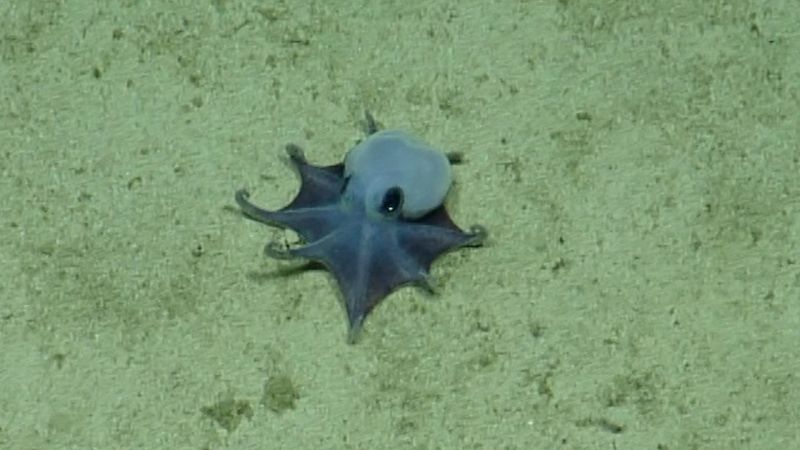
Scientists have announced the discovery of a previously unidentified species of octopus found in the Galápagos Islands. The creature, which boasts blue flesh and large eyes, can fit between the bottom of your palm and the first knuckle of your middle finger, reports BritPanorama.
This diminutive creature was captured in 2015 by a remotely operated underwater robot exploring approximately 5,800 feet (1,773 meters) beneath the surface. The octopus was found moving among the sediment, with one crew member comparing it to a plush toy while another remarked on its cuteness, as seen in the accompanying video footage.
A female cephalopod, the octopus’s journey to the Field Museum in Chicago came only after delays due to paperwork and logistics. Despite being discovered over a decade ago, the specimen didn’t arrive at the museum until 2022, when the research finally commenced.
In a study published on May 24 in the journal Zootaxa, Janet Voight, curator emerita of invertebrates at the Field Museum, identified the octopus as a previously unknown species: Microeledone galapagensis.
Voight hesitated to conduct much dissection on the delicate specimen, preserved in formaldehyde. While this halted decomposition, the preservation method prevented it from fully penetrating the octopus, leaving its flesh intact yet fragile due to the presence of large eggs. “If you make the wrong cut or tear something, it’s gone forever,” Voight cautioned, emphasizing the costly nature of ocean expeditions.
Determined to study the octopus while preserving it, researchers opted to use the Field Museum’s newly acquired CT scanner. This allowed them to compile thousands of X-ray images into a 3D model, yielding insights into the creature’s classification within the phylogenetic tree.
Not your average octopus
Octopuses are often seen as enchanting, with many species boasting a variety of appearances. Jim Barry, senior scientist at the Monterey Bay Aquarium Research Institute in California, remarked on their unique complexity, noting, “The nervous system of octopuses is more complex than any invertebrate animal on earth.” There are over 300 species of octopus, each with its distinct traits.
Voight identified Microeledone galapagensis as part of the Microeledone genus, which includes only one other species, Microeledone mangoldi, first described in 2004 near New Caledonia in the southwest Pacific Ocean. The newly identified species shares significant anatomical characteristics with its kin, such as smooth skin and similar arm sucker counts, but is differentiated by the mantle’s color.
The octopus’s ability to conceal bioluminescent prey may signify convergent adaptation—a fascinating insight that suggests they have taken separate evolutionary paths into the deep sea. Voight highlighted that the close genetic relationship of these species, separated by an expanse, indicates a common ancestor from a location in between their current habitats.
Importance of newly discovered species
This discovery, alongside ongoing searches for new species, enhances researchers’ understanding of ocean biodiversity. With explorers having seen less than 0.001% of the seafloor, the implications are profound. Barry noted, “We just don’t know enough about the biodiversity of the deep sea in general,” emphasizing the potential for continuous discoveries.
The Galápagos Islands, situated off the coast of Ecuador, host more than 1,000 endemic plant and animal species. The preservation of these unique ecosystems is vital, as they contribute significantly to global biodiversity, housing over 20% of marine life found only there. However, threats such as climate change impact these delicate habitats as well.
Continuous exploration is essential for bolstering scientists’ understanding of marine ecosystems, which offer services crucial for climate regulation. Yet, Barry warned, “Climate change is penetrating the deep sea,” altering systems in ways that are still being understood. Such discoveries underscore the importance of taxonomists in cataloging new species and informing the public about biodiversity.
“It’s changed how we understand deep-sea evolution and lets us know who we’re sharing the planet with,” Voight concluded, reflecting on the implications of the identification of Microeledone galapagensis.