NASA’s DART spacecraft successfully displaced the asteroid Dimorphos in 2022 during its pioneering planetary defense test, assessing the feasibility of preventing asteroid collisions with Earth, reports BritPanorama.
The European Space Agency’s Hera spacecraft has now arrived to evaluate the impact site and investigate the consequences following DART’s collision with the asteroid, which occurred at 13,645 miles per hour.
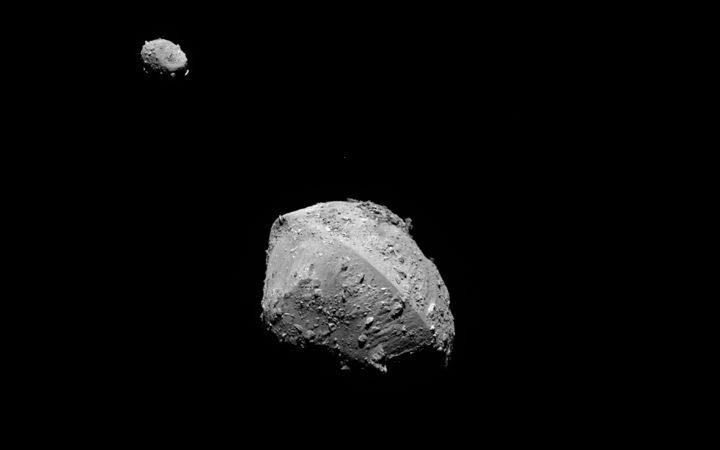
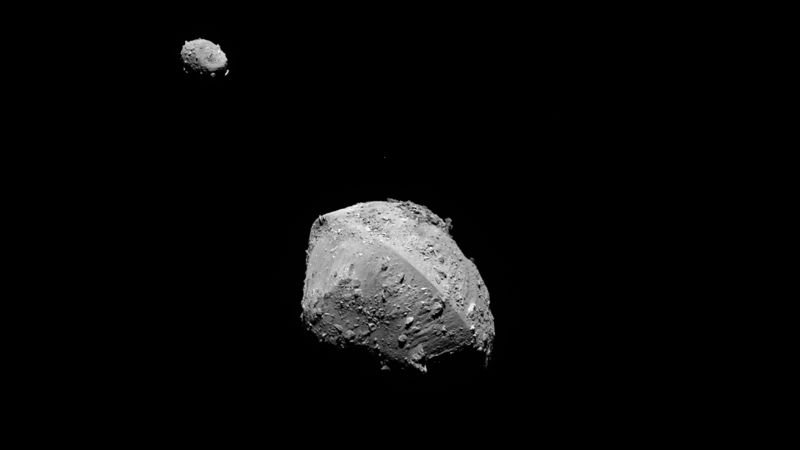
On Wednesday, ESA released initial images revealing significant findings, including a stadium-sized crater that has altered the asteroid’s previously rounded shape, alongside the unexpected presence of numerous boulders encircling the asteroid.
“It’s a big crater that is almost as large as the body itself, which is really spectacular,” commented Sabina Raducan, a planetary scientist with the Hera mission team, during a news briefing in Berlin.
Hera, which launched in October 2024, reached Dimorphos three weeks ago and is currently positioned about 30 kilometers (19 miles) from the asteroid, which orbits Didymos in a binary system. While neither asteroid poses a threat to Earth, Dimorphos’s size is comparable to asteroids that could potentially endanger our planet, making it an ideal candidate for these assessments.
The collision from the DART mission resulted in Dimorphos, measuring 151 meters (495 feet) wide, entering a chaotic spin. “Before the DART impact, Dimorphos was more like our own moon: It was always showing the same face,” Raducan explained, noting its current erratic rotation akin to a “barrel that you throw down the stairs.”
The remainder of Dimorphos exhibits no significant alterations, with its boulder fields appearing consistent with images captured by DART in 2022.
Astronomers observed that the DART impact caused a reduction in the time it takes for Dimorphos to orbit Didymos, shortening it by an unexpected 33 minutes.
Hera’s arrival marks the first opportunity for scientists to thoroughly investigate the outcomes of the DART mission, providing pivotal insights into asteroid deflection strategies, vital for safeguarding Earth.
Contextually, the launch event in Berlin highlighted the significance of the mission, with the Museum of Natural History serving as a reminder of past asteroid impacts, notably the one that led to the extinction of most dinosaurs 66 million years ago.
Unexpected flying boulders
Noteworthy among Hera’s early findings is the presence of hundreds of boulders previously uncharted, with more than 100 boulders ranging in size between a football and a washing machine, according to Naomi Murdoch from the University of Toulouse, part of the mission’s scientific team.
“As we approached Didymos and Dimorphos, we quickly realized the asteroids were not alone,” Murdoch stated, adding that these unexpected discoveries pose new challenges and risks for ongoing investigations.
The exact origin of these boulders remains uncertain. “We cannot say today, with the information that we have, whether these were debris coming from the DART impact or whether there’s another origin,” remarked Murdoch.
Margherita Cardi, overseeing one of the two CubeSats on the Hera spacecraft, noted that the discovery of the boulders presents significant challenges for future operations. The two satellites are scheduled for release in January, with plans to navigate around and eventually land on Dimorphos, though the boulders create potential collision hazards.
“We can take these challenges and understand what engineering approach we can depict and create in order to survive,” Cardi added, mixing caution and optimism for the spacecraft’s objectives.
In December, Hera is set to approach Dimorphos closely, at approximately 13 kilometers (8 miles), enabling higher-resolution imaging and essential data collection to assess Dimorphos’ mass.
“With the Hera measurements of the mass, we will then be able to see exactly how effective and efficient the DART impact was,” noted Murdoch. This information will enhance models predicting asteroid responsiveness to deflection attempts, positioning this mission as a pivotal exploration of binary asteroids, currently situated 193.5 million kilometers (120.3 million miles) from Earth.
“Sixty-six million years ago, an asteroid impact changed the course of life on Earth,” Ian Carnelli, Hera mission manager, stated. “Today, for the first time in history, humanity is validating how to prevent such an event from happening again.”