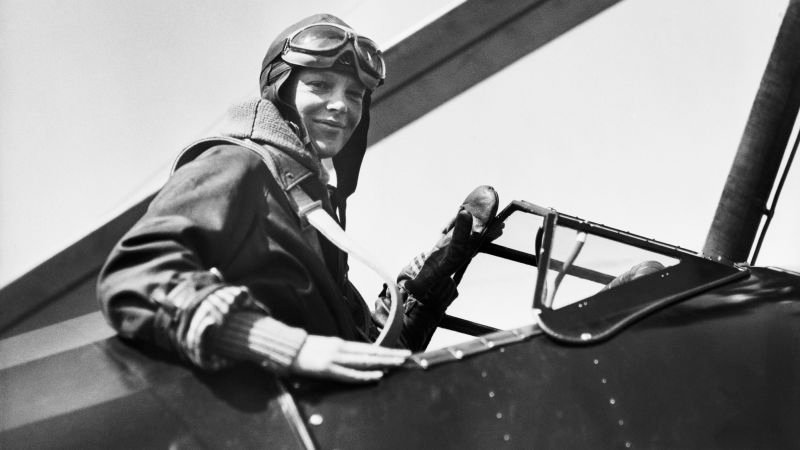
A recent expedition to a remote South Pacific island to search for wreckage from Amelia Earhart’s lost plane has come up empty, reports BritPanorama.
Researchers stated that they found “no conclusive evidence” that Earhart’s Lockheed 10E Electra aircraft landed on or near the small atoll, which is situated south of her original departure point, nearly 90 years ago.
The expedition to Nikumaroro Island was a collaboration between the Eugene, Oregon-based Archaeological Legacy Institute and Purdue University in West Lafayette, Indiana. A 17-member team arrived on the island on October 12.
The main objective was to investigate a blurry object known as the Taraia Object, detected in satellite imagery in 2020. Archaeologist Rick Pettigrew, the team leader, had initially believed the object resembled wreckage from Earhart’s aircraft.
However, the expedition ultimately “found no conclusive evidence to confirm a hypothesis that wreckage” from Earhart’s plane was “in a lagoon on a remote atoll in the South Pacific,” according to a Purdue University news release.
Evidence gathered during the expedition confirmed that the visual anomaly seen in satellite imagery six years ago was likely a collection of large trees deposited along the peninsula’s sandspit. “By the time the team arrived at the site, a good portion of the debris had fragmented and washed away,” the statement explained.
“The evidence for the castaway hypothesis, which brought us here, remained very, very strong,” Pettigrew noted in a video statement. He expressed a belief that it is “very likely that Amelia and her navigator, Fred Noonan, did in fact end up here on Nikumaroro Island.”
Steve Schultz, general counsel at Purdue and a field assistant, added that while the latest expedition could rule out this specific hypothesis, it “doesn’t detract from the existing, very strong, compelling case for the castaway hypothesis.”
The mystery of Amelia Earhart
Earhart and Noonan disappeared on July 2, 1937, while attempting to become the first woman to fly around the world. Their last sighting was taking off from Lae, New Guinea, for what was expected to be an 18-hour flight to Howland Island, a small landmass in the Pacific.
The disappearance of Earhart remains one of aviation history’s most captivating mysteries, sparking debate among historians and researchers on the circumstances surrounding her disappearance.
The predominant theory, supported by the findings of a large US government-led search following her disappearance, suggests that Earhart and Noonan ran out of fuel, leading to a crash in the Pacific Ocean near their intended destination.
Alternative theories propose that Earhart and Noonan managed to land their plane approximately 400 miles (644 kilometers) south of Howland, on or near Nikumaroro Island, where they may have perished from hunger or thirst.
A focus on Nikumaroro Island
Previous efforts to locate Earhart’s plane, including searches around Nikumaroro, have yielded no new leads.
“Nikumaroro Island has been searched more than 15 times, to no avail,” said Dorothy Cochrane, an Earhart expert and former curator at the Smithsonian National Air and Space Museum in Washington, DC. She remarked that the recent expedition joins the ranks of many who have not found definitive evidence of the Electra or of Earhart and Noonan at the site.
In 2024, the ocean exploration company Deep Sea Vision detected a plane-like shape using sonar imagery about 100 miles (160 kilometers) from Howland, but it was ultimately identified as rock formations. Another expedition in 2019, led by oceanographer Bob Ballard, who discovered the Titanic, similarly yielded no conclusive evidence.
The American researchers involved in the latest search employed a magnetometer to survey the lagoon, as well as sonar technology to probe beneath the sediment on the lagoon bed.
“We accomplished our main goal, which was to come here and test that hypothesis,” Pettigrew stated in a video.
Lying within the Republic of Kiribati, Nikumaroro is an uninhabited coral reef-fringed island that consists of significant coconut crab populations. The team took five days to reach the remote location from Tarawa, the capital of Kiribati.
The Purdue Research Foundation initially funded Earhart’s Lockheed Electra, with the intention that the plane would be returned to Purdue following her historic flight, according to the university.
At the time of her disappearance, Earhart was nearing her goal, having already flown 22,000 miles (35,405 kilometers) with just 7,000 miles (11,265 kilometers) remaining in her journey.
The search for Earhart’s plane appears unlikely to conclude here.
Deep sea exploration company Nauticos is currently seeking between $8 million and $10 million to fund a final expedition in the ocean surrounding Howland Island, utilizing new insights from experiments involving a replica of Earhart’s radio system. Since 2002, the company has undertaken three searches near the island.