Before Agatha Christie became one of the best-selling authors of all time, she worked in a chemist’s shop in her hometown of Torquay, England, in service of someone she referred to in her memoir only as Mr. P, reports BritPanorama.
Mr. P carried a dark lump of curare in his pocket — a poison that can quickly paralyze and kill. He walked around with it because it made him “feel powerful,” she wrote in “Agatha Christie: An Autobiography.” Christie couldn’t help but note that despite Mr. P’s “cherubic appearance,” such behaviors might make him a “dangerous man.”
In another instance, Christie’s sharp mind caught a mistake Mr. P made while he showed her how to infuse drugs into suppositories and inadvertently added 10 times the needed dosage.
Realizing Mr. P wouldn’t listen to a “little girl” who flagged his error, Christie had the clever idea to spill the medicine on the floor and “trod on them firmly” to prevent the dangerous drug from being stocked on the store’s shelves, she recalled in her memoir.
The spark for Christie’s gripping detective novels began in this unexpectedly sinister environment, as World War I raged in the background. Throughout her life, she would build a deep knowledge of the science of poisons that helped her leave a lasting legacy on the literary world and beyond.
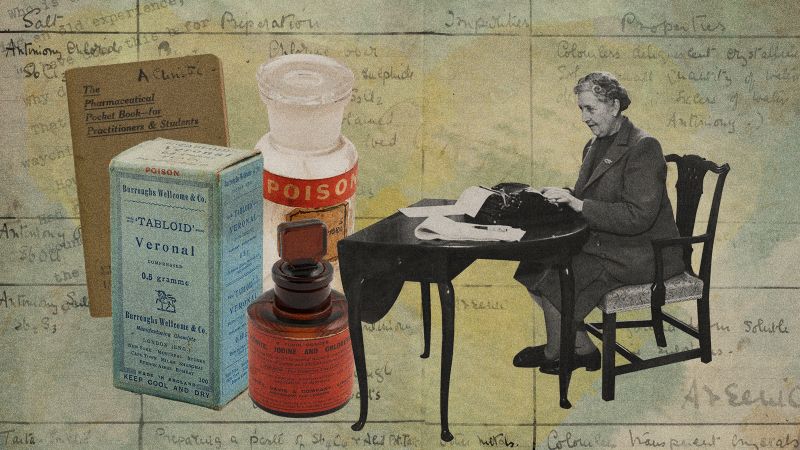
After Christie left Mr. P’s shop, she started to train as a pharmacist in Torquay’s hospital in 1916. That’s when the seed of a story began to percolate in her mind. A textbook called “The Pharmaceutical Pocket Book — for Practitioners & Students” that she read in preparation for her exams inspired the murder weapon in her 1920 debut novel “The Mysterious Affair at Styles”: strychnine, a neurotoxin once used in tiny doses as a stimulant, combined with other drugs to kill the victim.
Now, visitors can view her personal copy of the pocket tome — bearing mysterious stains and “A. Christie” scrawled at the top right — in a new exhibit, “Agatha Christie: A World of Mystery.”
Opening October 30 at the British Library in London, the exhibit marks the first time that the little book, and many of the more than 200 items shared by her family and trust, will be on display for the public, said the exhibit’s lead curator Lucy Rowland.
The textbook was one of many artifacts that revealed just how much research went into Christie’s work — and tangible proof that the author had a deep understanding of medications and deadly chemical concoctions, Rowland said.
Christie’s accurate descriptions of poisons, which serve as the murder weapon in 41 of her 66 detective novels, still hold up today.
“It was very easy to read Christie as a teenager and not notice that I was being taught science,” said Dr. Kathryn Harkup, former chemist and author of “A Is for Arsenic: The Poisons of Agatha Christie.” “It is stealth science communication at its peak. The plotting, the technical ability you need to be able to put across complex scientific ideas in a way that you don’t notice — my God, that’s a talent.”
And her scientifically driven tales of mystery and murder may have even helped solve real-world crimes: Her early days working with Mr. P, in particular, directly inspired later works that might have prevented poisoning cases.
Christie behind the facade
Christie remains the undisputed queen of crime 50 years after her death — and something of an enigma.
Publicly, Christie remained humble, famously referring to herself as a “sausage machine,” expected to churn out hit after hit for her publishers.
“All of that is part of building this persona that doesn’t threaten or scare the public,” said Dr. Jamie Bernthal-Hooker, a Christie scholar and visiting fellow in English and creative writing at the University of Suffolk in the UK. “Even today, people are afraid of clever and powerful women. I like to say that her greatest fictional creation was Agatha Christie.”
New explorations such as the British Library’s exhibit are providing fresh insights about the adventure-seeking woman who kept pace with the radical change in her lifetime, from 1890 to 1976.
“For the first 11 years of her life, Queen Victoria’s on the throne,” said Dr. Mark Aldridge, a Christie historian and associate professor of screen histories at Southampton Solent University in the UK. “By the time she’s writing her books in the late ’60s, she sees the moon landing. I’ve always argued that if she had lived a few more years and seen ‘Star Wars’ in 1977, she would have written ‘Murder in Space’ because she loved new things.”
While Christie lacked a formal education, her curiosity and observant nature guided how she saw the world. She also had a vivid imagination, likely because she came from a family of storytellers who loved to travel, said her great grandson James Prichard, chairman and CEO of Agatha Christie Limited, which manages the rights to her works. Literature, theater and operas furthered her interest in spinning tales of her own.
Before becoming a published author and working in pharmacy, Christie initially volunteered as a nurse at age 24 and treated wounded soldiers at Torquay’s Red Cross Hospital in 1914 during World War I. With her husband off fighting in the war, Christie felt motivated to help however she could.
She had to train on the job, quickly shifting from rolling bandages to tending wounded soldiers. Christie admits in her memoir she felt “disgraced” that she became faint at the sight of blood and wounds the first time she witnessed a surgical operation, but that wouldn’t happen again. Christie learned to steel herself and would avert her eyes during knife incisions.
She enjoyed nursing so much that Christie mused had she not married, she likely would have “trained as a real hospital nurse” after the war. In 1916, she pivoted to learn how to mix medications to assist the pharmacy, which was understaffed.
Christie’s insights from her rich life experiences are subtly but expertly woven into her novels and have helped cement the author as a genius beyond her time.
Specifically, Christie sharpened her attention to detail during her extensive pharmacy training for the Society of Apothecaries’ Assistant Examination in 1917. One night after awakening in a panic, she rushed back to the Torquay Hospital pharmacy, worried she had accidentally cross-contaminated an ointment during her afternoon preparations. She checked every single pot of ointment just to be sure, according to her memoir.
This firsthand experience manifests in her debut novel “The Mysterious Affair at Styles” when the character Cynthia Murdoch, a pharmacy volunteer, says, “If you people only knew how fatally easy it is to poison someone by mistake, you wouldn’t joke about it.”
Poison pen
There was a fine line, Christie realized, between the helpful and harmful nature of medication. Improperly measuring or mixing a medication could turn a lifesaving cure into a lethal substance, as exhibit visitors see as they walk through a mock dispensary.
On display, a 1925 poem penned in blue ink titled “In the Dispensary,” also reflects her thoughts on this dangerous balance: “Here is menace, and murder and sudden death — in these phials of green and blue.”
As a fiction writer, Christie wasn’t obliged to be accurate, but she took great pains to prevent any errors in her works — and that expertise came through in her writing without additional flourish. Other contemporary crime authors such as Dorothy L. Sayers often included extraneous details to show that they had done their homework, but Christie didn’t, Harkup said.
The review for Christie’s first novel that pleased her most was printed in “The Pharmaceutical Journal,” which celebrated her knowledge and use of strychnine, rather than fictional untraceable substances that were so often to blame for crimes in other stories. “Miss Agatha Christie knows her job,” the reviewer wrote.
During World War II, Christie — by then a well-known author — studied again to work in the pharmacy at University College London, where chief pharmacist Harold Davis suggested using thallium as a poison in one of her novels.
Christie paired the recommendation with her previous observations of Mr. P, who served as the inspiration for the nefarious pharmacist in her 1961 novel, “The Pale Horse.”
The plot is all about science versus superstition, said Southampton Solent University’s Aldridge. The victim in “The Pale Horse” appears to have been cursed by witches, but spoiler alert, is actually slowly killed with an unusual poison — thallium.
Nicknamed the “poisoner’s poison,” the tasteless, odorless toxic substance acts slowly and mimics potassium in the body, making it difficult to detect — until it’s too late.