A Russian bill moving through the State Duma would raise prison terms for public calls linked to mass unrest and violence, while allowing older online material to remain relevant to a criminal case for up to a decade. The text does not expressly target rallies or demonstrations. Its significance lies in the route it offers authorities: pursuing protest-related speech through laws framed as measures against terrorism, disorder and violence against officials.
Bill No. 14434-9 was recommended for approval at first reading by the State Duma committee responsible for criminal and administrative legislation, Russian media reported on 25 November 2026. It has not yet completed the parliamentary process. The recommendation was reported by Interfax and Wek.
The measure was introduced by lawmakers led by Vasily Piskaryov, chairman of the State Duma’s committee on security and anti-corruption. It is formally presented as a response to terrorism, mass disorder and violence against government representatives. Rights advocates warn that the proposed changes could widen the use of criminal law against public protest and digital political communication, even though the rules governing rallies themselves would remain unchanged.
The internet would carry a heavier penalty
The most direct change concerns Article 212 of Russia’s Criminal Code. The maximum sentence for public calls for mass unrest or violence would rise from two years to four years in prison. Where an alleged call was made through the internet or mass media, the maximum would reach six years.
That distinction gives the means of distribution a separate legal significance. A post, video, speech, lecture or message shared through an online channel could become part of a criminal case if investigators interpreted it as encouraging mass disorder or violence. The bill does not state that every criticism of the authorities would be a crime. The practical boundary would depend on how police, prosecutors and courts distinguish political opinion and information-sharing from a criminal call to action.
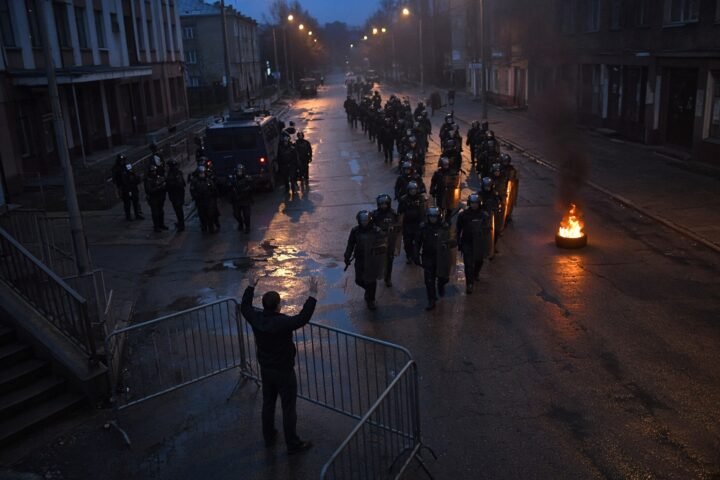
The provisions are not wholly new. According to the reporting on the proposal, the articles dealing with mass disorder and violence have already been used in cases connected with unauthorised street actions. That history is central to the concern raised by rights advocates: offences officially directed at terrorism or public violence may also become relevant in cases involving protest communication.
The administrative rules governing assemblies and Article 212.1 of the Criminal Code, which addresses repeated violations of the procedures for holding demonstrations, would remain unchanged. The potential expansion would instead operate through neighbouring offences: alleged calls for terrorism or mass unrest, violence against state representatives and the distribution of related material.
A ten-year window for prosecution
The bill would also amend Article 205.2, covering public calls for terrorist activity, the justification of such activity or its propaganda through the internet and mass media. The maximum period for a court-ordered ban on holding certain positions or working in education and journalism would rise to six years.
The restrictions described in the proposal could reach activities connected with public information, including administering websites and information resources, managing social-media pages or messaging channels, and creating or distributing content. A conviction could therefore affect someone’s professional and public life well beyond imprisonment or a fine, limiting the ability to teach, report, publish or maintain an online platform.
The committee says that raising the maximum penalties would place the affected offences in the category of serious crimes. The statute of limitations for prosecution would consequently extend to 10 years, while the period before a conviction is cleared would also become longer.
That changes the time horizon of online speech. Posts, comments and archived channel material published long before an investigation began could remain relevant if authorities later connected them to an alleged call for unrest, violence or terrorism. It would not mean that every old post led to prosecution. It would, however, leave a much longer period in which such a case could remain legally possible.
The bill also raises the maximum fine for violence against a government representative under Article 318, from 200,000 roubles to 500,000 roubles. That provision concerns conduct towards an official rather than political speech itself. It would nevertheless add financial pressure to cases involving alleged violence during a protest-related confrontation with law enforcement.
Why younger Russians matter to the debate
The proposed changes arrive as social networks and messaging services remain important spaces for political discussion among younger Russians. Data cited in connection with the bill indicate that 57% of Russian young people were prepared to take part in political or social protests, compared with 15% of the population overall.
Other figures suggest lower support among younger people for the war against Ukraine than among the population as a whole. ExtremeScan data from February 2026 put support for what the Russian government calls its “special military operation” at 30% among young people and 25% among students, compared with 44% across the population.
The same figures indicate that 25% of young people discuss Kremlin policy critically and 22% share protest content. Those numbers do not demonstrate criminal conduct or predict how courts would decide future cases. They do help explain why digital communication is at the centre of the debate: the same platforms host ordinary political conversation, criticism, reposting and material that investigators might characterise as mobilising.
An April 2025 survey cited in the discussion found that only 33% of respondents in both the 18-to-24 and 25-to-39 age groups supported suppressing anti-war statements. The figure does not establish how the public would respond to this bill, but it points to a possible gap between the state’s expanding use of criminal law and the willingness of younger adults to endorse restrictions on dissent.
The unresolved boundary
The proposal links several stages of political activity without formally turning them into one offence. An investigation could begin with a public message, move to allegations that online material helped organise or encourage unrest, and later include claims of violence during a confrontation with officials. Legally, those acts remain distinct. In practice, they could be examined within the same case.
That is why the bill’s effect cannot be measured only by its headline prison terms. Its wider consequence would be to increase the costs of public communication: a longer period of criminal exposure, heavier fines and professional bans that could continue after a sentence had ended.
Bill No. 14434-9 still has to pass through the remaining stages of the parliamentary process, and its final wording and application are uncertain. The decisive question will be how Russian authorities draw the line between political expression, the distribution of information, online protest mobilisation and a criminal call to violence or disorder — and whether material published years earlier is allowed to remain on the wrong side of it.