Russia plans to put schools, hospitals, kindergartens and other publicly funded institutions under regional limits for electricity, heating and water use. The proposal is meant to cut utility spending, but it would also create a new supervisory network whose powers, funding and responsibility for failures remain unsettled.
The bill was submitted to the State Duma by Federation Council senators Alexander Kutepov, Yuri Fedorov and Mikhail Borshchov, members of the chamber’s Economic Policy Committee. Russian media reported the plans on 24 November 2026. Izvestia reported on the proposed control of energy use in schools and hospitals, while a separate report outlined the planned consumption limits.
The government has given the legislation conditional support, asking for further work on the proposed bodies’ powers and financing. That leaves the political direction clear enough, but the practical system incomplete: who sets a limit, how it is calculated and who is accountable when a building cannot meet it?
A cap can reduce use without improving efficiency
The legislation would establish a regional energy-saving centre in every federal subject. These centres would coordinate efficiency measures, monitor electricity, heat and water consumption in budget-funded institutions, and adjust the limits applied to them.
Comparable centres already operate in 51 regions, but they have different legal statuses and powers. The bill would standardise the model and extend it nationwide. In practice, that could shift the focus of energy policy towards controlling consumption rather than improving the buildings and networks that consume the resources.
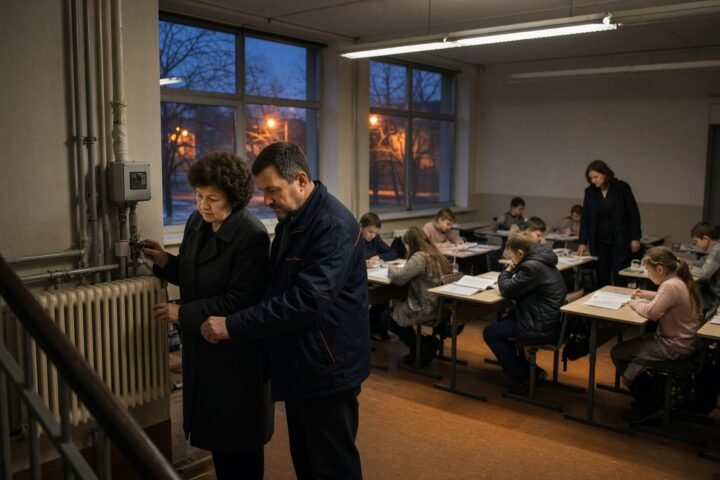
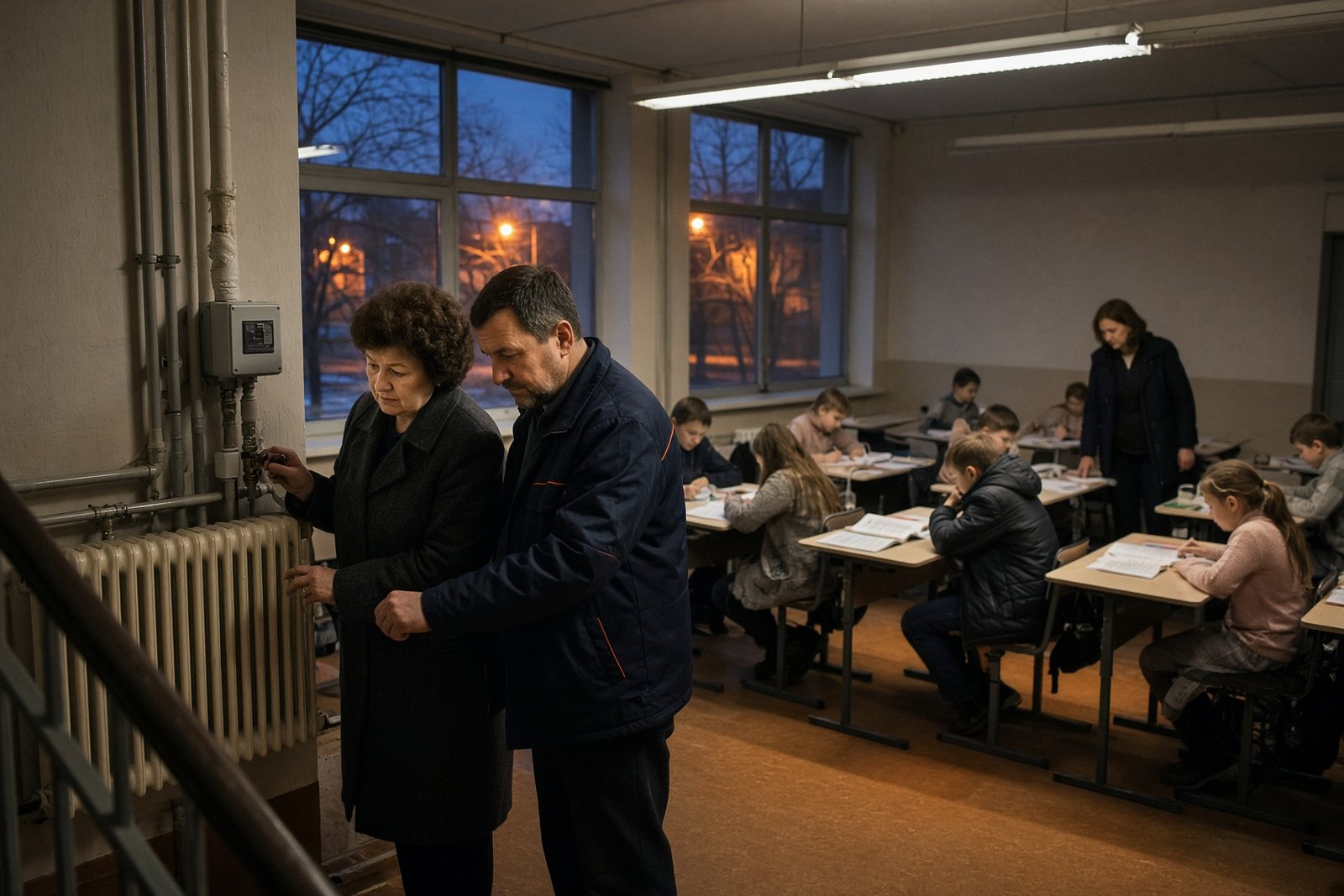
For a school or hospital, meeting a fixed quota may mean cutting use directly. Depending on the final rules, institutions could reduce lighting, lower indoor temperatures or restrict water consumption. Such measures would affect children, patients and staff, not just administrators.
The risks are different across public services. Hospitals may need continuous electricity for medical equipment and water for hygiene. Schools and nurseries require adequate heating and lighting for children to learn and remain supervised. The proposal does not yet fully set out how limits would reflect occupancy, medical requirements, building condition or local supply problems. It is also unclear how binding the limits would be or whether an institution could challenge a target that it considered unworkable.
That distinction matters because a lower energy bill is not automatically evidence of greater efficiency. If a facility consumes less because its rooms are colder or its water supply is restricted, the saving may represent a reduction in service rather than a successful upgrade.
A new regulator beside the old ones
The proposed centres would enter an already populated regulatory landscape. The System Operator of the Unified Energy System of Russia and the Federal Antimonopoly Service already perform important functions in the energy sector. The bill, as described, does not clearly explain how the new regional bodies would work with them or where their responsibilities would begin and end.
That gap could produce overlapping administration. Several organisations might collect the same data, conduct inspections or issue recommendations without a clear answer to the operational questions that matter most: which body has final authority, who can revise a limit and who is responsible when the target cannot be met?
Critics of the proposal have questioned whether another layer of oversight is necessary when existing institutions already regulate parts of the energy system. The concern is not that monitoring has no possible value. It is that new reporting and control duties could grow without producing a measurable reduction in consumption.
The government’s request for revisions points to the same unresolved problem. The centres are being presented as a nationwide mechanism, but the rules governing their powers and relationship with existing regulators have yet to be completed.
The savings may not pay for the saving
The financing model contains a more direct contradiction. The centres are expected to be maintained through savings in public spending. Yet under current legislation, savings created by reducing electricity consumption remain with energy companies rather than automatically returning to the schools, hospitals or other institutions that cut their use. The Accounts Chamber has highlighted this difficulty.
That leaves the proposed system without an obvious financial loop. A school could be ordered to reduce consumption without receiving the resulting benefit, while the centre responsible for measuring and supervising the reduction would have its own permanent costs. Lawmakers would need to establish who receives the saving, who funds the centres and how the net result is calculated after administrative expenses.
St Petersburg shows the scale of those expenses. About 294.85 million roubles is earmarked for the city’s energy-saving centre and the delivery of its government assignment from 2026 to 2028. Staff pay alone is budgeted at 58.5 million roubles in 2026.
Those figures do not, by themselves, prove that the centre is ineffective. They do demonstrate that a programme intended to lower utility costs can require substantial public funding before its net savings have been established. If similar bodies are created in every region, their operating costs will have to be included in the energy-efficiency calculation.
The bill’s critics fear that the result could be another bureaucratic structure for allocating and monitoring public money under the heading of energy efficiency. Whether that happens will depend on the transparency of the centres’ budgets and on whether they can show savings beyond the cost of running the system.
One national framework, radically different winters
Climate makes a uniform approach particularly difficult. In some northern and eastern regions, the heating season lasts between 250 and 306 days. In Sochi, it lasts about 94 days. The climatic burden ranges from roughly 2,325 degree-days in southern Dagestan to 11,281 degree-days in the Arctic district of Yakutia.
A limit that seems reasonable in a mild southern region could be impossible in the far north, where buildings need heat for most of the year. The pressure would be greatest in municipalities with ageing networks, poorly insulated buildings and limited budgets. They could face a choice between exceeding a prescribed quota and allowing conditions inside schools, hospitals or nurseries to deteriorate.
A workable system would need to account for climate, the duration of the heating season, the condition of buildings, opening hours, occupancy, medical requirements and the reliability of local utility networks. The proposal leaves unclear how much flexibility the regional centres would have to consider those factors.
That flexibility will determine whether the limits become a management tool or an austerity order. A target adjusted to local circumstances could help identify abnormal consumption and support investment. A rigid quota could instead penalise institutions for problems they cannot repair themselves.
When the heat fails, responsibility can disappear
A dispute involving School No. 84 in Yaroslavl illustrates the accountability problem. In case No. A82-13403/2024, the company TeploEnergoService reportedly advised the school’s management to seek compliance with the heating schedule directly from the heat supplier rather than resolving the inadequate heating itself.
The case does not establish that every energy-service contract operates in this way. It does show how responsibility can be divided between an energy-service company, a utility provider and the public institution occupying the building. The existence of an energy-service agreement does not automatically guarantee that a classroom or hospital ward reaches the required temperature.
A new regional centre could add another channel for reports and inspections without giving the school or hospital a direct remedy when supply fails. A facility might also be blamed for exceeding its limit because of an inefficient network or a poorly performing building, even though it does not control the underlying cause.
Before the limits become enforceable, lawmakers will need to decide who sets them, how they are adapted to climate and building conditions, who pays for the oversight system and who answers when infrastructure makes compliance impossible. Until then, Russia’s plan risks expanding the machinery of control before it can show that the machinery will deliver a genuine saving without making public services colder, darker or less reliable.