Serbia has granted citizenship to Ali Kadyrov, the 19-year-old son of Chechen leader Ramzan Kadyrov, using an exceptional procedure that requires no prior residence in the country. The decision gives him a Serbian passport and visa-free access to the Schengen area, while raising awkward questions about how Belgrade decides which politically connected Russians serve its national interest.
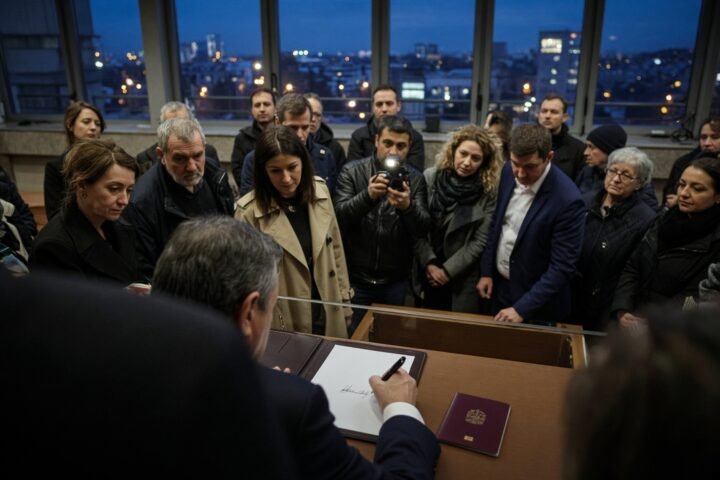
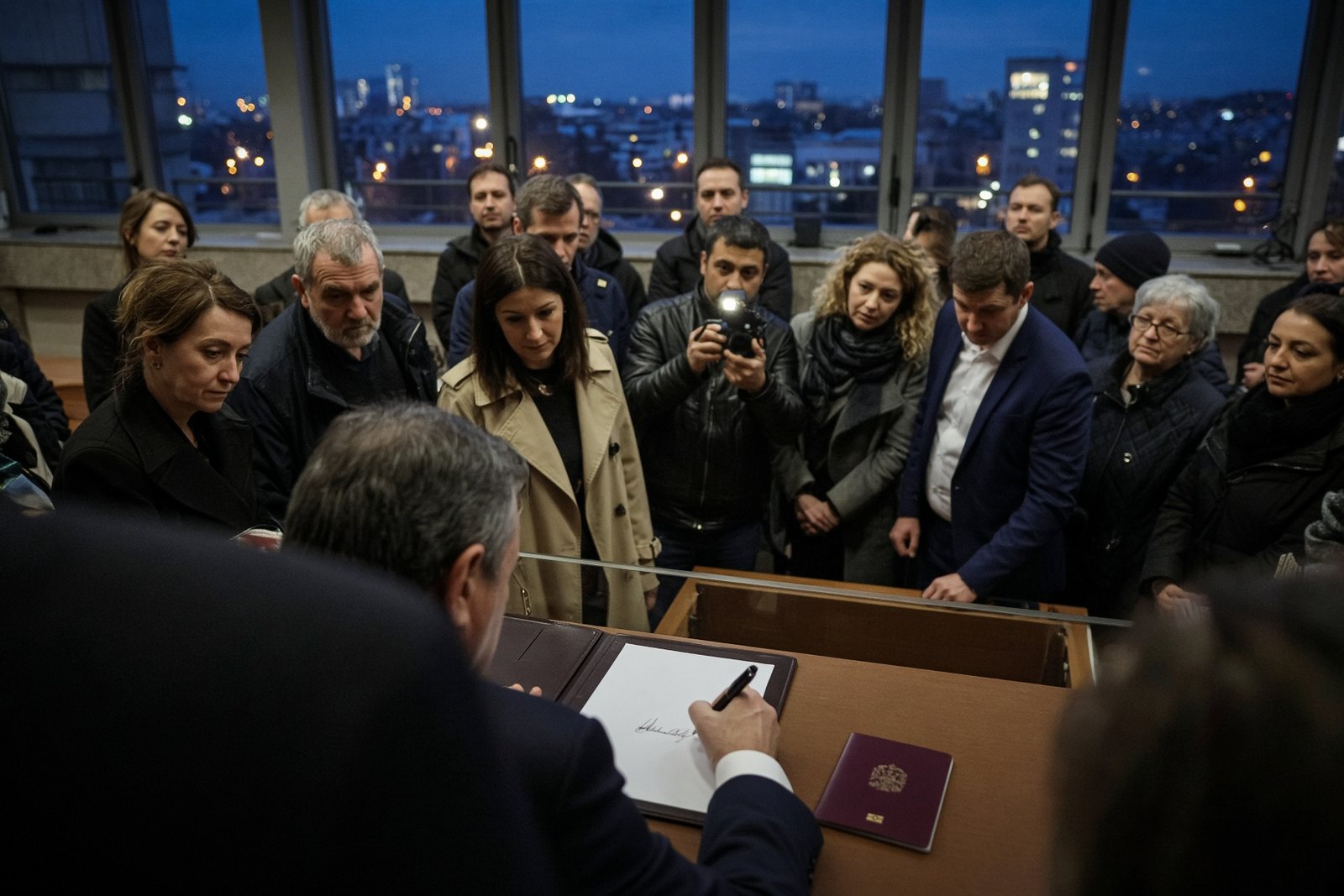
Ali received citizenship on 10 July 2025 under the name Ali Musaev, according to reports published on 24 November 2026. The decision was signed by Serbian Prime Minister Djuro Macut. On 22 December 2025, he formally changed his surname to Musaev through the central civil registry office in Grozny.
Meduza, Agentstvo and Radio Free Europe/Radio Liberty reported that Ali Musaev has since made more than 100 international flights on private aircraft, mainly to Dubai. During some of those journeys, he reportedly used the Kadyrov family’s Bombardier Global 6000, registered as RA73604 and acquired from a European owner in August 2025.
The reported flights demonstrate extensive international travel, but they do not by themselves establish unlawful conduct or prove how the Serbian passport was used. The significance of the case lies elsewhere: a European citizenship document has been issued to a member of a family whose head has been sanctioned by the United States and whose movements have long attracted scrutiny.
A passport changes mobility, not sanctions
Holders of a biometric Serbian passport may enter the Schengen area without a visa for up to 90 days in any 180-day period. That can make private travel, business meetings and access to European transport and commercial networks easier.
It does not automatically remove sanctions. The United States placed Ramzan Kadyrov on a sanctions list in December 2017 under the Global Magnitsky framework, citing responsibility for extrajudicial killings, torture and other serious human rights abuses. Washington imposed measures against some members of his family in 2022 as well.
The available reporting does not establish that Ali’s Serbian citizenship cancels any specific American or European restriction applying to him or his relatives. Nor does a Serbian passport, by itself, create an exemption from financial controls, asset freezes or entry bans imposed by another jurisdiction.
Its immediate effect is more limited but still important: it provides an additional travel document issued by a European state. The surname Musaev is also used for international travel by Kadyrov’s wife, Medni, his sons Adam and Akhmat, and his daughter Tabarik. That does not show that all of them hold Serbian citizenship, but it indicates that alternative surnames form part of the family’s cross-border travel arrangements.
The route reserved for the ‘interest of the republic’
Serbia’s exceptional naturalisation procedure allows citizenship to be granted in what is described as the “interest of the republic”. It does not require an applicant to have lived in Serbia beforehand. Since Russia’s full-scale invasion of Ukraine began in February 2022, more than 200 Russian citizens have reportedly received Serbian citizenship through the route, including figures from Russia’s political and business elite with connections to the Kremlin.
Discretion alone is not proof of illegality. The difficulty is that the public often cannot see what the discretion is based on. The authorities do not consistently explain the specific contribution that makes a person’s naturalisation serve Serbia’s national interest, or detail the political, financial and security checks that preceded it.
In Ali Kadyrov’s case, no detailed public explanation has been given for why a young member of the family of a sanctioned regional leader qualified. That gap makes it difficult to distinguish a decision grounded in a concrete Serbian interest from one shaped by political relationships or other considerations that have not been disclosed.
A related case has made the question harder to ignore. In April 2026, Serbia granted citizenship to Yakub Zakriev, Kadyrov’s nephew, a former Chechen agriculture minister and head of the nationalised Danone Russia business. After media attention focused on the decision, Serbian authorities revoked it.
The reversal shows that public scrutiny can alter the outcome of an exceptional naturalisation. It also raises a more basic question about the initial review: why did the decision require media attention before the authorities reconsidered it?
Influence is suspected; corruption is not established
There is no substantiated evidence in the reported material that Serbian officials accepted money or entered into a secret agreement with the Kadyrov family. The citizenship decisions alone do not prove that passports were exchanged for political, financial or other benefits.
But the lack of an intelligible public rationale leaves questions about political influence and possible informal arrangements involving Russian elites. Those questions are especially sensitive because of Kadyrov’s close relationship with the Kremlin and the family’s prominent international travel.
The concern for Europe is not confined to whether one traveller can avoid applying for a visa. If politically exposed people with opaque wealth, sensitive business relationships or links to sanctioned networks obtain Serbian passports, they may find it easier to move through European banking, property, transport and commercial systems.
That is an institutional risk, not a claim that Ali Kadyrov or any particular Serbian citizen has laundered money, hidden assets or supported criminal activity. The vulnerability arises from the combination of fast-track citizenship, no mandatory prior residence, limited public reasoning and visa-free access to the Schengen area.
Insufficient scrutiny of an applicant’s source of wealth or political connections could make it harder for European authorities to assess risks once that person is travelling with a passport from a country whose citizens enjoy visa-free access. It could also complicate efforts to distinguish ordinary migration and investment from the movement of assets or influence through politically connected networks.
A test for Serbia’s European ambitions
The European Commission has previously raised concerns about Serbia’s accelerated naturalisation of Russian nationals, including the possibility that passports could be used to evade visa controls or make security screening more difficult.
Serbia’s status as an EU candidate makes the issue more consequential. Citizenship policy is formally a domestic matter, but the practical effects reach across the bloc’s borders. Brussels expects candidate countries to maintain credible checks on politically exposed applicants, examine the origins of wealth and prevent their documents from becoming a convenient route around wider European safeguards.
For Belgrade, the Kadyrov cases therefore pose a question of credibility as much as administration. The government may lawfully retain a procedure for granting citizenship in the national interest. But the less it explains about who qualifies and why, the easier it becomes for critics to suspect that the route serves relationships that have little to do with a demonstrable Serbian benefit.
The immediate consequence is concrete: according to the published reports, Ali Kadyrov holds a Serbian passport and can use the ordinary visa-free rules for entering the Schengen area. The unresolved issue is whether his case, and the revoked citizenship of Yakub Zakriev, will remain isolated exceptions—or expose a wider policy that is turning Serbian nationality into a gateway for influential Russians seeking easier access to Europe.